
This is hell, said the man behind me at the Houston Museum of Fine Arts screening of Andrei Tarkovsky’s 1983 Nostalghia. He repeated, I am in hell.
I should have moved seats. I could have gone somewhere, anywhere, but I stayed where I was. Maybe part of me felt that I deserved to endure these criticisms. After my deployment to Iraq in 2006, I stopped going to movies. Thirteen months of watching other soldiers abandon themselves to HBO war dramas and Hollywood sequels to get through deployment made me uncomfortable with not just movies that glorified violence but the medium itself. I felt that cinema’s immersion transfigured reality, made our interaction with each other metaphorical and mannered and false. Books had their own issues, but words at least afforded some critical distance, a sense of perspective that might give space for people outside their own heads to exist and perhaps some kind of accountability for our occupation of Iraq.
Discovering Tarkovsky upended my attempt to build a coherent, if radically reduced, worldview post-Iraq. Ten years after leaving the military I found myself replaying certain scenes from his Solaris and Stalker well into the early morning hours, with no thought to plot, or social relevance, just the sound and absence and the want and the curious, sacred fullness that followed these unanchored gaps in experience. I often thought of how ridiculous I must have appeared at my desk, my face lit up by the computer screen like St. Teresa in Bernini’s sculpture, but I kept on watching, and hid my discovery from my friends and family, afraid of what they would make of it in the garish light of day. I did not think of Iraq at all.
But as is the way with all hidden things, I got greedy: I wanted more. I wanted to be with others who indulged in Tarkovsky like I did. And if there was one place in the world where I could be safe and confess my love of this outmoded Soviet-era artifact, it would be at a once-in-a-lifetime MFAH screening of the newly restored 4K Nostalghia. I would be safe there. Everyone would love it. No one would call me sentimental or retrograde or delusional. I would not accuse myself of religious mania or feckless escapism. I would not be self-conscious. I would be home.
Four rich, old Italians bathe in Palermo’s thermal baths. They gossip about the others staying in the resort: the depressed Russian poet and his beautiful young Italian translator, and then Domenico, the local eccentric, who has his feet, shoes and all, in their thermal pool. Domenico mutters about what God said to Saint Catherine (You are she who is not; I am He who is). “I don’t get it,” says one of the elderly Italians, a general, about Domenico’s madness. “I saw thousands of dead bodies during the war and I’m not mad.” The woman, possibly the general’s wife, defends Domenico. “He’s religious,” she says. She draws her fingertips over the water, backward, creating a small wave that rolls forward in the steam.
For the first time in the entire screening, the man behind me did not interrupt. He did not ask, What is this movie about anyway? He did not sigh in exasperation when his companion told him it was a movie translated from the Russian and set it Italy, or say, Jesus Christ, this is literally the most fucking boring thing I’ve ever watched in my life, like he did during the long opening sequence where several of the poet’s relatives and his dog sit by a Russian creek and stare at the camera.
He might have been tired or looking at his phone. Maybe he changed his mind. I settled in, thrilled to experience Nostalghia as it was supposed to be experienced—in the theater, with others who love Tarkovsky.
The Russian poet and the translator fight in the resort hotel’s hallway. Chinese music plays distantly, from the General’s room. The Russian poet refuses to respond to the translator, to be present. The translator punches the Russian poet’s nose. He represents to her all men—their stubbornness, their distraction, their insane narcissism and refusal to love the life they have, to love where they are, what is, and the implied misogyny of this rejection. It doesn’t matter if he is unaware of having rejected anything. To be oblivious to the good and the beautiful while they exist is his betrayal. She storms off. He cleans up the small, vicious puddle of nose blood from the marble floor and only smears it further. I thought again of the first week of my deployment to Mosul, when my Humvee section pulled up beside a man on the side of the road. He had no head. I stared at the corpse until my driver asked if we should call an ambulance or something.
Gross, said the voice behind me.
Tarkovsky’s father, Arseny Tarkovsky, went through six amputations on one leg during World War II. In this same war, fifty million human beings died violently over eight years. This morning, in a small city on Galveston Bay, I read about Poland, how the Germans killed 800,000 Poles during the war, whereas the Soviets killed 500,000. The historian writing the article took pains to figure out who killed whom, and how and why, and to avoid taking sides—to stay objective. This summer I went to Italy and walked through a graveyard outside Rome with 30,000 crosses and Stars of David. Each one represented the memory of an American soldier. A few years ago, I visited another graveyard, this one in Tucson, Arizona. For hours I looked for the grave of my platoon sergeant, and when I found it, I didn’t know what to do. Ants worked their way across the stone in neat, diligent files. Sprinklers clicked on. I walked back to the car soaking wet thinking about how 200,000 civilians died violently after the US invasion of Iraq.
On my bookshelf I have a book of poems by Arseny Tarkovsky. The English translation of one of the stanzas reads: And rivers pulsed in crystal slits,/ Mountains smoked, and oceans swarmed/ You hold a sphere in your palm, of crystal;/ on your throne you were sleeping calm./ And oh my God!—belonging only to me. He wrote this to his wife at the time, Tarkovsky’s mother. In Nostalghia the Italian translator reads from a volume of Arseny Tarkovsky’s poems translated into the Italian. “Throw it away,” says the Russian poet. “Poetry is untranslatable, like the whole art.”
In a scene from another Andrei Tarkovsky movie, Mirror, his most autobiographical film, Tarkovsky’s mother plunges her head in a small tub and slowly withdraws. Her hair hangs over her face while her arms and bent wrists extend away from her, shaking off water much like a tree canopy after a summer downpour, each branch jagging away from itself and the other branches. The ceiling behind her slops apart and drywall plunges to the flooded floor. She stumbles through this lake inside her house and pulls her hair back and tries to smile in the mirror and the smile becomes a grimace and then a smile again and then something else—a face, an attitude, a proposition. We hear only the trickle of water on stone. I don’t know what to think in the scene. I forget how to think.
Towards the end of the movie, the man behind me said, I swear to God if I have to endure another minute of this pretentious trash, I’m going to kill myself. On screen, Domenico stood on the pedestal of a Roman statue and decried the fallen state of the modern world and then poured gasoline all over himself. The audience gasped when they grasped that Domenico meant what he said when he said the world has already ended. Tarkovsky seems to have anticipated the reaction. He has Domenico’s dog, leashed to a Roman column, begin barking wildly, bewildered and terrified. Beethoven’s Ninth booms from a speaker dragged out by one of Domenico’s deranged friends, then fizzles out. The speaker has popped. We hear nothing but screaming.
✶
Walter Benjamin, in his essay “On the Concept of History,” tells us that every document of civilization is also a testament to its barbarity. You can find these words on his tombstone in Spain, where he committed suicide to escape the Nazis. Tarkovsky understood this as well as anyone. His grave is in Paris, far from home and from another totalitarian regime, the same one that funded most of his movies. His epitaph—“to the man who saw the angel”—is less dialectical than Benjamin’s, but it likewise suggests the impossibility of disentangling the origin of a work of art from its effects.
I don’t remember seeing any graveyards in Iraq, not a single tombstone, engraved or otherwise. I do remember the day we blew up an entire neighborhood with planes at the orders of our battalion commander, to show we meant business. Afterwards, we sat next to a mosque, its minaret toppled over in a heap of gutted bricks, and told the people they could go back to their houses now. No one seemed to see any irony here, not even those who had lost their homes. It enraged me. But maybe they all understood what I could not, that this is just how power goes, and to acknowledge its abuse in any fashion or form would be to give it more dignity that it or we deserved.
The translator arrives too late to save Domenico or the Russian poet. The police and the translator and the other insane, arranged like chess pieces, watch on as Domenico’s screams slow and then stop forever. I thought of Ian Fishback, the Iraq War veteran and Green Beret who wrote impassioned criticisms of US Army crimes in the Iraq War, worked toward a PhD on “the morality of war,” started acting erratically, appeared and reappeared in halfway houses, took psychotropic drugs, and died of a heart attack at forty-two, in an adult care center. Those of us concerned with such things watched it happen in news articles and TV shows and went on with our lives.
I wish someone would set me on fire, said the man behind me.
When the Swiss doctor Johannes Hofer first diagnosed nostalgia in 1688, he claimed that it produced “erroneous representations,” and the victims “tended to confuse past and present, real and imaginary events.” The earliest symptoms, the warning signs, included hearing “the voice one loves while conversing with others” and “seeing one’s family in dreams.” A few centuries later, Walter Benjamin, in that same essay on history, told us that nostalgia is an essential feature of modernity, it predicts the future and in doing so revises our understanding of the past. We are dragged into history looking backwards in the manner of Paul Klee’s Angelus Novus. Eric Kandel, winner of the Nobel Prize for his work on memory, argues in his 2006 In Search of Memory that we have two types of memory, short- and long-term, and that long-term memory is a map we have made that changes the shape of our brains. I have often wondered what Kandel would think of my captain, who, when shot in the arm by insurgents, demanded not medical attention but a camera. He had us take pictures from every angle, hundreds of pictures, as many as we could before the blood was wiped away. Was this short-term memory becoming long? Or long-term memory swallowing short? Kandel’s later books have all been about pre-World War II Austrian art and artists, and are, he admits, strangely obsessed with the memory of an unhappy homeland that made this art, and his own exile and concern for scientific truth, possible.
That final scene of Tarkovsky’s Nostalghia goes on for ten minutes inside the ruins of a church bathed in light, with the poet and his dog, and nothing moving but the camera and the snow falling and the water in those silty Russian streams. The man behind me had walked out with his companion before they had a chance to be bored by it. Maybe even now this couple walks underneath the magnificent Houston live oaks, paying attention to nothing, enjoying the warm presence of another body and the promise of a good meal and a better night’s sleep. Maybe all nostalgia for a higher kind of art is as dangerous as the crowds baying for a Return to German Greatness in a Leni Riefenstahl film. Benjamin believed so. He didn’t want to; he loved art and stories, and the people that made them, but reason told him that the mechanical world could produce nothing but violent, mechanical art, and he exhausted all the spaces on the chessboard of racist Europe and took his own life in the small Spanish port city of Portbou.
About halfway through Tarkovsky’s Mirror, a traumatized veteran trains little boys to throw grenades in the middle of the Russian winter. The boys joke around as boys do and throw a grenade that lands close to the boys and instructor. The instructor throws himself on the grenade. “It’s just a dummy grenade,” says one of the boys, whose parents have been killed fighting the invading German army, and who the others avoid as if he is diseased. The traumatized veteran struggles to his feet, the wound in his head beating like a heart. You can taste the snow in your teeth. The freckled, orphaned boy wanders off to the top of a nearby hill, crying, and stares down at the other children playing, a scene of dizzying distance and proximity, composed much like Pieter Bruegel the Elder’s 1565 painting, “Hunters in the Snow.” Tarkovsky then splices in black-and-white newsreels of twentieth-century slaughter. Nuked cities. Armies of Mao’s child soldiers chanting lines from his Little Red Book. Journalists snapping pictures of the bullet wound in Hitler’s head. A middle-aged man, leaning his head against his forearm behind a concrete bunker, looks uncannily like my soldiers and me waiting for the planes to destroy that Mosul neighborhood. Tarkovsky’s father’s voice arises in the background, On earth there is no death/ All are immortal…/ I only need my immortality…/ I would readily pay with my life/ for a safe space with constant warmth/ Were it not that life’s flying needle/ Leads me on through the world like a thread. Then a bird—much like the one that flies away alone from the snow-rimmed trees in Bruegel’s painting—lands on the orphaned boy’s fur-trapper-hatted head. The boy cups the bird in his hand.
✶
For years after my deployment, I would wake up from unhappy dreams and think of the day we drove up to an intersection just after the explosion of a catastrophic IED. The street had swallowed cars and a whole building and all the people inside. A sergeant I didn’t know ran up to me with his camera and showed me the image in it. The pictures he had taken of the destruction. It offended me. I thought he wanted to not see what was right in front of him by making it into a movie. He had no sense of the destruction we had helped bring about, the lives buried in that rubble, the image of the life he had buried himself within. I pushed his hand away.
But now I wonder if that man, that sergeant, reached out to me simply out of fear, and the desire to do something with his fear, to make it go away. Perhaps this is all memory is, all nostalgia is, the desire that leads us swordlike through time and into our immortality, which is this image of the man holding his camera out to me, rather than the yawning chasm and wreckage behind him, or the abyss of pain within his glass square.
The lessons of pain go deep. Kandel spent his entire adult life electrocuting mice to discover that unpleasant stimulation transfigures the mammalian brain. His research allowed for astonishing advancements in medication and psychiatry. We could finally make the pain stop for many people trapped in their past, like Kandel himself, forced to flee Austria as a child, haunted by the memory of Kristallnacht and relatives left behind. This is not nothing. But in the final pages of In Search of Memory, Kandel admits there might be in our brains a “second system” that exists behind this network of arithmetical anxiety, this learned Pavlovian pain and no pain. He confesses he couldn’t touch it in the mice. He had no tool to poke it with. He hopes future scientists will research this strange frontier, where security and self-worth and dignity are not just breaks from the pain or the consequences of it but things in themselves. It is nice to believe that they will one day get back there, far enough in the brain, to where we set out from.
In the meantime, all any of us can do is to seek out the home we never had in objects suspended before us, snipped from historical time like rose blooms. For Kandel, this is the art of Vienna and the paintings in the Kunsthistorisches Museum. For the alien trying to be human in Tarkovsky’s Solaris, it is Bruegel’s “Hunters in the Snow,” a reproduction of it, painstakingly copied to look exactly like the original in Vienna’s Kunsthistorisches Museum. For me, it is the stuttering adolescent boy at the beginning of Mirror, wondering whether to give up, to sink into silence. “Your hands don’t move,” his doctor says as she hypnotizes him. “Now I’m going to lift this transfixion and you are going to be able to speak freely, easily, and articulately. From now on you will speak loudly and clearly. Look at me. Odin, dva, tri!”
✶✶✶✶
Michael Carson deployed to Mosul in 2006 with the US Army and now teaches community college in Baytown, Texas. His recent work has appeared or is forthcoming at The Hudson Review, Chautauqua, The Threepenny Review, and The New England Review.
✶

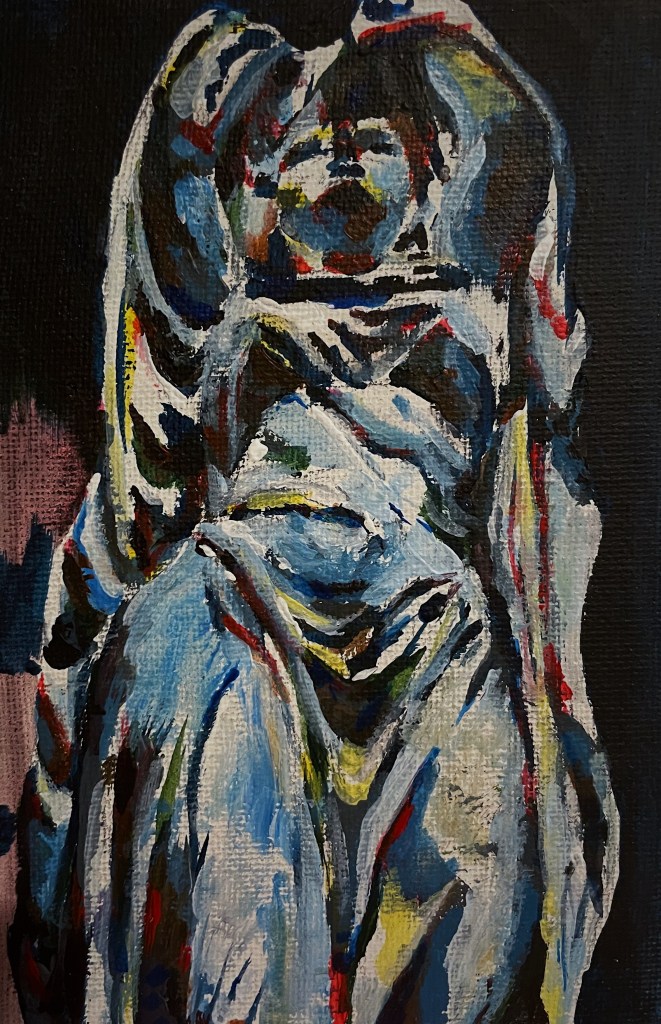
Mia Broecke is fifteen years old. Half-Belgian, half-English, she lives in Fourqueux, France. She paints in her free time and her art has previously appeared in the North American Review and Reed Magazine.
✶
 Another Chicago Magazine