
The ghosts of lives long gone haunt old things. Walk through any antique store stacked to the gills with bric-a-brac from decades past: a toy robot, a porcelain figurine, a silk scarf, a suede shoe. Such artifacts outlive the people who owned them. Who played with that toy? Who collected that figurine? Who wore that scarf, or that shoe? Objects have stories of their own, indelibly affixed to forgotten human ones. These stories imbue objects with evanescent power, animating the inanimate, bringing them to life.
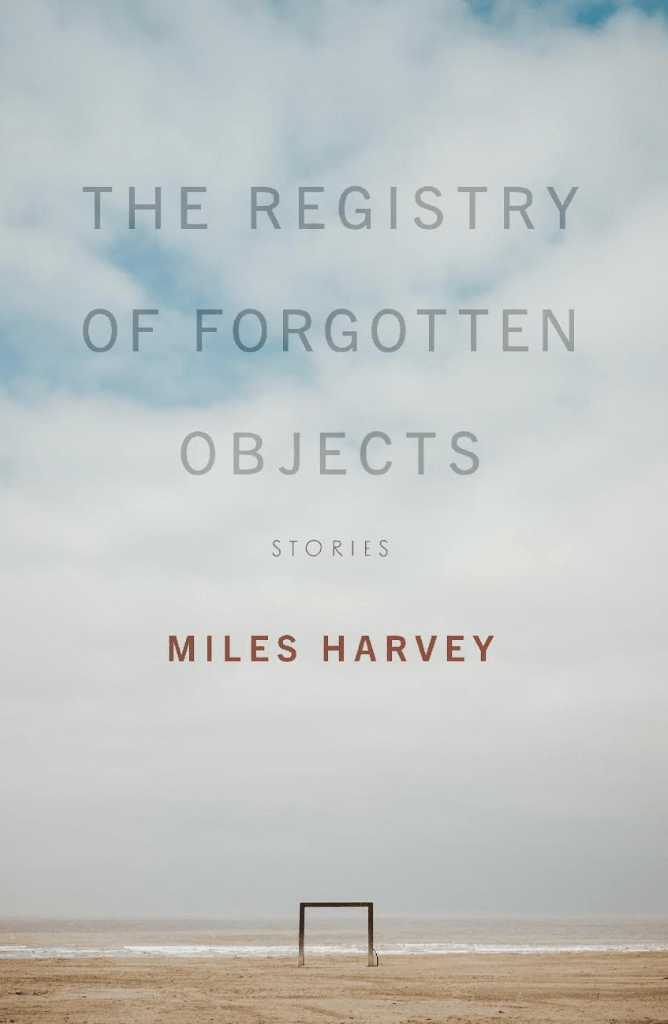
This is the through line of the twelve short stories in Miles Harvey’s beautiful, wistful collection, The Registry of Forgotten Objects: Stories. Taking place in varied settings—a near-past, a slightly-askew now, and a futuristic dystopia—these epic, yet quietly connected stories are loosely linked by theme, language, and character. They vibrate off each other in ways that combine gentle sadness with gut-punch passion and deeply satisfying surprise.
Harvey—whose previous works include the nonfiction The King of Confidence, Painter in a Savage Land, and the bestselling The Island of Lost Maps—ventures for the first time into fiction here. It’s no wonder Forgotten Objects is the winner of the 2023 Non/Fiction Prize from Ohio State University’s The Journal. Characters often go unnamed, which contributes to an almost mythic tone. Harvey’s book is like a collection of deeply intimate fables: fables that explore the past and present, familial relationships, nostalgia, and the ephemeral nature of life’s tragedies.
Like an oil painting, Harvey’s prose is imbued with rich imagery. In “Why I Married My Wife,” birds “paint the branches” and have “iridescent wings.” A pair of ancient twins in “Balm of Life” wear “matching salmon sport coats.” In “The Pied Piper of Fuckit,” an underground tunnel is crowded with “rocks, hunks of bizarrely shaped granite that seemed like three-dimensional Rorschach tests.”
Intertwined with this imagery are unexpected, reflective metaphors. In “The Drought,” one of the book’s most haunting images describes an eclipse of moths blanketing the bodies of two lovers, symbolizing their thirst and need for one another by “tangling in their hair and caking on their skin like delicate barnacles.” The moths—dying of dehydration—are engaged in an act of “puddling,” massing near any available water. “Some species were even known to suck tears from the eyes of cattle. The drought… had made the poor creatures desperate—attacking the lovers for their sweat.”
One of the most satisfying elements of the collection occurs whenever a supporting character in one story takes over as the main character of another. Conversely, a story’s protagonist could, elsewhere, hover in the background (or is merely referenced in a single sentence), much like the unexpected cameo of a favorite actor in a film. A grieving father’s misanthropic teenage daughter—who appears in just a single paragraph in “Beachcombers in Doggerland”—reemerges 100 pages later, grown up and the focal point of the colorful, New Orleans-set “Four Faces.”
That same daughter’s mother makes appearances in even more stories—not only in “Beachcombers,” but as a parishioner to a fraudster priest in “The Complete Miracles of St. Anthony.” This mother—an enigma who serves as a symbol for irrepressible grief in all her previous cameos—finally has her background rounded out and revealed in “Song of Remembrance”: she is a Holocaust war orphan.
These soft linkages aren’t limited to the characters, but to the objects that become characters in and of themselves. An ancient coin. The Collected Stories of Eudora Welty. The most prominent of these objects is a wooden barber shop pole, whose life we track through Forgotten Objects’ two most powerful stories: the first and the last—its dystopian bookends. The pole’s life begins in that dusty brown town suffering from a relentless period without rain in “The Drought,” and ends in the exponentially more apocalyptic future of the collection’s title story
And yet, all twelve stories are distinctly their own, stand-alone pieces with wholly-formed worlds. Each story is as rich and condensed as a novel that can be read in a single sitting. Intense with memorable imagery, characters, settings, and themes, they will sit with the reader long after the final sentence has been read. As the protagonist of “The Man Who Slept with Eudora Welty” remarks (quoting Welty), the act of reading is “‘a shared act of the imagination’ between writer and reader… and this shared act is perhaps as close a relationship as two people can have.”
Perhaps Forgotten Objects can be best summarized by the Japanese concept of mono no aware: the acceptance of transience, the appreciation of life’s impermanence, and the beauty of saudade. Ken Liu, author of the Hugo Award-winning short story “Mono no Aware,” explains in a Haikasoru interview with Nick Mamatas that the phrase means to create “empathy towards the inevitable passing of things.”
Mono no aware threads through the pages of The Registry of Forgotten Objects: each story confronts the passage of time and is suffused with intense pathos for the people of the past. As Harvey writes in “The Master of Patina,” we might believe “we would endure forever, not wither away as we have, the years rushing past, everything blurring and fading, everything drifting into dreams, our story coming to an end with the four most ruinous words ever spoken: once upon a time.”
✶✶✶✶

Laura Hawbaker is a Chicago writer and editor with a background in ELL and education. She is the editor and creator of MASKS Literary Magazine, and her book/film reviews have appeared in Newcity Magazine, Bright Wall/Dark Room, and PopMatters. She holds an MA in linguistics and an MFA in creative writing. She’s currently working on a novel. Follow her on TikTok and Instagram.
✶
 Another Chicago Magazine