
As children, my brother and I occasionally slept over at our grandparents’ posh apartment in a Chicago hotel. Our grandmother – wickedly funny, cynical, and manipulative – doted on me, as I could charm her, but she was irritated by my brother, who was both gawkier and less conniving. She preferred a little subterfuge in her relationships. My grandfather, already in the early stages of dementia, sat and stared out the window. Our grandmother had food delivered and did her best to spoil us.
At one sleepover, we awoke to find our grandmother’s cherished crystal milk pitcher broken in the refrigerator. In a fury, she asked each of us whether we had gotten up for a glass of milk in the middle of the night. My brother and I both swore that we had not. She asked our grandfather, who had little left in the way of short-term memory. He, too, said that he had not gotten up to get milk.
Grandma then decided that it must have been my brother – her least favorite person within reach. At first, I delighted in the trouble he was in, but she browbeat and shamed him for an hour, demanding that he confess. Although I didn’t know the name for what my grandmother was doing, I knew that I was witnessing abuse. Finally, my brother cried out that he had broken the pitcher. He hadn’t, but he said he had, just to make the torture stop. Our grandmother had conducted an interrogation and framing of which the Chicago Police Department would have been proud. Because I was Grandma’s favorite, one protestation from me was all it took. I said I didn’t do it, and I got believed (and I swear to this day I didn’t break the pitcher; it had to have been our grandfather). For my brother, no truth was true enough. Only falsely implicating himself satisfied Grandma, at whose house we never slept again. Our enraged mother made sure of that.
✶
“We hold these truths to be self-evident.” With that phrase, Thomas Jefferson laid the foundation stone for a national way of thinking: some truths were woven into Nature itself, and to proclaim them was simply to align oneself, and one’s nation, with Nature and natural reason (and, for some, Nature’s God). Inherent in the statement that some truths are self-evident is that the system of government that abides by that statement knows what the truth is. The nation that upholds those truths is a nation built on the Truth itself.
But what happens when, two and a half centuries later, people from other cultures (and other faiths) encounter and attempt to interact with these assumptions? What happens if they appeal to the self-evident nature of their own suffering, and the justice of their request for asylum in the country that holds that all are created equal? What happens, not just in the U.S. but in Great Britain and other Western nations, when those who have suffered at the hands of their own government seek refuge? Oftentimes, the cultural and linguistic barriers between immigration officials and asylum seekers can doom petitions for asylum at the outset. As an example, Americans generally believe that honesty is meaning what you say, when you say it. But other cultures may not share this assumption. For example, the Iranian expectation of taroof – refusing offers of help three times before accepting – can mean that Iranian asylum seekers in the West might reject help when it is offered the first time, expecting it to be offered again. When it is not, they are stranded.
The author Dina Nayeri knows this all too well. Nayeri fled Iran with her mother and brother in 1979, when she was eight years old. Her mother’s conversion to Christianity shortly after the Iranian revolution having put the family in danger (Nayeri’s father, whom she has seen only a handful of times in the intervening decades, remained in Iran), the asylum-seekers lived in refugee settlements in Dubai and Rome, eventually being granted asylum in the U.S. and settling in Oklahoma. Nayeri became an American citizen in 1994 and, possessed of a ravenous and obsessive intelligence, went about seeking – and gaining – entree into the most prestigious undergraduate (Princeton) and graduate schools (Harvard, the Iowa Writers’ Workshop), and jobs (McKinsey). Nayeri is now an author of fiction, creative non-fiction, and drama, and a resident of Scotland. Her work draws extensively on her roots in the Iran of the early days of the Islamic Revolution, the absurdity of the asylum experience, and the unshakeable confidence of her contemporaries in the heartland evangelical Christian community in which she passed her painfully awkward adolescence. Her book about the immigrant experience (her own and others’), The Ungrateful Refugee (2019), was shortlisted for several nonfiction prizes; an essay by the same title was one of The Guardian’s most-read long reads in 2017.
In fundamental ways, Nayeri has been barred from belonging – a fate she has both mourned and welcomed. She knows America and Americans from the perspective of the pedigreed professional, the celebrated author, the confident corporate foot soldier, but also the angsty outsider teen and the shunned immigrant. We in the West are, notes Nayeri, “trained to believe in the power of [our] wishes”: certain of our own significance and certain we can make our own reality and impose our truths on truth itself. She knows because she has witnessed it firsthand and, to the extent an outsider is ever granted the grace to do so, she has tried out for herself the act of manifesting one’s own reality through the power of belief.
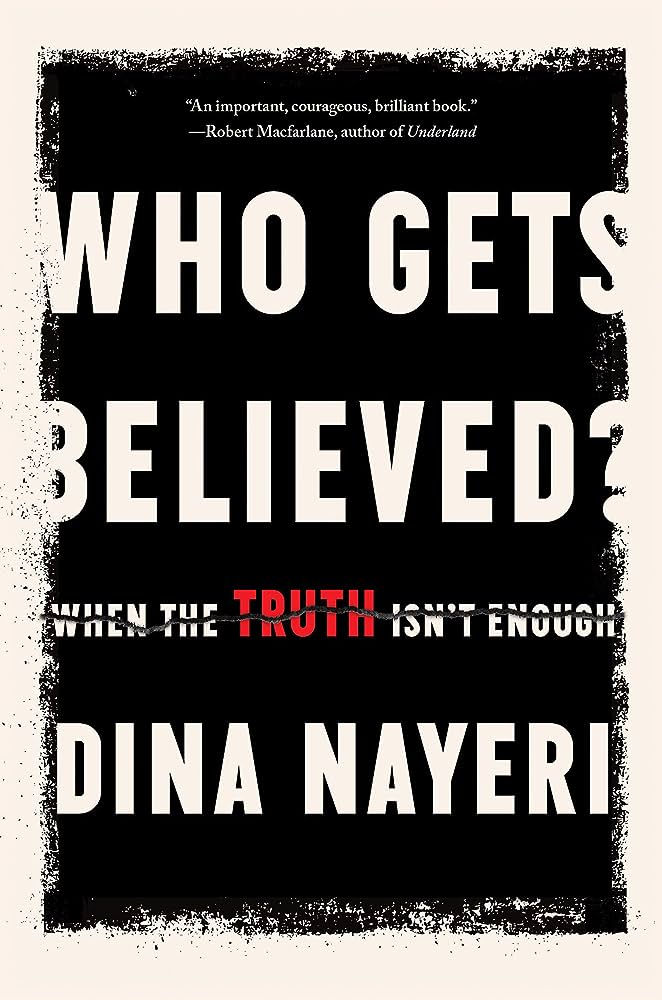
In Who Gets Believed? the author weaves the story of her adolescent striving to belong with the stories of other outsiders tormented by their struggles to gain entry into inner sancta, primarily in the U.S and Great Britain: asylum-seekers, settled but isolated immigrants, and refugees from Covid during the pandemic among them. She follows the quest for belonging into the psychological realm, through the tribulations of her partner’s mentally ill brother. The question that forms the title of the book indicates not only the plight of the outsider but her own culpability for sitting in judgment of the brother, whose claims of mental illness she steadfastly refuses to believe. So cosseted is the brother in the anxious, therapeutic embrace of his nuclear family that Nayeri, believing him to be little more than a grifting attention-seeker, comes to see that she has fallen short of her own standards for finding and facing the truth.
She is, then, aware of being the bearer of a the paradox of irreconcilable truths: she is a defiant anti-elitist whose resumé is a long list of the most elite schools, the most generous grants, the most august literary prizes, the most esteemed employers and publications. She is the atheist alternately drawn to and repulsed by religious belief, the student of human nature who mistakes mental illness for mere manipulation, the immigrant to America who has left America behind. In seeking to belong, Nayeri has become expert in the performance of belonging (not only “name it and claim it” but “fake it till you make it”), but also the unending search for a true home – a place where one can be fully oneself and be believed. She is a keen critic of Western culture and an anthropologist of its deeply ingrained inauthenticity. In Who Gets Believed?, she strives to solve the central puzzle of the West in the 21st century: how can a culture be a beacon of hope if its people are hopelessly self-deluded? How does proclaiming and performing “the truth” summon a falsehood into being?
Nayeri, alone in her own wedge of an enormous Venn diagram, whose circles of family, faith, country, and profession all curve away from her, sees Western values through the lenses of both the seeker and the critic:
How could I have believed that all stories are heard the same way? That every story in the public record is entered by a neutral party with good faith, expertly drafted, details checked? How could I have assumed that the game is fair, and that every true story has an equal chance of being believed? The world has shown me, again and again, that we live by wildly different and ever shifting rules designed by the privileged for their children.
✶
Nayeri ends a July 2018 LitHub piece on the Trump Administration’s caging of asylum-seeking children with a cry of indignation:
What happened to America’s inner world? What made it into a place of nightmare and meanness and hate? Where is America’s magic, the enchantment and goodness that we felt from across an ocean, as we made our way toward it?
In this book, her gaze is more knowing, her judgment more seasoned and severe:
When I first arrived in America, I found that many of the girls in my school were trained to believe in the power of their wishes; they strutted about the schoolyard, confident that what they wished for would come true . . . They didn’t talk much about work or sacrifice, as my Iranian classmates had done . . . We knew that buying one thing meant giving up another. We knew that the only people who’d tend to our dreams were us, and we felt lucky to have the chance to try for ourselves. Who taught American and British children that they matter so much?
The collective delusion she identifies is reinforced – in church, in school, online – through repetition. Just such egocentric and supposedly self-fulfilling utterances are used by the powerful today to bend reality to their will. In the case of the asylum-seeker, however, the shapers of reality sit across the table, thumbing through the application, the claims of torture and persecution, the photographs and medical records. In this environment, performativity is essentially imposed on the asylum-seeker, for whom “[t]he claim for asylum is a speech act.” The request to be granted refuge in Britain or the US from victimization based on sexual orientation, religion, tribe, and/or familial ties, as soon as it is uttered before certain authorities, initiates a formal evaluation of the refugee’s narrative, which is held up to impossibly arcane, contradictory, even Kafka-esque standards by asylum officers over endless retellings. If, for example, in the recounting of rape, torture, or any of the numerous other forms of persecution, different words or phrases are used, if events are told in different order, if precise details are not recalled in exactly the same manner, then the narratives are deemed inconsistent and therefore untrue. If burn marks from torture devices are deemed too symmetrical on the back of the asylum-seeker, they are judged to have been self-inflicted, or classified according to the absurd acronym “SIBP” (self-inflicted by proxy, meaning the victim, in order to improve their chances for being granted asylum, has been accused of arranging for someone to intentionally inflict the wounds while the victim was intentionally rendered unconscious). All this Nayeri learns through thorough relentless research and extensive conversations with asylum seekers. And these are in response to the search for an answer to the question that is the book’s title.
What is the connection between this and a middle-schooler from a foreign country questioning the authenticity of her classmates’ speaking in tongues at church on Sunday? And between that and an author retreating, at the height of the pandemic, to a French village, where she takes long walks, raises her small daughter, and lives communally, again a refugee – but this time by choice, seeking asylum from contagion? How do her skepticism and self-reliance cause her to dismiss her brother-in-law’s mental illness as performed helplessness? Nayeri connects these disparate pieces with storytelling, investigative reportage, philosophical introspection, and cultural criticism to create a work of searing honesty, self-scrutiny, and prophetic warning. Early in the post-collegiate phase of her exhaustive search for credibility and belonging, she lands a job at the consulting firm McKinsey – “a master class in how to be believed, and that was (still) all I cared about.” But the art of believability erodes the self-evident nature of even the most durable truths: “In those long nights and weekends [of work]”, she writes, “I learned the trust signals . . . I learned to listen and negotiate calmly, to release sunk costs, to leave a solid voicemail, to look a sixty-year-old CEO in the eye and become a de facto manager to a dozen thirty-five-year-olds who hated me, to hide my youth with no-lens glasses and slim-cut pantsuits, with razor-edge haircuts and control over the pitch of my voice, my eyebrows, my emotions, my reactions to exhaustion and stress.” What she learned from CEOs was different, but just as useful: “the single unifying skill I witnessed from corporate leaders wasn’t math wizardry or verbal clarity or confidence building: it was stringing together random metaphors to create a broken but dazzling picture, to imply expertise too deep to probe, and to place the cognitive burden of deciphering each unrelated metaphor on the listener, so that she will miss some galling but central fact.”
Who Gets Believed? is a warning wrapped in a harrowing piece of cultural criticism, and the warning is this: Don’t get too comfortable. Don’t grow accustomed to being believed. Given the way things are breaking, there may come a time – perhaps soon – when your belonging, your beliefs, and your assumptions do not go unquestioned. On the day when your assumption craters – that the cop who stops you won’t write that ticket, or that the prosecutor will go easy on you, or even that the immigration officer you suddenly find yourself pleading your case to in some foreign land will believe your story the first time – you will find yourself in a strange and threatening new world.
In any place and time, but especially ours, the critic of culture, the curious outsider, the indefatigable seeker after truth is an invaluable resource for curing complacency and obliviousness. This book demands and deserves to be read – especially in a time when performative “truth-telling” is taken as unassailable authenticity – even when, especially when, it deliberately disses the truth. The dyed hair swooped over the balding pate, a studied glare piercing the orange darkness from under tufted brows, merchandised on mugs and t-shirts: all this serves as a malevolent metaphor: what gets believed today is what most assaults the senses; and who gets believed are the assailants.
With every passing day, Nayeri’s book is an increasingly profound and medicinal shock to the system; a defoliant for the chronic, malignant self-deception that has crept like kudzu across the blighted landscape of Western liberal democracy.
✶✶✶✶

David Gottlieb is Director of Jewish Studies at Spertus Institute in Chicago. He served as founding executive director of Full Circle Communities, Inc., a developer of affordable housing and provider of supportive services.
✶
Whenever possible, we link book titles to Bookshop, an independent bookselling site. As a Bookshop affiliate, Another Chicago Magazine earns a small percentage from qualifying purchases.
 Another Chicago Magazine