
Dear mother, mother
no one told me to omit
felony charges
and incarceration when
entering Japan customs
Dear mother, mother
I almost didn’t get in
to your home country
because of my honesty,
trust me, won’t happen again
We flew like a crane
neck stretched above the ocean
small shadow, vast blue
dear mother, mother, I’m home
I’ve returned to the great source
They led me to a back room. White walls reflect the fluorescent lights. Uncomfortable chairs, small desks. A woman from Korea sits across from me. Young. A blond streak contrasted with her jet black hair—bangs above the eyebrows, cat eyes/magenta eyelids. Contacts. High heels, fur coat, probably fake. Maybe not. She looks like my first teenage crush—Karen O. I avert my gaze as if I am still a teenager. Being in this room makes me feel like I’m in after-school detention. She looks my way once. A quick glance. We are both wondering why the other is in this room. Can we help each other or are we doomed? There are no windows. Poor ventilation. Posters of cartoons that do not lighten the mood but lay a heavy hand atop my chest and around my throat. The air is thin, my lungs small. Palms moisten like tide pools. What are they thinking about me? Was this similar to when you first came to America?
Three simple questions for the average human being: Have you received deportation orders from Japan? Have you ever been convicted of a crime? Are you carrying drugs? Would you fail this test? Would you allow yourself to lie? I have lied for so long I’m afraid to return to the place of dissimulation. I have heard before that three lies make a truth. If a lie is told to create less harm, is it actually truth? Do I confess I am a criminal? Was a criminal? Am I always a criminal even if I no longer commit crimes? Am I always committing crimes by merely living? I exist, therefore, I am crime. Will I ever escape paper? What average human being would spill? I say average, but in America, one-third of us have a criminal conviction—so, I guess this question to lie or be honest is more difficult than I imagined. How would you have answered, mother? Your past so long ago that it is no longer of any consequence? I am haunted by my past, and I know you are haunted by yours too.
Customs agents come and go. They ask me to specify details on my criminal charges. What was my age? What kind of drugs? Who was harmed? What was my punishment? I think of the Buddhist precept on lying. I think of the terms relative/absolute. I think of all the arrests I’ve had. I think of where my life is now. I think that I won’t tell them anything. I think that I made a mistake. I think of the family traveling to the Philippines I met in line at the airport. I think that I never traveled like them with my own family. I think of how they got along and how foreign that is to me. They asked me if I could speak Japanese. Yokunai. They reply that their children can’t speak Tagalog. Maybe I am their lost child. Assimilation is part erasure, part allowance. We wished each other a safe voyage. This journey to Japan is my narrow road to the interior. My best friend is Filipino. He is searching for his interior. We haven’t spoken in two years. Or three. I hope his mind is intact. Incarceration has lacerated our judgments. I think about him often, wherever he is. I wonder if I look Japanese enough to be let out of this room. I wonder if I am foreign enough to be let out of this room. I wonder if I will be let out. Mother, we are untethered, unweathered, and ungovernable. H. L. T. Quan says ungovernability and the crafting of rule breaking are intimately linked. Rule breaking is the means by which unhappy subjects and communities seek out to find themselves and do things that the tyrants refuse and end up in the unhappy archive…the ungoverned…overthrow not only rulers but the rules themselves.
Am I Japanese
or am I American?
can I just be both
or can I only be one?
I’ve heard once: not one not two
Dear mother, mother
what is the point of borders?
colonization
is a hard word to swallow
imperialist is too
One cell is all cells
I still hear the click at night
or my friend drowning
I am a remote island
searching for the lost lighthouse
My rakasu took two years to stitch. Namu kie butsu. Namu kie butsu. Namu kie butsu: I take refuge in Buddha. Repeating this phrase with each in and out stitch. Day after day. I am a different human for doing so. But I am still me. Part of me sewed the panels as a precursor to traveling to Japan. The past me knew I needed to have a priest’s signature stamp before my excursion. I needed repentance. Was my younger self worthy of such a trip back home? There are so many things I’d like to tell my younger self. What would you tell your younger self? Why did I have to wait ’til I was thirty-one to fly west over the Pacific? Mother, why have you not returned? I slide my rakasu out of my envelope. The inside sleeve shines blue blossoms against silver thread. I repeat my dharma name—Koji—to spread compassion far and wide—and point to my chest. How can I be a criminal if I wear the Buddha’s cloth? The agent agrees. Or maybe is sympathetic. Maybe he knows the story of Anguilimala—the finger necklace. A notorious bandit who killed 999 people. Before his mother would be his 1000th victim, the Buddha’s compassion and wisdom struck Anguilimala to the ground. He had a spiritual awakening and became a monk in the Buddha’s order. A story proving the redemptive qualities of following Buddha’s teaching. I believe the agent believes I’m sincere and authentic. I am tired of repeating watashi wa nihon americanji desu and watashino haha wa Kanagawa desu, watashino sobo wa Sapporo desu—who I am and where my family is from. I place my rakasu around my neck, hanging over my chest. They say let’s start over from the beginning. They tell me I must have made a mistake. To bury this under the rug. Your family is from here, welcome to Japan. I fill out a new form—I say no to every question and my lies turn to truth.
The sun never set on us. Twelve full hours of M. P’s Remembrance of Things Past. From LA to Tokyo the entire deep blue of the Pacific was visible. Not a star or shadow of the moon. Night did not come until departing Narita airport for Ueno Station. All the neon flashed en route. Like the opening hand of practice. It has been said that is what enlightenment is like—a flashing or a strobe. Our ability to experience true reality is in flickers. Do you miss the neon? Are the ionized atoms I’m observing the same photons you saw as a child in the sixties? Maybe they are like starlight and I am viewing the past in the glow. The train pierces between neighborhoods—swallowed by thick darkness—like spilled marmalade over a baguette. The man sitting across from me is Danish. Sweat rolls from his temple to his neck. His bag is full of prescription pill bottles. He smiles at me and says I am on the right train. Emerging from Ueno Station is like the sudden awareness of walking in a dream. A dream within a dream within a dream. My lungs have craved Japanese air. You and baachan must have had decades’ worth of Japanese air in tanks. An autumn breeze whispers freedom between my ears. A freedom I’ve never experienced. Even when I lost my freedom and gained it back. Young couples cuddle on benches. Men in suits smoke behind glass and throw butts beneath their loafers. Oak branches sway. A small group drinks espresso outside a French cafe. Large maple leaves piled beneath tables. A solitary cherry tree reflects the red pagoda from the north. A plaque at the base of the tree reads: Cherry blossom near a well are in danger by drunken fellows. Mother, you instilled this poem in me at four years old, when you told me I needed to return to our home country. It was at this age that I became conscious of the differences between apples and persimmons. I have waited since four years old to exit Ueno Station and walk the steps of Kiyomizu Kannon-dō Temple.
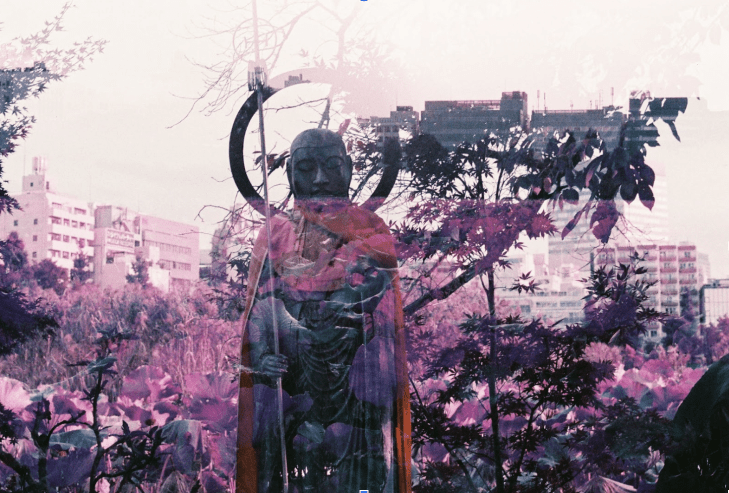
I have waited since four years old to walk through the vermilion torii gates of Hanazono Inari-jinja Shrine. I have waited since four years old to bounce lily pad to lily pad across Shinobuzono Pond. I have waited since four years old to stand at the island temple dedicated to the goddess Benten, surrounded in all directions by rose-flushed lotus flowers and black-headed gulls. Red is the color to expel demons and illness. Crimson capes and bibs and leaves and gates and thin fortunes flutter about the sanctuary like cinnamon. My palms reach for Jizo statues to graze fingertips and feel what my ancestors felt when stone was the only medium for comfort. The sun sets behind Taito City and I am stuck clockwise, circumambulating the lotus field while chasing my shadow. The Heart Sutra is chanted in the north corner and monks are selling arrows and good-luck emblems and bracelets meant to keep good health. Do you still have your charms, mother? Was it ever awkward seeing monks on your way to school or was there a sense of relief and comfort? I’d take orange robes over orange syringe caps any day. But I am not who I was when I was in poor health—searching for veins and seeking enlightenment. You always did tell me I would never outrun myself. I am handed an incense in my state of confusion. Delicate old hands guide me towards the shrine—a flame from an old candle wick heats the sandalwood. I bow nine prostrations and enter more neon.
Maple leaves scattered
open sky stretched with bright fire
I’m alone here, but
not lonely, but completely
solus, the bright autumn moon
Vibrant lotus pond
millions of torii gates bend
the blood moon and wind
carrying our prayers towards the stars
that reflect the temple well
Monks slowly shuffle
groundskeeper waters the trees
and the flower bush
match is lit, thrown into sky
dharma permeates as smoke
The smell of the ryokan (旅館) in Asakusa is my baachan. Nestled between an art gallery and soba shop. I can hear her voice between the tatami and thin rice paper walls. A dark burgundy table from my childhood memories sits in the middle of the room. Could it be the same one I cracked my head on twenty-eight years ago? Does baachan miss being so close to the ground? Mother, how long did you two not speak to each other? Do you miss sitting seiza? I cross my legs and straighten my back. The illumination of Senso-ji Temple enters my windows. The tea kettle whistles and tea leaves slip between my fingers. The cross streets of Tanuki and Koen Dori push fireballs. Hanging lanterns glow parallel to aluminum. Long black leather coats twirl atop tile. Noodles are slurped between sake shots and disposable flashes. There are eleven raccoon dog shrines to rub for prosperity. I have been told I was a raccoon dog long ago. I am a raccoon dog. The street lamps carry love, affection, good health, reconciliation, exam luck, road safety, children’s good health, strong friendship and prayer, and a beautiful heart. Everything has a crack in it, that’s how the light gets in, Cohen once said. Rumi said the wound is the place where light enters you and I am a walking laceration. Here, everything is light, that’s how the cracks get in—all the imperfections we should worship. Kintsugi—golden joinery. We are all connected by these slips in the dark. Without the darkness, the shrines would never shine so bright at midnight. The moon’s reflection would never expound the dharma. A stubbed toe on a pebble on a starless night would never flash enlightenment. Shitou Xiqian said Branching streams flow in the dark…within brightness there is darkness within darkness there is brightness…within the darkness, all words are one.
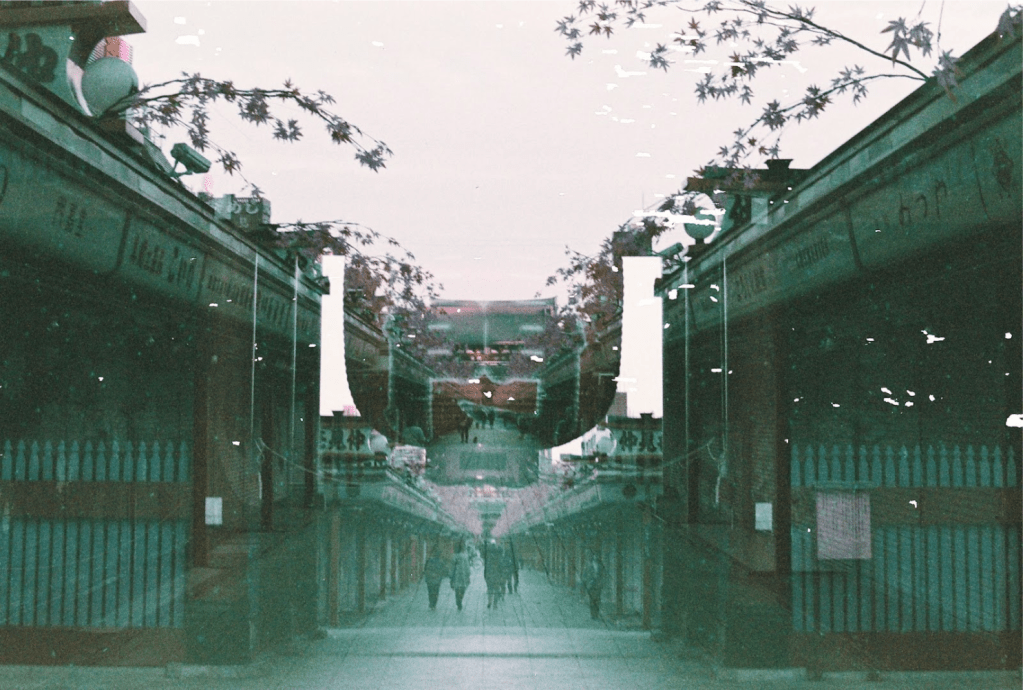
At 4 a.m. I am awakened by a vision of the river goddess. I am told without words that she saved baachan from drowning. After the funeral of my great-baachan. After a mokugyo drum was broken through. After a shaman sprinkled gold dust into the house’s fire. When the vision evaporates, I am standing beneath a nearly thirteen-foot lantern. The gods of wind and thunder—Fujin and Raijin—ask me why has it been so long since you’ve returned. I answer them that I’ve never been here. They laugh and freeze in place. A vibrating clap in the distance echoes into the dawn. I walk down Nakamise—all the storefront gates closed. The spirited murals reflect old photos of my family—the Satos, Miyamotos, and the ones I have no names for, only black-and-white photographs and lineal memories of ancestors from the Ryukyu Islands paddling against waves and colonization. The street is empty except for the thin line of sun beginning to rise above the tin tops. I weave through the middle of the warmth and pass the cherry blossoms, weeping willows, scarlet maples, silk cocoons, and kites. I can hear bells to the north—steady canvas thump and dull wooden beat. I think of my friend Nhut, whose back is covered by the thousand arms of Avolokiteshvara, and how these grounds dedicated to Kannon extend beyond the place of visibility. My scars dissipate as I walk through Hozomon Gate. Two Deva Kings in the closed-mouth style suddenly open wide and ask me why has it been so long since you’ve returned. I answer them that I’ve never been here. They laugh and freeze in place. A few strands of cypress wood splinter in the shape of a half circle. The words under phases are whispered and the wind sweeps the ground clean.
Incense smoke slithers beneath the chozu-yakata and within the tsukubai. Silence envelops the cold, early morning between sporadic birdsongs of Japanese bush warblers. At 6:30, priests begin to chant for Kannon beneath the immense sloping roof of Kannando Hall. The bodhisattva sits behind the gate enshrined in the naijin. Older folks in bright tracksuits and expensive, form-fitting suits have their hands in gassho. Briefcases lean against their right calves. A woman in her sixties continues to bow slowly over and over again. Gently bobbing her head to the beat of the drum. The main priest’s chanting shakes the foundation. The samurai stone statues become Noh play dancers. Yen coins are tossed in the altar, falling like pinballs. A young couple pays for omikuji like tangled yam, it is difficult to straighten your peace and mind … it is difficult to identify what is right and wrong … like a fish caught in the net, you will struggle … you and your neighbor will be deeply sad, but if you believe, you can escape… the fortune is misinterpreted and they tie them to a tree. The kanji for daikyo (大凶), great bad luck, is revealed against the bark. The life force of the tree expands. Mother, you always told me everything is alive—even the trees and grasses, do you still believe that? I have carried my entire life this way—speaking to the wind calms me. Near the five-story pagoda, a groundskeeper sweeps fallen leaves and debris. A stubby-legged golden corgi shits near a bush. Devotees of Basho bow to the stone haiku. Buddha’s ashes blow at the epilogue of the early morning ceremony.
Bentendo Temple
a cloud of flowers and smoke
a Buddha bell from
Ueno or Asakusa?
I sit alone in the hall
Dear mother, mother
so many temples and shrines
on my morning runs
I am cradled by prayer
every step taken, sacred
Dear mother, mother
my eyes have met the eyes of god
mornings you see breath
the temple grounds hold birdsong
the guardians hold the sun
I’ve stumbled across so many vortexes and black holes. The torn flesh of space where birth and death are the same verb. Somewhere along these Tokyo streets is a bar your aunt owned during the late 1960s Japanese student revolution: from the protests at Nihon University to the riot at Shinjuku Station. Your aunt is an ungovernable figure I have always looked up to in my dreams because she has provided endless possibilities of freedom for my future. You were so young then, mother, do you recall conversations of politics and uprisings while eating plums? People only know of the West’s movements during this time, but Japan’s New Left was in full throttle at your birth. Did people speak of the Zengakuren? Were any of our family members at the demonstrations against the US-Japan Security Treaty? Did you hear the name Mitsu Tanaka while sitting beneath the bar top? The address you gave me was a blank slate—the watering hole no longer there. The community hall, for drinking until the sun rose, was misplaced somehow. It has been erased from the physical realm but I hold it in my memory. A place even more real than this plane. The space in between. It saddens me that your aunt owning a bar back then was uncommon. IS uncommon. We have a long way to go. I have heard so many times why our family was scattered across the four islands, but I am still confused about the reasons. Karl Marx once said reason has always existed, but not always in a reasonable form. Maybe reason exists in emptiness. Maybe I am still unable to accept equations. How long did it take for me to accept I was powerless? How long after that did it take me to accept I actually had power? Is power a vernacular or a formality? Speaking of language, I spoke of you to a family traveling to the Philippines. The matriarch told me I shouldn’t wear a mask because I look more Asian without it—when my bottom face was covered, she looked through me. It’s funny what my brother and I have inherited. I, you. He, our father, who didn’t believe me when I told him about an incident where I was the casualty of prejudice. He told me no one thinks I’m Asian. Our last threads were completely severed moving forward.
Since entering the ryokan, I have been dreaming of yokai. The scent of baachan’s home has manifested apparitions. She carried them long ago and I have carried them back. They have appeared from wind, water, and stone. Shuten dōji, Tamamo no Mae, and Emperor Sutoku. Oni. Kitsune. Tengu. In my dreams, though, they are not the great, evil demons of the old eras. They are simply orphaned and confused. The faces before their faces. I remember the horn, long nose, and nine-tails from baachan’s glass cabinet. Objects and art to remind her of memories. I have been reading about memories while traveling. In Swann’s Way, Proust says remembrance of things past is not necessarily the remembrance of things as they were. The bonds between ourselves and another person exist only in our minds. This reminds me of the Yogacara—also known as citta-mātra, or mind-only school—founded by fourth-century Buddhist brothers Asanga and Vasubandhu. External objects do not exist. In Fukanzazengi, Dogen says in stillness, mind and object merge in realization, and go beyond enlightenment. Someday, there will be a system that will police our memories. I am trying to prevent that. Mother, are your crystals and stones still protecting against demons? Will they work this far away? I’ve carried my decade’s worth of baggage with me. The layer of negativity draped across my sleeves is dispelled at the Tori no Ichi festival. My first ceremony in Japan. The celebration of autumn harvest. Groups of men huddled in semicircles quietly chanting, then slowly speaking louder and louder as the drum beat progressed. Headbands wrapped around bald heads. Sweat slowly dripping from the afternoon sun. Large Buddhist altars hung above bright red booths. Golden faces, sharp-lined kanji, protected energy rakes, and Ufodo’s tightly sealed. Blue and white kimonos skim the concrete. Wooden getas clacking across the temple steps.
Five lines wrap around the corner in the main plaza of the temple shrine. Simultaneously, ten hands swing the rope to scatter the bell sounds. I wonder how many coins have been tossed this morning alone. This is the first Toro no ichi in two years since the pandemic. Autumn can sometimes exist as the beginning, contrary to the belief of the properties of spring. You and my father taught me about contradictions. Not from conversations we’ve had, but simply how you two think and act—your substance is simply an anomaly. The greatest of Zen koans. I pray for both of you here, but at a smaller shrine away from the dancing and chanting. One, occupied by an older woman who resembles an aunt I’d only seen in black-and-white photos. A few tears drop from her cheek into the dipping stick. She washes her left hand. Then her right. Then both. Then drinks from a puddle cusped in her palm. I begin to cry in her silent movements. When she leaves, a piece of the shrine crumbles and taiko drumming echoes across the walkway. The gold and silver kumade rakes begin to shake by themselves. A rooster can be heard in the distance and wooden amulets fall from the pagoda roof. I was stopped by a young man on my way to Ichiyo. He too, had a face tattoo. It was the first time I saw this—and the only time. Tattoos are still quite taboo but not like when you were still living here. He read the kanji on my neck but we were unable to communicate further. While he was setting up his booth of chain necklaces and skull rings, I dipped into an alleyway. Too afraid to look in a mirror. I regret not asking him to switch places with me.

Day of the rooster
orange monks perform handstands
bells ring forever
the sun rises and sets but,
the market still continues
Dear mother, mother
stomping feet at Otori
like lightning and rain
I’m washed of my aversions
I cry between the fox shrine
The jingle of charms
I sit in middle of pain
this year’s death too high
I’ve lost family to this pain
this delusion, gone too young
I have my first soba dinner ten minutes before midnight. An alleyway of neon and bright lights that never flicker. A photo of Tommy Lee Jones stares at me as I enter. All the shops have closed except for the bars and noodle houses. I used to work as a ramen cook on the west coast. I can feel that old self coming back, wanting to escape the current definition of us. Those were simpler times. Filling the wadashi pot with kombu and shiitake. Weighing noodles and measuring rice. Cutting chashu and boiling tofu. There is an old man in the corner rolling buckwheat flour. In the opposite corner, a young couple sips sake. A rerun of the Japan Series is playing on a tiny television. Yakult vs. Orix at Meji Jinju. The bright green of the field contrasted against cobalt blue stadium seats. I dip my noodles and slurp between innings. The crunch of yam tempura sounds like the cracking of the bat on screen. When I finish, the cook leans over and says these noodles officially carry the Shinshu name. I ask what that entails and he replies the noodles must carry at least 40 percent soba flour mixed with the regular wheat flour. I ask him where he is from and he replies the birthplace of soba of course! Ina City! Famous for sakura and soba. He learned English while cooking in America for a decade. The most widely practiced form of Buddhism in Japan is Jōdo Shinsū (浄土真宗), The True Essence of the Pure Land Teaching. The cook tells me the noodles and the practice aren’t related and then laughs. I pay my bill and walk out into the cold, star-filled night.
The sound of crackling wood wakes me. As if a small campfire atop Mt. Hotaka is embering in the ryokan. My futon feels like lead and my sweat seeps into the tatami like jasmine leaves. The light above Senso-ji fluctuates like a wave and I follow a ghost towards Sumida River. When I reach the river walk, it vanishes. A small splash plops in the distance. My baachan used to tell me she would always chase spirits who kept her from sleeping. Sometimes deities. Sometimes mischievous pranksters. My cousin once saw a ghost in the hallway when he woke up along the California coastline. He said he wasn’t afraid but curious. When I would stay over, we would stay up all night waiting. When I was younger, life felt like a continuous waiting. A constant anticipation at the bus stop. Or at the general assistance line. Or a methadone lobby room. Have you ever felt the same way? There are no feelings of pause or expectations here. I am one with the rotation. The croak of a frog cuts the early morning stillness. A light breeze tumbles a few maple leaves across the street. The Tokyo Skytree emulates an iridescence across the night sky. An orange Tabitha brushes against my shin and leads me towards the old red-light district. The beginning of the Tokaido road. Yoshiwara was the most famous yūkaku in Edo. Similar to what the Sutra Baths once were. The unofficial-official licensures of these shadowed districts catered to the merchants—one of the lowest classes of Japan at the time. Destroying the upper-class courtesans with the creation of geisha. These brothel-rich places radically disrupted the class balance. Isocracy, liberalism, market socialism, pleasure, intoxicants, silk kimonos, and nihongami.
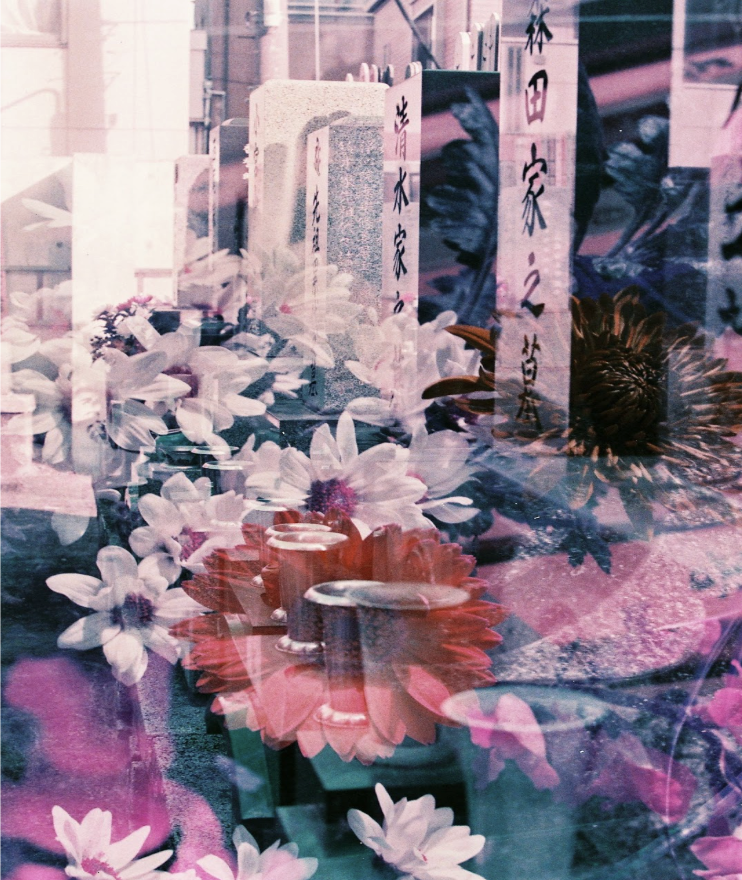
Mother, I am visiting countless graves with our kamon—paulownia and oak leaves chiseled in stone. Packs of cigarettes and single sake shots. Seven stars and Choyo. Roses and alstroemerias. I trace the engraved symbols through floods, famine, and fire. I speak softly to the urns, slightly cracked in the middle. I repeat the purification all my ancient, twisted karma/from beginningless greed, hate and delusion/born through body, speech and mind/I now fully avow. I perform mudras at Jokan-ji for the spirits of sex workers who were forgotten when they died. There is a mass burial of 500 who died in the great Ansei earthquake. Nage-komi-dera. I come from a line of throwaways. It is fitting this temple is known as that. These would have been my alleyways if I knew how to control time. At Yoshiwara-jinja Shrine, I place a coin atop the head of a carved lion. I hope it will give it breath. The woman behind the counter sprinkles fish food into my palms. Bright red and yellow koi whip their tails back and forth. Their mouth agape like a well beneath a field. Priests and monks carry a line of people outside the torii gate as if they were the head of a snake and the crowd a long, serpent tail. Not a single sound made it through into the shrine. A new aizome cherry tree stands at the Omon Gate—the meeting place of love and chance. Kannon pierces below, draped in green cloth. A crooked path of stone leads to Imado Shrine—where I find the orange-striped Tabitha resting at the foot of the temple entrance. The cat folds her legs, straightens her back, and whispers shu-jō mu-hen sei-gan-dō/ bon-nō mu-jin sei-gan-dan/ ho-mon mu-ryō sei-gan-gaku/ butsu-do mu-jō sei-gan-jō.
Dear mother, mother
the first Buddhist funeral
you attended was
for your uncle, but never
met, that event changed my life
Alone at these graves
I am searching for your face
the ground speaks softly
smoke rises from four corners
there is no birth and no death
Dear mother, mother
I know the red-light district
and the place of sharps
I’ve overdosed here before
these women have saved my life
Every morning the sizzle of fish in cast iron fills the narrow halls. The innkeeper’s wife dances in the kitchen between fluffing eggs and piling pickles. Coltrane and Monk blare through a little speaker. I haven’t noticed other guests during my stay until now. I have only interacted with the ghosts and dreams of the bamboo here. Japanese breakfast is the greatest breakfast. Although you never were one to cook. That was not your strong suit, although I remember our first bonding moments were over tempura roots and strong miso soup. Your night shifts kept us from interacting in the morning. During the day. Sometimes I wouldn’t see you until your day off or if I woke up when you came home in the middle of the night. In elementary school, I secretly wished you would go back to cleaning houses—so I could accompany you into the world of strangers. I leave the ryokan as steaming plates are delivered to guests in complimentary kimonos. An unnaturalness contrasted against the fountain, emptying water into the indoor pond. The bullet train is everything you said it was. The bento boxes are everything you said they were. Why can’t I get onigiri as easily in the States as here? Especially if 7-Eleven was invented in Texas. There are enough of us in North America where this makes sense. There is enough appropriation in North America where this makes sense. If only my childhood lunches contained more of you than my father, I may not have turned out the way I did.
Someone told me Japan is eighty percent mountains and forests. My life’s goal is to be a mountain and to marry a forest. I am halfway there. My wife is the reason my lungs fill with oxygen. I am still working on being a mountain. I lose it when I say sentences like these. I think about the harm I have caused and can never undo. I think about the feeling of getting pistol-whipped and robbed. And responding by creating more harm. I think of pulling a trigger beneath a crescent moon in winter, hitting only brick and tile. These violences don’t cancel each other out. If I were made to bleed, I would further open the wound. If my possessions were stolen, I would give everything I own away. If I were made to feel small, I would spread the rumor I was dead. My past collides with my present barreling south on the Shinkansen. I see my prepubescent self in the bathroom mirror. Dogen would correct me and say the past is the present and the future is also the present, the past doesn’t become the present, the present is just the present. My teacher would tell me our identities are always changing and not to get hung up on one. I am attempting to separate myself from felon, but there are so many barriers. I repeat a silent prayer passing through Kanagawa—did you hear it, mother? On some trail, someone was climbing around Mount Oyama and Tanzawa. I could hear the echo of their trekking poles scraping rock through the countryside. Last summer, I met two strangers from Hiroshima hiking the Pacific Coast Trail. We met at the crossroads of the John Muir Trail and took selfies together. Three Japanese hikers running from the noise. I wonder what they were searching for.
I sit in front of English speakers on the Shinkansen. Car 16. Seat 13-A. An Indian British family from London and a young Japanese American from the San Fernando Valley. This is the first time I hear a fluent English-as-a-first-language conversation, yet I stay silent and attempt to make them believe I only know Japanese. Gomenasai. Sumimasen. My most said words here. The young Japanese American could be my cousin but I hid behind the curtain of jealousy. I overhear he is visiting family in Osaka. I am covetous. I want no one to recognize me. No one to assume I am Californian. No one to assume I have never been here before. I fall into the landscape beyond the tracks as if I am tumbling into a tea pot of sencha. Yellow-lime green rice field and artistically arranged dirt roads crisscrossing, low hanging thick clouds, a shoreline range of mountainous peaks that extend further than my neck can turn. I am observing a Miyazaki scene and can no longer tell anyone my age. Do you remember the first time we watched My Neighbor Totoro? I believed he was real long ago but gave that up when I was forced to mature too early. This autumn train ride is giving me that certainty back and I believe I will find the forest spirit somewhere around Kyoto. My first train ride at thirteen, I was arrested and embarrassed. Traumatized. Buried. I wish I could comfort my younger self with a photo of the central coast train tracks of Honshu. Maybe then he wouldn’t blame himself for everything.
Nearly a full moon
Kamo river flowing strong
old stilts in runoff
young couples wear scarfs and gloves
Yasaka shrine shines the street
Night comes early now
lanterns shine through rice paper
dumplings dipped in sauce
I slurp ramen, ramen slurps
Kyoto is then and now
Tonight the river
reflects the entire moon
dear mother, mother
do you remember the moon
in Kyoto, long ago?
✶✶✶✶
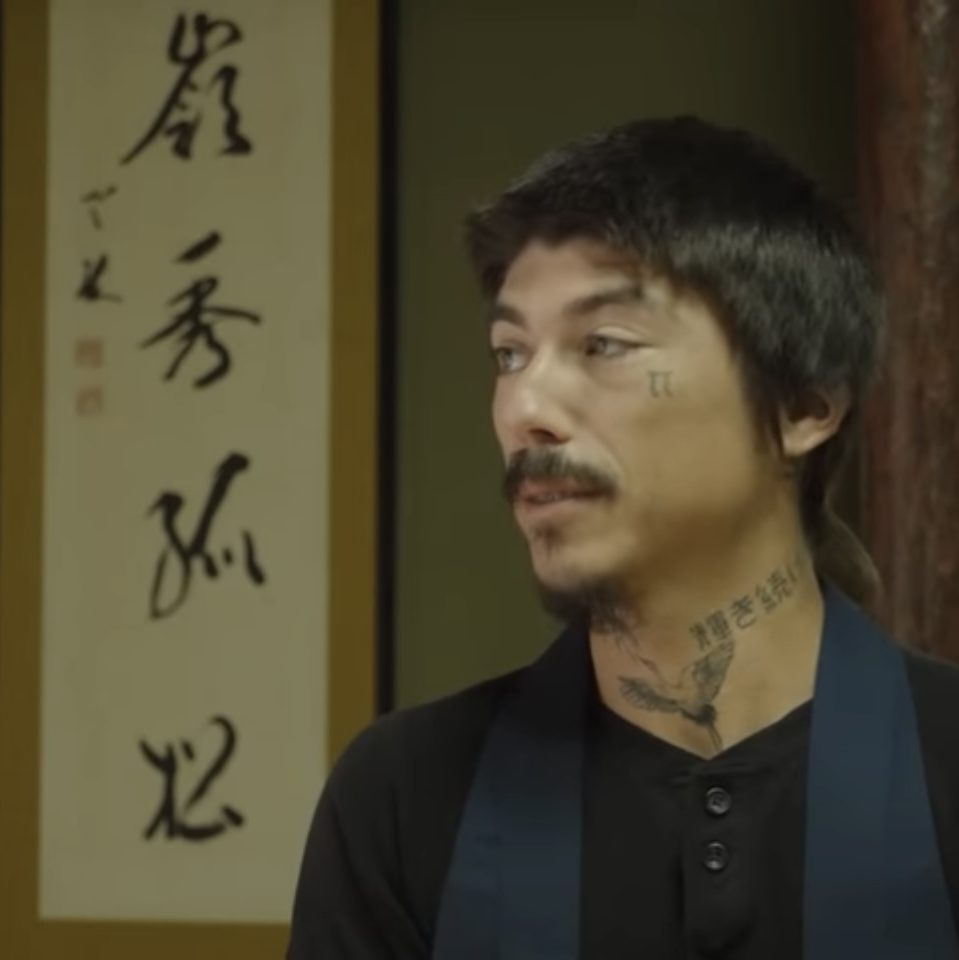
Tony Koji Wallin-Sato is a multicultural Nisei writer who works with currently and formerly incarcerated students in higher education through Project Rebound. He is the prison education coordinator for CSU Long Beach, a lecturer in the critical race, gender, and sexuality studies department at Cal Poly Humboldt, and an in-prison teaching artist with the William James Association. His chapbook, Hyouhakusha: Desolate Travels of a Junkie on the Road, (Cold River Press) and his first book of poems, Bamboo on the Tracks: Sakura Snow and Colt Peacemaker (2024, Finishing Line Press) was selected by John Yau for the 2022 Robert Creeley Memorial Award. His second book of poems, Okaerinasai, (2024, Wet Cement Press), is a finalist for the Big Other Reader’s Choice Award and the Big Other Poetry Award. His third book of poetry is forthcoming through Kaya Press.
✶
Whenever possible, we link book titles to Bookshop, an independent bookselling site. As a Bookshop affiliate, Another Chicago Magazine earns a small percentage from qualifying purchases
 Another Chicago Magazine