
The pages were like tissue paper, they were so delicate, but the words proclaimed certainty. Opening the black leather volumes of the Encyclopedia Britannica in my family’s back hallway, I would scan the authoritative entries, simultaneously soothed by the reliable alphabetical order and excited by finding a long-searched-for entry. I didn’t know it then, but this ten-year-old was joining a millennia-long tradition of hunching over lists that promised knowledge of the world. The Babylonian Urra=hubullu, Pliny’s Historia Naturalis in the first century A.D., Diderot’s Encyclopédie in the eighteenth century, Wikipedia in current times: all point to a consistent human effort to catalogue the world around us.
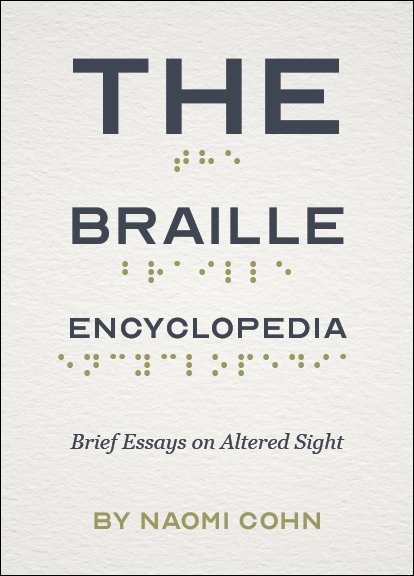
In her debut memoir, The Braille Encyclopedia: Brief Essays On Altered Sight, writer and artist Naomi Cohn (2023 McKnight Artist Fellow, Best of the Net finalist, and two-time Pushcart nominee) turns the encyclopedia inward, using the format to enchantingly choreograph insights into her own experience with pathological myopia, a rare retinal condition that causes her vision to gradually decline. Importantly, she is not completely blind: “I live lost in the few millimeters between lines of braille, lost between poetry and prose, lost in the zone between total sight and total blindness,” she lyrically writes.
Her academic background shines throughout the entire book as she includes historical, scientific, and etymological research, but she does not position the encyclopedia as a pedagogical tool. Rather, it is a scaffold for her ninety-seven short meditations on her autobiography, explorations of the history of braille, and inquiries into what it means to exist with a visual impairment. With largely one-word titles like “Buttons,” “Poetry,” and “Yearning,” Cohn’s entries jump between timelines, subject matter, and location, showing us that average retinae are far from the only way to see the world.
She begins with “Academia,” and as she describes growing up as the bookish child of academics at the University of Chicago, we are quickly entranced by Cohn’s writing: “I am made of words, the organized chaos of text, ant colonies of characters streaming over paper, each letter coalescing into ever greater meaning with its sisters.” She poignantly asks, “In such a teeming ocean of words how could I know there was anything else to swim in?”
The new ocean she’ll swim in is braille. After years of worsening vision, Cohn finally receives her diagnosis at age thirty, snippets of which she expertly reveals across different entries without burdening the writing with medical minutiae. Cohn admits that she never meant to learn braille. When she comes across it in her Adjustment to Blindness Training—programs that help those experiencing vision loss to develop skills so they can live independently—she thinks that learning braille will only be a “passing curiosity.” She has her frustrations with the language—her hands dance “clumsily” along the lines of raised dots—but she ends up falling in love with it, discovering that it expands her relationship with the words she has loved her whole life.
She offers insights into daily life with braille, describing how it allows her to distinguish between homophones in a way that print reading does not. She also deftly employs the perfect dose of humor. In one of the funniest scenes, she recounts an experience with a dictation device, an alternative to writing with braille: “When I dictate: The Complete Book of Menopause / into a note on my phone, it types: The Complete Book of Men. / And then pauses.”
Most poignantly—and in some of the book’s strongest writing—Cohn offers breathtakingly beautiful descriptions of how braille expands her literary life. Braille helps her find her own writerly voice, one that is “Sometimes wild, sometimes catty, but more and more, a voice that does not pull punches. Not wrapping everything in endless modifiers. When it’s so much work to write a single word, it had better be worth saying.” She also considers braille alongside her Judaism. She describes how the braille Torah is not technically kosher, since it needs to be touched by a human hand. Significantly, the book’s last entry is titled “Zutz,” a Yiddish word meaning a poke or a punch that she used to hear her father say. She now uses the word to describe making the dots of braille.
Even as she analyzes braille in the context of her individual life, she beautifully uses it to explore the broader experience of reading in general: “Braille promises the pace and interplay I miss, the pause as an idea lifts from the ground. The impossible helium of an image fills a bag of brilliant silk that didn’t exist until I imagined it.” The reader comes to understand that braille is not merely another way to read and write but rather a guide to entirely new meanings in and of itself.
Cohn also vividly brings Louis Braille to life—imagining him as a young boy in the section “Awl,” named after the tool he was blinded by as a child, and later as a teenager developing his system at the National Institute for Blind Youth (Institut National des Jeunes Aveugles) in Paris. When we learn in “Obituary” that there was no obituary for Braille, we feel personally offended.
She expands beyond braille to muse on other aspects of visual impairment, as well, including anecdotes of practical matters like vocational rehab, sewing, and confusing ointments in her bathroom—“A tube of toothpaste and a tube of ointment feel so similar in the hand. Desenex and Colgate feel so different in the mouth”—while also articulating profound emotional conundrums. She uses mirror neurons—neurons that fire in the same way both when we perform an action and when we observe someone else performing it—to pose a playful yet resonant question: “Where does this leave me and other blind folk? If I don’t see you laughing or crying, do I not care? I am not sure … Do I now feel empathy in my shins?”
Her lyrical writing is undeniable, but a reader might wish Cohn had turned her love of words more toward the people she loves. About halfway through the book, the individual entries risk feeling like scattered braille dots under the hands of a novice reader, as we search for greater interpersonal meaning to connect them. While we long to hear more about her husband and mother, the most profound relationship we miss is that with her father. Her diagnosis came mere months after her father’s diagnosis with dementia, and even as she admits she has never been able to separate the two “trajectories of unraveling,” she leaves us with frustrating half-glimpses of this unique and powerful emotional experience.
But we miss these personal relationships largely because Cohn’s writing is so compelling. Her individual poetic musings offer profound insight into what sight really means, and her work as a whole makes us reconsider a question at the heart of encyclopedic efforts: What is the relationship between cataloguing and understanding? While the encyclopedia may have originated from this need to possess—to perform a certain mastery over the world around us—Cohn’s book instead becomes a compassionate invitation to consider how we are all, somehow, “lost in the zone between total sight and blindness.” We are grateful to have guides like Cohn to shepherd us.
✶✶✶✶
Anne Sawyier’s writing has appeared in the Los Angeles Review of Books, DePaul’s Slag Glass City, and Half and One. Beginning in Fall 2025, she will be attending Columbia University’s MFA program in Creative Nonfiction. Originally from Chicago, she earned her AB in Art History and Arabic from Harvard (2012), a master’s in Art History from Oxford (2013), and an MFA in producing from the American Film Institute (2015). She worked in television for eight years, including as a development executive at Annapurna TV and a TV literary agent at Verve. She is a devoted cat mother to Walter and Temmy.
✶
Whenever possible, we link book titles to Bookshop, an independent bookselling site. As a Bookshop affiliate, Another Chicago Magazine earns a small percentage from qualifying purchases.
 Another Chicago Magazine