
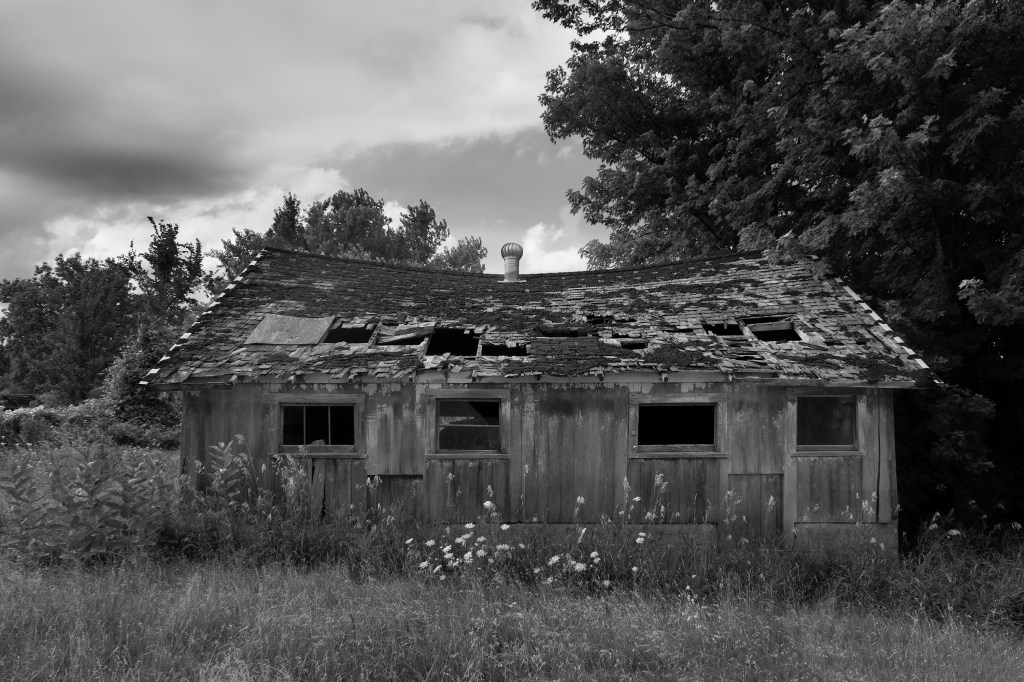
This week, ACM is posting poetry every weekday. This is the first.
The Belt
It’s not on the list anymore. It hasn’t been in a while.
But it was every year of my childhood along with wallet, handkerchiefs,
and white tees. And I remember the slender racks
at the department store with small hooks all around the circular
spinning top—a shiny metal flower we turned, turned,
turned inspecting buckles and faux leather hole-punched strips
that hung like wind chimes not chiming but swinging
when moved by my hand that blew over them slowly. Dad
will love this one, I’d say, grabbing hold of a smooth dark brown beauty
to wrap around his waist. We would always share
a birthday, Dad and I, and always buy each other gifts. The belt,
Mom assured, would be mine to give this year,
giving being a pleasure she taught me, and generosity being part
of raising a child in the Proverbs 22:6 way she should go. Children
forgive so quickly, the simplicity of an apology
followed by social encouragement to maintain status quo. My father
opened the gift and said, “Thank you,” running his fingers along
the dark brown whip in the same way he would say sorry
years later, after he’d done it—but for what he was sorry I still
don’t know. This birthday, turning four, I wasn’t yet aware that the gift
I was giving had multiple functions as I beamed when he took
his old belt off, slid the new one on through loops, a motion
I would come to fear years from now bent and shaking, bare-bottomed,
the serpentine offering stinging and bruising my skin.
patriarchy | ˈpātrēˌärkē | [a retrospective]
like moribund wood
buoyant in a swamp
of non-flowering, single-celled slime
without root or leaf
or vascular tissue, decay
has its own garden
stimulated by nutrients
from fertilized soil
run-off: too much
of a good thing used to meet
agricultural need. now,
the pond breeds algae—mostly
autotropic, sometimes
parasitic—
converting this seemingly organic
old wood [old word]
into energy;
my unicellular self
breaking down what i thought was
the old world in poems,
poorly, hating
with all my tired soul
the insensate limb floating
in stagnant water,
fallen from
a thriving oak tree: fathers belong.
i have one. i want one.
In My Father’s World
manhood would be the rule—excepting the tears my father cried
as John Wayne slithered his body through the trenches
of WWII on our living room’s TV coddling a gun. Hero-
worship sized us all up and called us selfish, my brother falling in line,
following aggression into hours of anger exchanged with our father:
punched walls, thrown hammers and wrenches,
prayers to God sounding more like Old Testament battle cries
than petitions for strength, provision, or hope. You’re stupid,
my father dismisses, waving the back of his hand toward my brother’s
beet red face. In the bedroom, later, his smoldering sobs
burn holes through my soul, listening. I have learned not to comfort.
I have watched the tree outside my own bedroom window
turn yellow, orange, brown, leafless, green. I have written poems
too, the sound of our father ascending the stares
also pounding in my ears full of questions. I’m sorry, he says, tenderly,
through my brother’s bedroom door, the expectations of manhood
complete: apology, sincerity, apology—take it and move on.
In my bedroom alone, shaking, I have prayed the old prayers too.
Old Republicans
make love, or what they called love in the 1940s, 50s, 60s,
and 70s—the decades before I was born. I know
because I’m here, born in the Vietnamese Year of the Snake,
1977, and this explains why, in theory, I am so protective
of environments, being of air and soil and water; and why,
in the year preceding my year of each zodiac cycle (the Year
of the Dragon) I lament as “everyone keeps food for him
or herself.” Famine, says lore, is likely these 365 days
that my father, no longer having my mother to need
and bruise like a too soft apple pulled from its tree or a peach
dropped from a branch easily plucked off the ground
before rotting, will celebrate 2024, another Year of the Dragon,
after voting against my body (not nearly enough of a concern)
and her ash-heaped body (no longer a concern) of which
I have retained a spoonful in a little velvet bag to plant
with a lilac bush when I buy my first home. Next year in this
new Year of the Snake—my year—I will buy my first home,
and I will plant her in the ground below the roots of a lilac bush
and tell her I am sorry her husband is still an old Republican
bleeding red all over the map of our bodies in 2025. And,
having no desire to sing, I will sing her a song of women
to drown out the whistling I hear in the backdrop of this year
from men who believe their famine is the only historical famine
anyone has ever known, bartering our bodies to their false
kitchen gods—the price of gas! the price of milk! the price
of bread! the price of eggs!—surmising these gods
will supernaturally satisfy cravings and white rage. My father
is still a boy strolling casually and righteously though orchards
he never assumed his responsibility to nurture and tend,
picking up fallen apples in his path and tossing each away
until he finds one acceptable to eat. In the Year of the Snake, lilac
wafts through the open windows of my new home, and I pray,
by the wisdom of a fallow field, his Dragon is wasted away.
Burning Barrels
The old ones were 55-gallon standard drums
with holes punched near the bottom for proper ventilation
of smoke rife with dioxin, a proven human
carcinogen that increases the risk of heart disease, diabetes,
and endocrine malfunction. The rusting barrel stood
off the ground on cinder blocks in our backyard, early 1980s,
and the fire that flowered above its lip spoke
with many tongues: arsenic, carbon monoxide, benzene,
styrene, formaldehyde, lead, and hydrogen cyanide. Waste
regulations have since been changed, burning barrels
removed from neighborhood yards: what can be burned,
when it can be burned, and where it can be burned
monitored by city and state with permits purchased. In rural
America where trash often has nowhere to go but down
into the ground or skyward due to no weekly service
provided to cart it away, residents still burned
plastic, cardboard, glossy paper and other forms of waste
well into the 2000s creating noxious fumes, suburbia
encroaching, inhaling and ingesting the toxins. But to be
American is to write a letter to the editor of the local
newspaper about the size of government and the American
way—to live the burning. To be the burning. To say
Jesus is coming soon. Get your heart ready. And observe rising
temperatures and wildfires with helpless attention,
someone else to blame. Anyway, says my Bible,
Earth will be consumed by hot judgement someday, God
at the center of the damage and all his children vanished
in a cinema-worthy escape, flames licking at their heels to signal
how lucky are the righteous to be covered in the rapture’s
unbreachable after-life insurance plan, fine print
at the bottom stating works cannot save you; therefore,
in your letter to the editor, you explain to burn or not burn
isn’t really the question. Big brother better repent.
✶✶✶✶

Kimberly Ann Priest is the winner of the 2024 Backwaters Prize in Poetry from the University of Nebraska Press for her book Wolves in Shells, as well as the author of tether & lung (Texas Review Press) and Slaughter the One Bird (Sundress Publications). A professor of first-year writing at Michigan State University, she lives with her husband in Maine.
✶
Michael Anderson takes pictures while traveling in national parks, rural counties, and cities. He carries his camera while running errands on his bicycle in Chicago.
✶
Whenever possible, we link book titles to Bookshop, an independent bookselling site. As a Bookshop affiliate, Another Chicago Magazine earns a small percentage from qualifying purchases.
 Another Chicago Magazine