
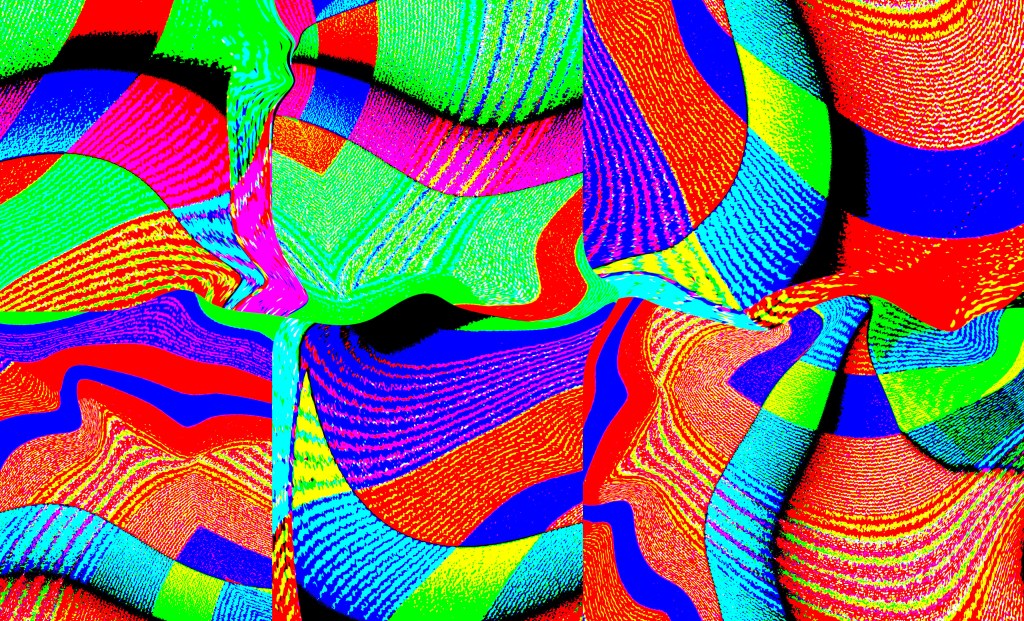
We must take satisfaction in the small things, I told myself, walking down Grand Street. Perhaps, perhaps, the wheels are starting to come off the Trump bus (the court decisions, the declining polls). But what will undo the damage done, the hundreds of thousands fired, the families ripped apart? The trust and data lost? What will undo the damage of childhood? As I passed the tire store, on Grand Street, across from the tortilla factory’s faded Quetzalcoatl mural, a man lunged toward me, stuck out his tongue. Began a curious dance of mimicry. It took me a moment to realize what was occurring. For a second, I thought he was coming on to me, that this was some kind of performance of solidarity. It took a moment to realize he was making fun of me. (It always takes me a moment; indeed, I tell myself, I never know what’s going on; perhaps I’m too much in my head to know what’s going on, or too much on my phone; sometimes not until years later do I understand what was going on. Or maybe—even years later—I just think I understand what was going on. Then something happens and I realize I don’t understand. And then …) I don’t believe evil is just some dark metaphysical force, I told myself, this morning on Grand Street, but the amount of brutality and sadism in the world does kind of make you wonder. We’re all damaged beings, I thought, inhaling the scent from the tortilla factory. I was wearing my mother’s pink running jacket, as I walked down Grand Street; that’s why he came at me. It has always been because I wanted to be my mother that people have come after me, I tell myself now, and told myself on Grand Street. One of the essential qualities of my mind has always been an inability to distinguish between “being” and “being with.” I wanted to play with girls, and hence decided, age eight, that I wanted to be a girl. Why is it, I asked myself and the sky, as I continued down Grand Street, that the current trans debate focuses so much on trans women in sports? Rather than on, say, sports? By which I mean—I told myself—my experience with sports. (The experience of others, is to me–let’s be honest–of minimal interest.) A paper bag and a condom lay on the damp sidewalk. I’m not against sports, I thought, my problem is with sports education, by which I mean PE, by which I mean that vast gulag of induction into masculinity. This is what needs to be addressed, I thought, continuing down Grand Street. My focus is on boys; after all, I was one. I am my hobby. Janice Ian knew the truth at seventeen, I knew it at twelve, or before, knew sports was about being a boy; being a boy was about sports; the two were inseparable; you didn’t get boys without sports. PE was needed to manufacture boys, I thought, on Grand Street, the Quetzalcoatl mural and the tire store now behind me. I knew that sports was, at its essence, about force, that is to say violence; that was the reality; sports weren’t about “being a good sport”; not on the soccer fields of Phoenix, Arizona. (I need to analyze the shame I feel as I write this; the shame that arises from the internalized accusation that I’m making something out of nothing; that I’m being absurd; that what I’m talking about is just growing up. We must always examine all normalizing discourses. There was much I didn’t think about, I thought, on Grand Street. Where, I wondered, did the tortilla factory workers come from? Mexico? Guatemala? ICE, at any moment, might arrive. For the great majority of my life, it seemed inconceivable that one might ever articulate the trauma of the binary bathroom setup; now you are allowed—in certain precincts still—to talk about bathrooms, but you can’t talk about sports, I thought, on Grand Street. How much are the tortilla factory workers paid? (I was going to make an analogy here, to Marx’s essay On The Jewish Question, in which, I told myself, Marx had flipped the question of what to do about Jewish assimilation on its head, questioning, instead, religion itself, saying that it was religion itself that was the problem; in the same way, I had hoped to say, half-cheekily (a defense mechanism) that maybe it shouldn’t be the inclusion of transwomen in sports that’s the focus but sports themselves. It turns out, however, that I had misremembered Marx’s essay entirely, or maybe not ever understood it in the first place). It’s been pointed out that you don’t get British colonialism without the playing fields of Eton, I thought, on Grand Street. I don’t know any transfemme humans who don’t live with the trauma of those playing fields; it had nothing to do with play, it certainly wasn’t playful; it’s hard to comprehend the scale of what’s going on, all of the children who will die because bro-in-chief Musk fed USAID into the woodchipper. After the guy stuck out his tongue at me, after he started his mincing dance of mockery, it took me a second, as I’ve said, to realize what was going on; “Fuck you,” I said to him, it all happened very quickly; childhood did not happen quickly; because of ketamine I’m getting more assertive, as perhaps is Elon Musk; when I was twelve I could not have imagined that people would ever say I didn’t need to go to the boys’ room; the boys’ room was hell, as were the playing fields; the playing fields were perhaps a less concentrated hell, but hell nonetheless; the boys’ room was the ninth circle; I held it in; I’m no Cory Booker, but I held it in. I’ve held everything in; a few years ago everyone was saying “It gets better,” I was skeptical, cynically unwilling to accede to that assertion until my life got better; unlike all of you Bodhisattvas, I’m only interested in myself; now trans people are being erased from history; they have taken the word “transgender” off the government websites, they removed it from the Stonewall Monument website; it took me my whole life to say I existed, now we are going back to “normal,”; i.e. to my non-existence; perhaps before I cease existing—again—we might critique the normality of sports; it’s in erasure that the real violence lies, not in the guy sticking out his tongue; that lasted a few minutes; his body said “Fuck you fag,” by “fag” he meant “girl-boy.” There are species of trans discourse that reify gender; I have no interest in these, I thought, continuing down Grand Street. The air was cool. We need to take pleasure in the small things, since there are few signs that anything is going to get much better for a while, and even if some things do start getting better, that won’t do much for those killed by the bro-machine, for those stacked like cords of wood in the CECOT prison in El Salvador, for the kids forced back in the closet–although, to look on the bright side, I’ll at least have the satisfaction of my cynical inner maxim—”it gets better, but then it gets worse”—having been proven right.
✶✶✶✶
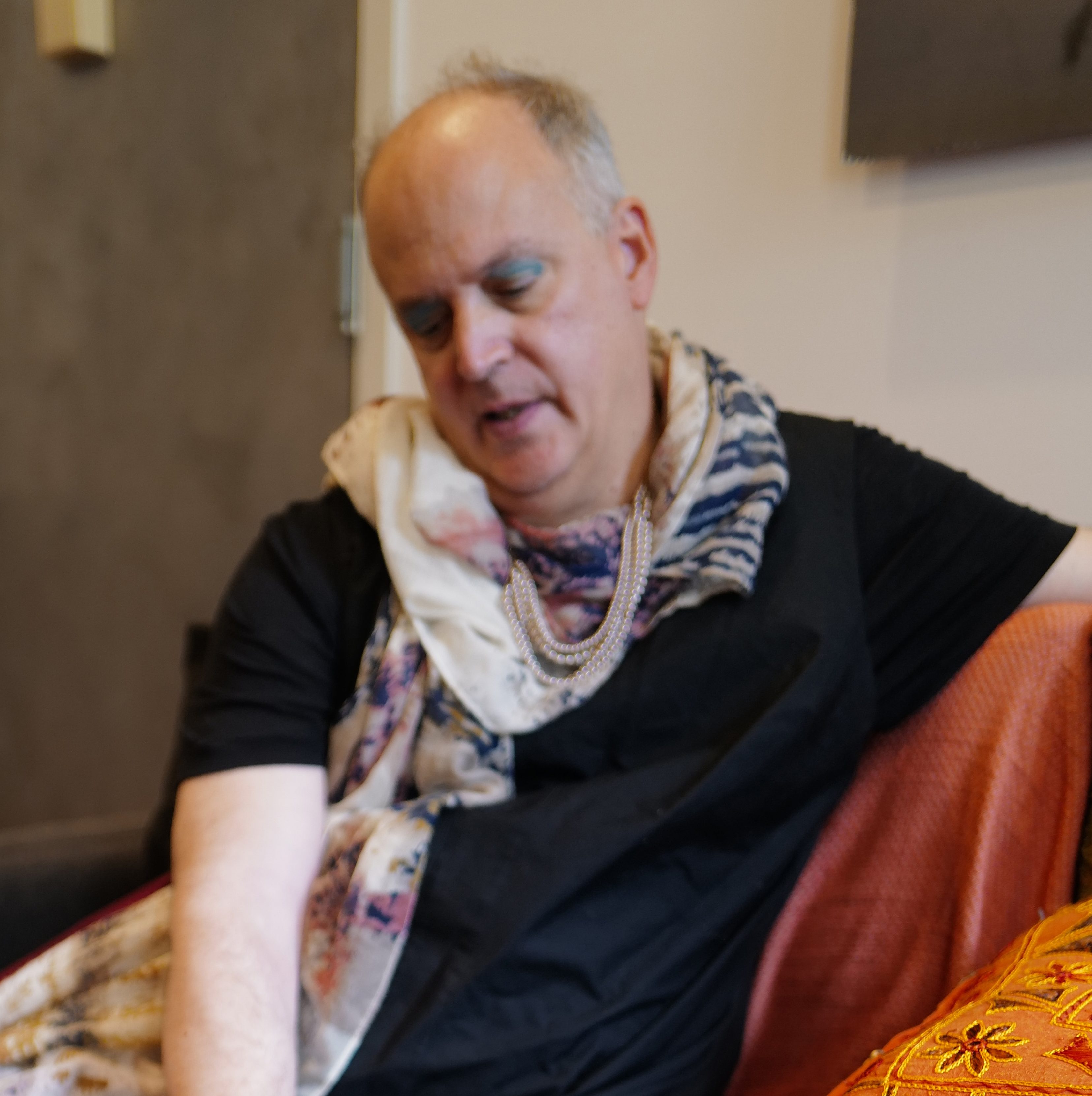
Ru Marshall is a writer and visual artist. Their forthcoming biography, American Trickster: The Hidden Worlds of Carlos Castaneda, received the 2016 Hazel Rowley Prize from the Biographers International Organization and has been optioned for film/TV by Hybrid Cinema. They are also the author of A Separate Reality (Carroll & Graf, 2006), which was nominated for a Lambda Award for debut fiction. They have twice been nominated for a Pushcart Prize, and their prose and poetry have appeared in Salon, N + 1 Online, Evergreen Review, The Barcelona Review, Your Impossible Voice, The Kenyon Review, Michigan Quarterly Review, and numerous other publications. Their visual work has been exhibited at Participant Inc., Studio 10 Gallery, Cathouse Proper, Baxter Street, White Columns, Art in General, Peter Kilchmann Gallery, Richard Anderson Fine Arts, Caren Golden Gallery, and numerous other venues in the United States, Europe, and South America.
✶
Edward Michael Supranowicz is the grandson of Irish and Russian/Ukrainian immigrants. He grew up on a small farm in Appalachia, but has lived in some of the rougher parts of DC and Boston. He has a grad background in painting and printmaking. Some of his artwork has recently or will soon appear in Fish Food, Streetlight, Straylight, Gravel, The Phoenix, and other journals. Supranowicz is also a published poet.
✶
Whenever possible, we link book titles to Bookshop, an independent bookselling site. As a Bookshop affiliate, Another Chicago Magazine earns a small percentage from qualifying purchases.
 Another Chicago Magazine