

Homesteader
Opening his hands, the man thinks: my daughters will have a better life than me. Their hands would stay smooth, pale—not burned by the sun, and their palms would not turn into a map of cities of rivers of labor. But he didn’t know. He didn’t know how to be careful with his wish. In the country where everything is centralized in the capital,“better life” means they left the village. They left him like summer leaves abandoned the rubber trees in his farm. But unlike the leaves, they don’t return when the rain comes. He and his wife, therefore, stand there, leafless.
Two of the girls, grown up now, are living in the capital. The middle child ran away to the other side of the world. Choosing to be the wrong kind of doctor. When she was still little, she used to walk behind him and his cows through the lines of coconut trees. Out into the prairies. Asking senseless questions. Stupid little girl, she confused gravity with vacuum, thinking things could float once the last bit of air was removed. She used to talk nonstop, now she calls so little, asking strange questions. One time she asked him about that Wednesday morning in 1976. He was just fifteen then. She wasn’t even born yet! Crazy girl, cried over dead communists. What has she been doing in America? Countries kill their people all the time.
Lately, she asked him about the farm house on the hillside—her first home. And the nocturnal bird that sounds like a wailing ghost. She’s up to something, his wife said. But he doesn’t mind as long as she calls. It’s cold over there in the Sonoran Desert. She needs to put a beanie on her head before the cold catches her. She told him she still dreams about the farm house, about the rubber trees. It’s the same place he goes to when he sleeps. But in his dream, it’s still all woods, overgrown just like when he got it 36 years ago. And he would wake up in panic, thinking he had to clear out the land again.
Note: “Opening his hands, the man thinks:” is a line from Jean Follian’s A World Rich in Anniversaries.
From the field
One lonesome hill. Two pregnancies. A woman picked flowers just for her youngest daughter. Wild and weed. She taught her how to make a squirrel tail from golden grass. The girl watched her mother’s thumb and index finger. Holding tight at the bottom of the long weed. Then, moving up, up, skyward. And, like magic, spiky florets stood on top of one another with no spine to hold them together. But that was transient. Together, they were not strong enough to withstand the wind. And the girl moved on to something else like ivy of tiny bells of flowers, half-purple, half-white, on the forest floor. Among many bushes with miniscule red umbrellas, the woman picked black berries and put them in her mouth. Her child followed her lead. Not knowing it’s alien to their land. Not knowing it has toxins. Sweetness on their tongues. An exit door. Herbicide in the gallon next to the cow barn. Mother also passed on knowledge of other things. Traveling back in time, feeding ashes to the girl when she was just born. Kids who talked back were parentless—born out of bamboo. Through the green skin of the gigantic grass, the girl saw babies sleeping in a shimmering chamber. Fat weevil larvae breathing in the sweet scent of the wood.
Letter to the Cha-Muang Tree
Do the bats still come for the sugar apples in the garden?
When I finally realized that my world has turned upside down, all I think about is how to become a bat. I remember them. Brown. Flapping their wings so fast they became blurry, bolting into the tree. In the canopy, it sounded chaotic as if they were at war with the twigs and the leaves. It was later in the evening, the insects were out for their concerto, and stars were rising up. I miss them in the remnant light of the countryside. Not from the moon or the stars, but the two lamp posts, and the old porch lights at my parents’ place. Dad said during the day they stayed somewhere dark; a cave up in the mountain, or inside a dome of dead palm trees. Mom said they hung from the ceiling of a monastery she visited. Nasty, they pee everywhere, one night on a nun’s face.
My oldest memory of bats is intertwined with that of a woman from the village. She used to live across my Grandfather’s farm. I don’t remember her name, or know how her life has turned out. Back then, in her garden, she had a few rose-apple trees. And she sold their beautiful pink fruits—watery, crunchy, sweet, and popular. My parents had to ride their bike to her house early. I remember going there one morning with my mom. The dew hadn’t evaporated yet, still laced on the grass. Then I saw, there they were, the bats, tangled in the net above her fence. Trapped at the garden’s periphery, unable to reach any of the fruits. Some were struggling, beating their terrifying wings, as if to declare their existence until the last breath. Some had already stopped moving. Oh, the cost of sweetness. I didn’t tell anyone I was scared, not even my sister. In the village, we weren’t supposed to question such deaths, left alone grieving. There was no time for it. Animal deaths happen on various occasions and there are always reasons. Frogs, squirrels, wild ducks, snakes, birds, fish, chickens. Sometimes they were killed to protect fruit trees or farm animals. Sometimes just for leisure. Sometimes for hunger. Sometimes for celebrations. For offerings to some Chinese angels, or deceased ancestors, or mountain guardians. Or for lost souls wandering through the land. Sometimes I squeezed my eyes hard as I held a roaster, as my dad put a knife blade beneath the animal’s throat. None of these prepared me for the violence. Or any nonsense beyond the village. No, not at all.
In My Grandfather’s Rubber Tree Plantation
1.
I remember when my grandfather went to visit his rubber trees. He would ride his bike uphill, rattling on the unpaved road, paddling past a big tree where my two cousins used to climb to reach the branches full of black fruits and put the bruised sweetness in their pants’ pockets. Their mother was in Bangkok, selling vegetables. Everything happened there—from malls to massacres. Mosquitos are humming like bees. If bloodstains still hold truth and memories, maybe we can free our ghosts, one day.
2.
It’s always dim underneath the canopies of rubber trees. Each leaf is a light thief, a deep green city with its own roads and irrigation. On the western corner of the farm, their young barks overshadow the house my uncle left behind. He left to find love in another city. Termites who move in are full of wood and words from his forgotten books. A barbet, green and full of memories, is sitting in his dying mango tree, as if to compensate for all the leaves that were lost.
3.
There is a fig tree and free sky in the south. Near the creek, my grandmother planted banana colonies. Their young leaves glow under the afternoon light. Within each leaf periphery, there is a midrib, which is gleaming, curved like the backbone of an ancient beast, from which the packets of light slide down the earth, from which leaf veins emerge like a ribcage. And, with no sign of crossed roads or capillaries, they keep running—in parallel—to the margin.
✶✶✶✶
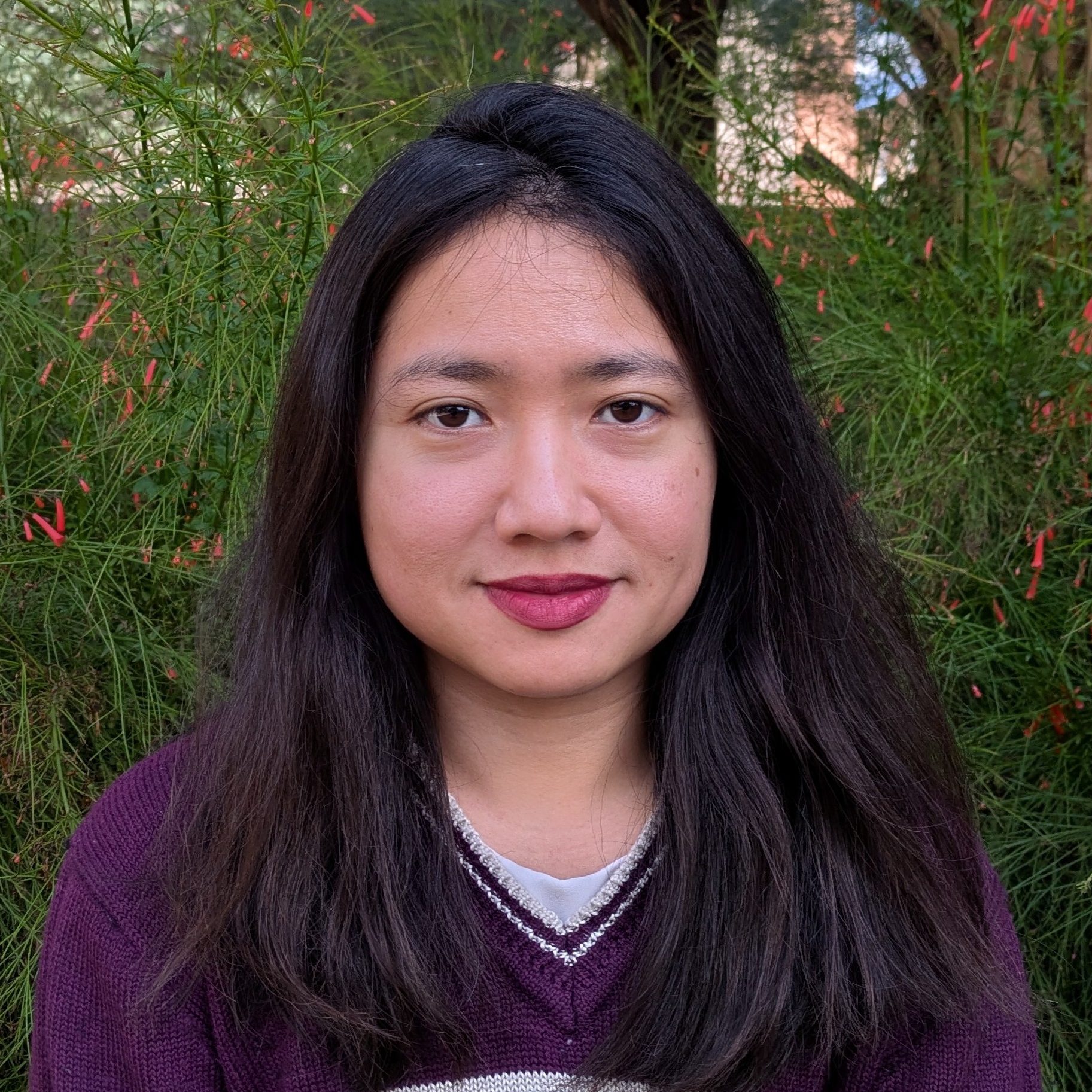
Srisuda Rojsatien (she/her/hers) is a Fulbright scholar from Thailand. A chemist by training, she earned a doctorate degree in Materials Science from Arizona State University in 2024. It was during her PhD studies that she found a poet in her. Her writing investigates places, aiming to find truth and another plane of existence. Her poem “Starlings” won the 2025 Tempe Writing Contest. Her essay “Redefining my Thai Identity” was published in New Mandala.
✶

Mary Tina Shamli Pillay’s poems, fiction and art have featured on BBC Radio, Kitaab, The Mean Journal, Blink-Ink, Borderless Journal, The Chakkar, Dusk Magazine, Madras Courier, The Pine Cone Review, The Literary Times Magazine, The Punch Magazine, and forthcoming in Shooter Magazine (cover art), Ink In Thirds (art), Chestnut Review (art), and Artist Talk magazine among others. She is passionate about writing, art, cats, and food. Find her on Instagram @marytinashamlipillay.
✶
 Another Chicago Magazine