
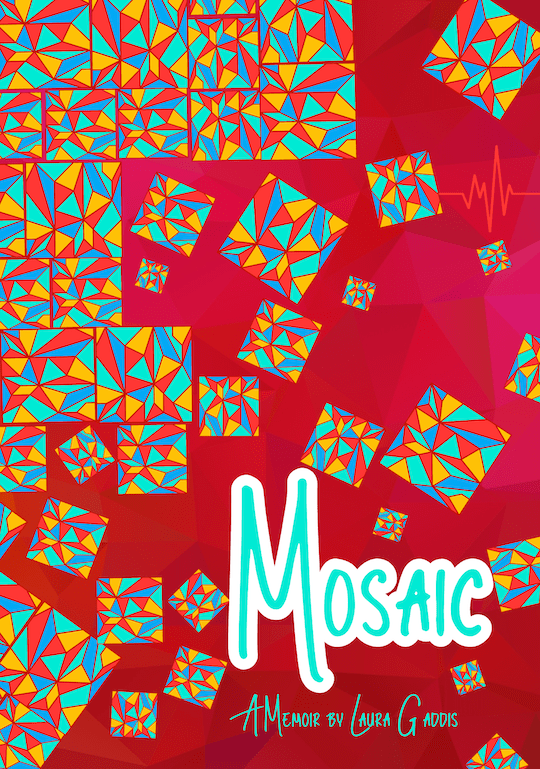
Mosaic is a story of exploration and self-identification, of grief, relationships, tackling mental health, and how to walk through difficult times when there is nowhere else to go. The story follows Laura, who along with her husband Jason, embarked on having a baby, only to go on a journey that spanned over five years. Over this time, Laura learned the hard truth about pregnancy loss, the medical field, and how to negotiate unforeseen difficulties. She persevered through four high-risk pregnancies, with the last one being a pregnancy more successful than the rest. Yet, it posed many tribulations, launching Laura and her husband into the world of an unpredictable birth, fetal abnormalities, their premature baby, the NICU, and breath-holding. Through the story, the book delves into grief and resilience, and how they work together to get Laura through a difficult time in her life. It shows how relying on her own mother also taught her how to enter motherhood for herself, no matter at what stage she considered herself to be a “mother.” Mosaic explores how to use challenges to change us into better versions of ourselves.
✶
Making It
The day I gave birth to our first baby, Sophia, I was allowed to leave the hospital just thirteen hours later. The nurse, Jeanette, who had given me the discharge papers, had instructed me to take it easy for a few days, explained that I would continue to bleed until my uterus expelled all of its contents, that I could go ahead and resume drinking alcohol, that I should take Tylenol for any lingering soreness. She was the one who delivered our box of the only belongings that Sophia had: a cast of her (slightly larger than Barbie) hands, the dress the nurses put her in to take her birth photos, the disc of those photos, the blanket that protected her skin from ours, the tassel to her knit hat (one that would have fit a Beanie Baby), a poem about angels, her inky hand prints and foot prints.
Jeanette said, “take your time and you can leave when you are ready.” She left us alone with the folder and the box.
Jason hugged me. He grabbed my hand with his left and held Sophia’s box with his right.
Sophia’s body had already left the hospital, transported to the Milwaukee County coroner’s office for the autopsy en route to the funeral home. Jason and I exited with all we had.
Studies have shown that couples who suffer miscarriage are twenty-two percent more likely to separate than those who have healthy, living babies. For those who have a stillbirth—the loss of a child who dies in the womb—separation of husband and wife was forty percent greater. The same forty percent applied to live births that devolve into death. Those are the babies who suffer the misfortune of having their genes mutated in such a way that the disfigurement of their hearts, or lungs, or brains, or intestines, or skin, or mouths, or hands, or knees, or ankles, or feet deem them not compatible with life. Just as my first and fourth pregnancies had been presumed to be.
After coming home from Sophia’s birth, I took two weeks off of work before I decided I needed to normalize my life. During those fourteen days, I drifted. The kitchen, the living room, the bedroom, our small backyard pulling weeds from around our patio. I didn’t want to see our neighbor so I rarely ventured out. She knew we were expecting a baby. She was that middle-aged single neighbor that walked her dog daily while stopping to chat with every neighbor on the street. The Halloween before Sophia’s birth, I had popped outside onto our front porch to hand out candy to some children. Sitting on her own front step, she waved and said “How are you and the baby?” I didn’t know how I would answer that question any more.
One day, Jason and I went to Target and bought a jigsaw puzzle. We spread out the pieces on our coffee table. Hours passed as we put together the pastel flowers.
Some days I spent reading A Time to Decide, A Time to Heal: For Parents Making Difficult Decisions About Babies They Love, a book compiled by two social workers and a medical doctor. It was the consolation prize the hospital sent home with us.
Marital separations often happen soon after the loss, with most occurring during the first one-and-a-half to three years. But passing year three does not guarantee relationships are safe. Up to ten years later, couples still fell victim to the damage loss can befall on a relationship, the heartache that wedged between two people who were experimenting with grief. Jason and I weren’t born knowing how to handle the loss of a child. How to handle naming a baby who wouldn’t live more than an hour and a half. It wasn’t innate for me to watch Sophia lie in Jason’s palms while loving her and awaiting her death. I hadn’t learned how to respond when the doctor checked her heartbeat for the final time. Yet Jason and I survived.
I couldn’t look at the pictures we brought home from the hospital the day Sophia died even when my family wanted to see them. I closed myself in the bedroom, laid on the bed, and hid my face in the comforter.
The first night home I was exhausted. Saved by my body’s inability to stay awake any longer, I slept. Fitfully. When I woke in the morning, there was a moment, a single fraction of a second, in which I didn’t remember that I had just given birth and lost a child the day before.
Once, years later when working at the neuropsychology clinic, I said to my coworker Karen: “I wonder if that is what it is like to have dementia. Do they feel a blissful lack of confusion, a moment in which they do not, or cannot, remember that they can’t remember?”
Karen nodded. She knew what I meant.
But, unlike dementia, infant loss doesn’t induce a lingering forgetfulness. The pain of the birth, the fear of seeing Sophia’s tiny red body, the way her skin tore as she rolled on my chest, the slowing of her chest rising and falling, the doctor calling her time of death—remembering it all again was torture.
This remembering happened the next morning. And the next. And the next…
Within the sleep was the insomnia. I fell asleep for an hour or two, but then would wake. I found my way to the couch. I turned on late night TV. Some nights it wasn’t too bad—Carson Daly’s late night show shifted my mind from how life sucked (how I wasn’t sleeping and would be exhausted, how I just knew I’d never have children, how I kept realizing that I was now a mother to a deceased child) to current music trends. Peppy and sometimes obnoxious, the songs were not my life. I needed anything but my life.
Infomercials dominated the rest of the night. The 1 a.m., the 2 a.m., the 3 a.m. I learned about My Pillow™ and how it could contour your head and neck in the perfect way. It could help you sleep so soundly that you would feel better rested than ever before! It stayed cool while keeping you comfortable.
Would it also take away the pain? Would it allow me to sleep again?
I respected Jason’s need for grieving in his way although I was never sure what way that was. Sometimes he cried. Sometimes he just held me. Sometimes he didn’t say much at all. I could always see his eyes moving back and forth, appearing like he was scanning the room for all the answers. I knew this face. It came out when he was thinking about a new proof for his math papers, or when he was thinking about a funny clip he found on Reddit, or when he was trying hard to not make a joke when I said words such as ‘balls’ or ‘holes.’
In the days following Sophia’s death, and the other losses, I saw this face a lot. His eyes surveyed the floor (a lot). He appeared to be thinking (a lot). I never knew what was going on, but the pain on his face never wavered.
He noticeably became more emotional to others’ plights. When a Facebook friend of his had a child born early and had to stay in the NICU, his eyes filled with tears. His voice choked. He needed a moment to calm the muscles in his jaw, the ones that pucker when crying is imminent. It made his chin quiver.
I never knew what he was thinking when his cheeks tensed or when his blue eyes watered. Yet I could sense the emotion. I could feel his sadness. It didn’t matter to me which moment he was remembering, or wishing wasn’t real. I was just glad I wasn’t alone.
We both bought diaries. His: a plain black leather cover. Mine: tan with a blue and green bird and an art deco flower. I wrote letters to Sophia. I told her how beautiful she was (but not that I was scared to see her reddened skin, her bent limbs, her fragile body, her hairless scalp). I wrote of the moments I touched her (but not that I thought I ripped the red skin on her arm) and the words I whispered (I love you; I’m so sorry; you are the best baby…).
At night we sat up, side-by-side in bed, our journals on our laps.
Did you write in your journal? Oh, you did, that’s good! No, no…you don’t have to share. That’s for you.
And yet I longed to know what he said to Sophia, (maybe it was: I love you; Hello, I’m your daddy; I tried to save you; I did everything I could to help your mommy; you can rest now; if there was a God—and I figured out over time there likely wasn’t—but if there was; he would never let this happen.)
✶✶✶✶
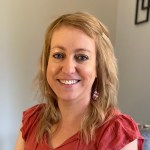
Laura Gaddis (she/her) is an author/educator from Oxford, Ohio. Her memoir Mosaic (Unsolicited Press) delves into loss, motherhood, and parenting a child with disabilities. She has been published in Thin Air Magazine, 805 Lit + Art, Stonecoast Review, Brevity Blog, and elsewhere. Laura’s essay “Well Meaning People” was Pushcart Nominated. She has been awarded a teaching fellowship for the Desert Nights Rising Stars Writers’ Conference with the Virginia G. Piper Center for Creative Writing at Arizona State University.
✶
Whenever possible, we link book titles to Bookshop, an independent bookselling site. As a Bookshop affiliate, Another Chicago Magazine earns a small percentage from qualifying purchases.
 Another Chicago Magazine