
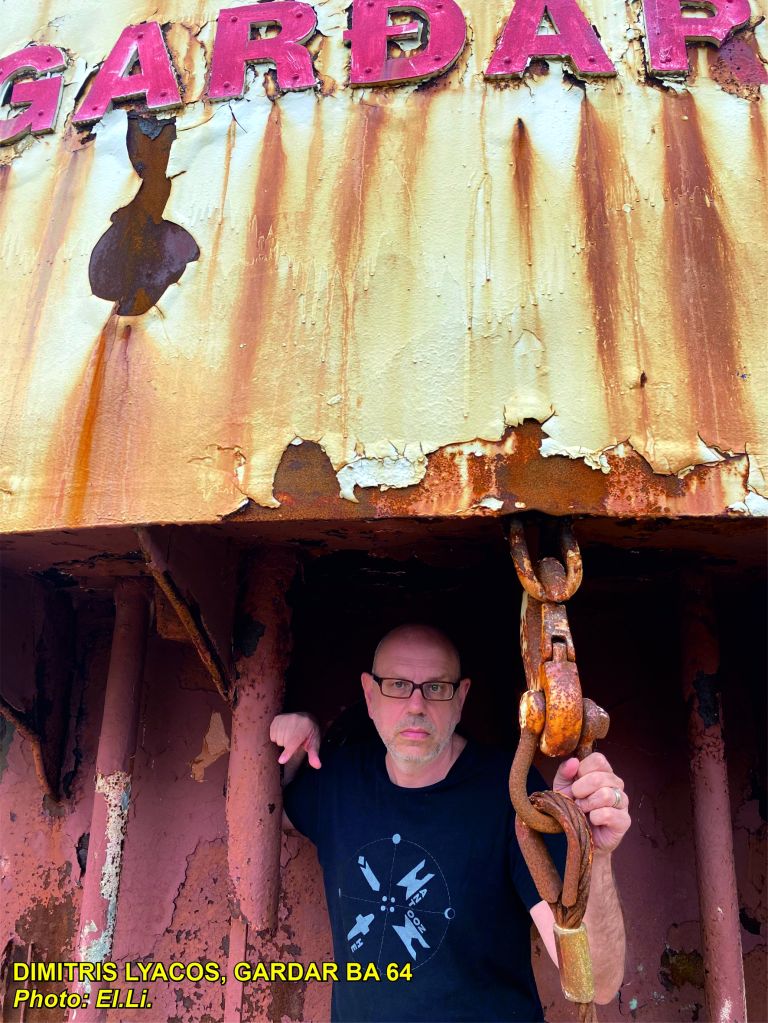
Dimitris Lyacos
Dimitris Lyacos is a contemporary Greek writer. His Poena Damni trilogy reexamines key elements of Western anthropology, religion, myth, philosophy, and ritual—among them, the scapegoat, the quest, the return of the dead, redemption, physical suffering, and mental illness—interweaving prose, drama, and poetry in a fractured narrative. Developed as a work in progress over the course of three decades, the Trilogy has been translated into more than twenty languages, without ever appearing in the original Greek. It has also inspired musical, visual, and theatre projects—the most recent is a piece for violin and cello by US composer Gregory Rowland Evans, premiered in Cincinnati, Ohio, by The Antigone Music Collective. Lyacos’s characters are always at a distance from society. They are fugitives, like the narrator of Z213: Exit (the first book of the trilogy). They are transient dwellers of an ephemeral borderland, like the characters of With the People from the Bridge (the second book), or survivors stranded on remote islands, like the protagonist of The First Death (the third book).
Lyacos’s new book (Until the Victim Becomes our Own) is forthcoming in the Italian translation in April 2025. Described as prequel of the Trilogy, Until the Victim Becomes our Own outlines a detailed portrait of Western civilization, examined and reassessed from its Judeo-Christian foundations, through industrialization and the birth of capitalism, to the digitally global present day. Employing alternating narrators—its standalone chapters complementing each other like a montage sequence of shots—Until the Victim Becomes our Own follows the metamorphoses of violence, as history and language determine its multiple, unexpected, protean embodiments. Excerpts from the book in the English language have appeared in Image, MAYDAY, Chicago Review, and River Styx in 2024.
Toti O’Brien: At the end of your Trilogy’s English edition, an intriguing “Translator’s Note” might deceive the reader for a moment. It is actually written by you. I would like to use it as a springboard for discussing the meaning of translation in the context of your literary work. Why that note? How did it come about?
Dimitris Lyacos: At the end of the Trilogy there is also a glossary, which translates ancient Greek words (the text has a few of them) in English. When Professor Victor Ivanovic—my Romanian translator—got there, he asked, “Do we need a glossary?” “Yes,” I said. He replied, “I don’t think so. It is useless for the Romanian public,” and I started to get slightly perplexed. Then he added, “Do you want me to write a translator’s note about it?” “Look,” I said, “why don’t I write it? ” I sat down, and this text came up. I think that it further connects the three books, as the person describing the translating experience (the fictional translator) “might” be the protagonist of book one, who is recaptured and brought back to where he initially escaped, and we go full circle. Today I read the note after a long time. I was a bit concerned. I wanted this interview to be as fresh as possible, didn’t want the note to infiltrate my system just before our talk. But I read it, and somehow it reconnected me with other ideas on translation, such as, “How do you bring a message from one side to the other when there is a lot of noise in between”?
In your note, you explain this very process through the metaphor of the bridge. Can you elaborate on it?
It isn’t my metaphor! It is in the tradition. And I’d rather use the term “communication channel,” borrowing from information theory. But, wait! We have already started to discuss my texts, and translation theory. Why would people who aren’t directly involved care about the specifics of the process? See? For instance, the conversation we recently had on violence would potentially regard anybody. Anyone should be interested, if not by the contents, at least by the subject matter. Translation, on the contrary, sounds like a “niche” that concerns you, me, those who are professionally implicated, readers who like to compare an original to a translated text, wonder how much the latter is faithful, etc. I was hoping to treat the translation “issue” as one of more general concern. Think, for instance, of the major works that were first translated. Say, the Bible. If translation had not happened, we would miss a great part not only of the Western culture, but of culture at large. Starting with the Septuagint, the Bible was consigned to the world through translation, and the same occurred with the Koran. For both texts, translations had to strictly adhere to the original, and initially encountered serious opposition. In the sixteenth century, Tyndale, the first to provide an English version of the Bible, was strangled and then burned on a pyre. Even the title “Septuagint” is revealing. Legend goes that seventy-two people translated the text in solitary confinement, each locked into a cell, and they simultaneously produced the same outcome—as if to say, “We want something that is one hundred percent faithful to the original.” No freedom of interpretation would do. No one could say, “My translation will be slightly different from yours,” or, “I have the right to add my personal cultural elements, my POV!” They sure couldn’t. When the seventieth came out with the same text, it was a miracle from god, preserving his own voice through the predominance of the original text. With regard to the Koran, I think the Muslims believed any translation, in whichever language, would be a way of interpretation. I am not an expert on Arabic culture, but when you go to a mosque inscriptions are always in Arabic, because the sacred text must stay sacred. Translation is only allowed as a channel through which all the godliness of the original reaches the target text. Again, the authority of the original prevails. Then, the funny thing with me is that I may be the only author whose books only exist in translation. The original Greek isn’t published. This translation and that one can be compared—let’s say the Spanish with the English, and so forth. You, for instance, have read the Italian and the English, but you haven’t seen the original and, as far as I am concerned, it is as if the original didn’t exist.
Let me clarify this! On one side, we have a myth about the supremacy of the original, plus a legend about sacred texts being magically “channeled” into another tongue, while remaining substantially unaltered. On the other side, your case seems to birth the opposite myth, right?
I like this idea. Say, this might have happened for any reason. Perhaps, I wasn’t able to find a publisher for the Greek original (unlikely, but it could be a working hypothesis). Still, the facts could nurture the myth that I oppose the archetype—the predominance—of textual authority.
Truly, we are just mentioning two opposite practices, both proving that translation implies attitudes and beliefs, actually impacting cultures and people.
Actually, I think that we live in a state of constant translation—we have, for decades, not just in metropolitan areas, but in tiny towns and villages as well. We are a complex mixture of languages and cultures among which we don’t always build bridges, or very frail ones. Often, we aren’t even aware of the fact that bridges should be built.
I agree. We live in a world of translation—and mistranslation, as between the coexisting people and languages there’s a lot of noise—meaning, all the elements that don’t let the message from the source be appropriately received. Tackling the noise problem and accuracy of transmission is what does the job. It allows us to have mobile phones. It enables the two of us to talk right now, thanks to a process of signal, coding, decoding, both on your side and mine. It is great that these processes exist. But you are right. In real life, huge amounts of “translation” are needed among worlds and individuals, and huge gaps of “noise” don’t allow people to be integrated—don’t allow, say, a migrant to feel secure within an environment that is foreign to her. To mention, once again, our conversation on violence, you see how language is power, how language can be violent. When, for instance, someone tries to obtain a residence permit in a country of which he doesn’t speak the language—going through procedures he hardly understands, unable to translate what he hears to himself or to his family—there is much noise between the source and him, which engenders a state of extreme weakness. Then, translation isn’t only a literary concern!
This brings to mind something that I’d like to discuss. I’m thinking of orality, and the way it affects the language in your books. Your texts are “literary,” no doubt, but simultaneously aren’t. Somehow, they bridge Scripture with spoken word—also, with stream of consciousness, sheer, “untreated” thought processes. Your style might seem hermetic, while in fact it comes closer to the reader than other styles do. I believe that your very language makes translation both harder and easier. Do you agree?
Yes, the language I use is “literary” because it tries to be dense, to use minimum space while carrying maximum information (I guess, everything, from an image to a musical piece, to a metaphor, is information). I believe that literary language is more condensed than speech. On the other hand, sure, there is an element of orality, because people are talking, and they need to be natural, idiomatic. It is crucial for me to have a kind of transparent speech that can resonate with the reader—or whoever might be confronted with a text, even aurally. See, this is the part of communication. I’d like for the text to be clear, which means idiomatic, so that even condensed information can flow. We have examples of eminent literature that are hard to swallow. I can think of many authors (from Eliot, to Zukofsky, to Paul Celan) whose works are somehow impenetrable to the wider public, as—unless you try hard—the message doesn’t come through. Or it does in a vague way, which still matters, but if we want something definite, we have to use a language that reaches—I don’t want to say “reader”—the receiver. We are lucky, of course, to have all sorts of texts! I am not trying to introduce a new norm by which we “should” be clear. It depends on individual agendas and projects. You don’t read Mallarmé, for instance, to someone who just wants to hear a story: there is none. In my case, though, I’d like to combine the maximum possible density with the maximum possible transparency, and I think it’s a balance.
It sure is. To be clear, you say, may require the use of idiom—the most differentiated area of language, the most idiosyncratic, unique. To produce idiomatic text inevitably gives translators a wide margin of freedom. Are you comfortable with this side effect?
Yes, I am. Back in the nineteenth century, German scholar Friedrich Schleiermacher theorized that translation could either domesticate the text (bringing it closer to the reader via an idiomatic use of language) or foreignize it (staying more faithful to the original). He was in favor of foreignizing, strictly adhering to the literary structure and idiom adopted by the author. Today, we lean towards idiomatic translation, which I guess is easier for the reader. In a world where we are bombarded with so many texts, if most were foreignized, we would be lost, especially in English. Every author aspires to be translated into English. Imagine if all were foreignized! Translations aren’t quite popular among the Anglo-American public, much less than texts originally written in English. If, at that, you’d publish foreignized texts, interest towards foreign literature would further decrease. I am aware, of course, that some scholars in the US are in favor of foreignizing translation. This, though, is more theory than practice, because when you bring a foreignized text to a publisher, editors will send it back. Almost all US editors are strict about this. You give them an idiomatic translation and they suggest more editing, aiming at a result as fully idiomatic as can be.
I agree.
See? Of course, communication—the idea of bringing to the reader a text that resonates—is paramount. On the other hand, the process of creating a “transparent” translation alters more or less the original message (otherwise, like in the story of the Septuagint, all translators would come up with the same identical book). As we said, it’s a balance, and not an easy one. In my Translator’s Note, for instance, we see someone that (like a migrant just arrived in a European coastal town) doesn’t speak the language. Hence, he’s confronted with a text he doesn’t understand, but with the help of a dictionary he creates “a new text.” In fact, he builds an order based on another one—a meta-order, derived from that of the source text. Still, he doesn’t have a final criterion establishing whether the two share a meaning, if there is a meaning out there to which both texts connect. Ultimately, we don’t know how much communication our translations allow, especially when they try to link far-apart cultures and worlds. We are domesticators. We domesticate everyone, to different degrees. Say, an American and an Italian, an Italian and a French, belong to close cultures, so they need to domesticate each other less. When a culture is farther away from us, we tend to domesticate more, and we lose precious information. This is the drawback of bringing the author to the reader—or the sender to the receiver.
Yes. When I look at non-western cultures translated into English, I can often see loss of information. Would you think, though, that the emotional response of the receiver can be sufficient proof of communication? Say that we lose cultural data when a text from a distant world is domesticated, but the receivers’ emotional reactions to the original and to the translation compare. Is this relevant?
I think it’s important, but might not be enough. We are domesticating it all. Twelve thousand years ago, vertebrates on our planet were one percent of the biomass. Today, they are ninety-nine percent. I mean that the world has been gradually homogenized. Somehow, translation works both ways. It allows the original to exist. By translating it, we respect it. We say, “These people should be there and should keep their language.” But to exactly reproduce the idea, concept, and structure of a source text, when it widely differs from the target culture, might impede comprehension. On the other hand, as we domesticate the contents, we don’t have as much access to the source world as we would if we’d move out of our immediate environment, and step closer to them. When translation fully domesticates the original, such a rough, grainy outline remains of the world we are trying to understand. So, it’s a negotiation of sorts.
I can think of translation as one of few alternative modes—a science (attempting to establish an accurate equation between texts A and B), a mystic or religious experience, as in the story of the Septuagint (which achieves the same perfect equation by way of divine intervention), or an art (where apparently arbitrary choices aim at the most possibly coherent result).
I don’t think that I would use any of these concepts. To me, translation is a process of communication that will be increasingly refined. Signals will be perfected, and so will channels. We may end up perfectly understanding each other, thanks to the technology—that’s the word I would use, in fact—in a future that perhaps isn’t yet foreseeable. But we’ll lose some of the very useful noise that is here with us, today, just as we have lost many species… Think of how many plants and animals existed in the past of this planet, and how many you see around now. A lot will go extinct, for us to be able to refine our channels and better communicate. Information will increase in quantity, channels—senders and receivers—will improve in quality, but perhaps we will have to shrink the dimensions, meaning that what’s now considered “non-translatable” may disappear.
There will be a part of loss attached to this progress.
If you need to translate, somehow you have to simplify. If you need to simplify, to condense, there will be loss. Think of a hypothetical, very complex language. Should there be a sort of evolutionary pressure on languages, it would not survive. English gives you many functional solutions, while some other languages might not. So, they might go extinct. In their case, no translation work will be needed anymore.
✶✶✶✶

Toti O’Brien is the Italian Accordionist with an Irish last name. Born in Rome and living in Los Angeles, she is an artist, musician, and dancer. She has written four collections of poetry and three of prose. Her short story collection, Alter Alter, was released by Elyssar Press in 2024
✶
Whenever possible, we link book titles to Bookshop, an independent bookselling site. As a Bookshop affiliate, Another Chicago Magazine earns a small percentage from qualifying purchases.
 Another Chicago Magazine