
As we huddled in the high school football bleachers, wind raked the stadium with the sickly sweet tang of burnt leaves and fog shrouded the lights. We were waiting for the gymnasium to open, sipping steaming coffee and eating burritos that I, vice-chief of the Chiricahua Apache Nation, had bought from a food truck where the cashier asked a question that’s standard across the Land of Enchantment to those ordering Mexican fare: Do you want green or red? By this she meant to ask which I’d rather have spread over my burritos—fiery green chili or the more aromatic and piquant red. I went with green, to the approval of all as follows: Victorio Fuente, chief of the Chiricahua, and an old-school outfitter crafted from bull hide stretched over a six-foot ironwood frame then fastened with brass nails. Yin Lin, the slinky faculty colleague from Shanghai I met through my department chairman and enticed along on our second date. And Sylvia, the petite bespectacled environmental lawyer from Yale who represented the Gila Guardians, a militant anti-mining NGO, and by the look of things, was Vic’s presumptive girlfriend.
Sylvia, a bundle of nervous energy, wiped her face with a napkin, then started in. “The good news is this. Getting a permit for a new mine in New Mexico is almost impossible.”
Vic snorted into the collar of his flannel, bought by Sylvia to replace the powwow shirts he wears everywhere in all seasons. “Impossible as in two mares can’t make no foal?”
My breath turned to fog when I laughed. “Or impossible as in the Mariners winning the World Series?”
“Somewhere in-between, gentlemen.” Sylvia was warm in a cream turtleneck and a fur coat at no risk of getting doused with paint as it might be in New York. “New Mexico’s the toughest state in the West for Big Mining. It hasn’t issued a new drill permit in twenty years. Not saying they can’t, but the odds are in our favor.”
The meeting was scheduled to begin in fifteen minutes but, as it was in Silver City, I knew it would be more like twenty-five. I checked out the parking lot. Traffic attendants dressed in suits, ties, and long coats directed vehicles—battered domestic pickups and trucks but a few Priuses too—toward the lower-level lot. They’d cordoned off the upper level for VIPs, which explained the trio of blackout Chevy Suburbans gleaming like they just rolled off the assembly line.
It was going to be a full house. Tomorrow’s front page news.
“The New Mexico Mining Act,” Sylvia explained, “regulates every aspect of a mining operation. Agencies you’ve never heard of have thumbs in the pie. And any company wanting to mine must post a financial bond to ensure that after the ore plays out, the site will be restored.”
“No mining company like Aurum never put it back like it was, hey,” Vic muttered. “Aurum’ll wreck Nde benah,” he added, using our words for Chiricahua Lands.
“If Aurum gets an extraction permit out of the State, which won’t happen,” Sylvia said. She believes this town hall will push citizens to weigh in and tip the balance. It’s a big boost to have a Native tribe in opposition, she told me once. It changes the optics. I hope she’s right. “If Aurum hears locals oppose their mine, among them the people upon whose ancestral land they plan to dig, they may abandon their plans,” she says.
“And I may wake up in my double-wide in a Miss-America-and-her-twin-sister sammich.” Sylvia slugged Vic’s shoulder.
Lin scooched closer and wrapped an arm around my waist. She seemed toasty in a long Pendleton coat I’d bought that morning to help forget last night’s jeremiad. It was also her birthday, which I’d forgotten if ever I’d known it, so that’s how I couched the gift once she informed me.
“Mining companies evaluate cost and risk,” Sylvia said. She takes her career as an environmental lawyer seriously. A true believer. She’s always teaching and explaining to her, prepping them in advance. “If it’s too much trouble to get a permit here, Aurum will decamp for the developing world,” she said.
I was skeptical. “You think, Sylv?”
“Aurum typically takes the path of least resistance.”
Vic darkened until he was the color of a smoked brick, which was hard because his skin is normally the same mahogany brown I am. Or it was. Vic’s gone now. “Our land ain’t typical, hey,” he said, right as ever.
“It’s rare earth,” Lin chipped in. An obvious double entendre, given that rare earth mining is the business of the mine we were there to oppose.
A Lincoln SUV began rolling into a spot reserved with orange cones. An attendant rushed to whisk the cones away.
“But if Minerals and Mining grants Aurum a permit,” Sylvia said, “don’t worry.” We knew the process, she’d told us all this before. But even she seemed nervous, and it appeared to ease her anxiety a bit if she talked it through. “We’ll appeal to the Mining Commission. And from there to District Court. We’ll stall Aurum. Time is money. Every day we drag them through environmental litigation, Aurum isn’t drilling but it’s incurring big expenses.”
“For all the lawyers, hey.”
Sylvia waved her hand. “Honey, I can tell lawyer jokes all day long. Try me. Yes, for lawyers, scientific experts, and reporting requirements. And every step of the way, regulatory agencies watch them like hawks.”
A striking redhead, six feet tall not counting unpronounceable heels, accompanied by an All-American guy a half-foot taller than her, built like the Hulk, nose high in the air as if to be extra alert in this environment, exited the Lincoln. Based on Sylvia’s briefing, I figured it was Aurum’s president and CEO, Stanley Tough, who despite the boy’s name was all woman, and Chief Security Officer Baylor West, a spooky former SEAL.
My palms tingled and reddened. “Vic, ready for your speech?”
“Mas o menos.”
“A few last things,” Sylvia said. “Aurum’s permit application is vulnerable.”
“How?” Vic asked.
I ribbed him. “Jefe, you sound like an Indian in a John Wayne film.”
Vic laughed. It was good to see his spirits up.
“Aurum’s baseline,” Sylvia told Vic in an answer to his question, “is deplorable on every metric. Water. Air. Wildlife.”
“Never stopped no mine before.”
“Aurum’s bad acts will. If it comes to it, we’ll attack the Forest Service’s environmental impact statement.”
I checked my watch. “Time.” I offered Lin my hand. Vic offered his to Sylvia. Anxiety reared its ugly head while I descended the rows of seats. I leaned into Lin and breathed, slowly and deeply as I was taught. A compromise was available, I told myself. Aurum’s leaders were successful. Surely they’d be reasonable and rational.
Halfway across the artificial turf, Sylvia dug in her bootheels. “One more thing. Aurum is the Manson Family of international mining. They’re vicious and hated for it.”
I led us, against my better judgment, into the buzzing gym.
✶
“Aurum is your ally,” said Stanley Tough in a mellifluous contralto. With that, the redhead concluded a glitzy multimedia presentation to the thousand audience members that made mining look like God’s gift, and the hole Aurum wanted to gouge deep in Grant County soil an industrial Disney World. “We’re a responsible partner in restoring America’s dominance in rare earth minerals,” she said into her lapel microphone. She was such a bullshitting beauty. “The Chinese Communist Party is threatening to cut off all mineral shipments to the U.S. Why should America beg them to send us their rare earth supplies when the rare earth we need for economic and national security is here at home?” Like a pageant queen, Stanley Tough glided gracefully through the front row crowd of heavy hitters. Senators Miles and Hijodestro. Governor Gomez. Raul Tejada, our member of the House of Representatives.
Behind these VIPs were the hoi polloi—a Grant County cross-section that cared enough about Aurum’s intent to mine to give up an evening during holiday season. Behind our salt-of-the-earth demeanor, we, the leaders of the Chiricahua Apache Nation, and Sylvia Green awaited our turn to rebut Aurum’s brazen sales pitch.
“What does the Burro Mountain Project mean for you?” asked the woman in charge of a fifth- generation Canadian mining dynasty from the stage. Sylvia said Aurum was known for lawlessness and the vast global tentacles it pressed into other people’s backyards. Stanley’s delivery was practiced; her poise, remarkable; her value proposition, irresistible to residents of a rural county two hundred miles from the nearest city who’d suffered the perpetual recession that mining and agricultural communities had endured since globalization began in the 1980s. President Tough drew out the silence as she moved through the sea of humanity she intended to win over, then stopped and answered her own question: “Jobs.”
Applause from underlings. Visions of campaign contributions and lobbyist grease spun through politicians’ heads. I spat the brew from Aurum’s hospitality section back into a foam cup and set it under my folding chair. It smelled like a cancerous camel pissed in a jar of aged turpentine—which is what I knew the Gila River would taste like if Aurum got its mine.
Aurum’s leader continued without notes. “Over twenty years New Mexico’s lost twelve thousand jobs and one billion annual payroll in copper alone. Mine closings have battered Animas, Questa, and Silver City. Freeport-McMoran laid off six hundred of you. Right before Christmas.”
Some of the locals booed. Some dropped salty language.
“Where did your jobs go?” Stanley asked the recently unemployed through whom she wended.
“China!” shouted one recent pink slip recipient.
“Exactly,” cooed the mining company’s head cheerleader. “Isn’t it time for Grant County and Silver City to stop exporting jobs and people?”
Whistles. Cheers. Stanley Tough was now two rows from our delegation.
“In extracting and processing the rare earth America requires to preserve our way of life, Aurum will create four thousand highly-paid green jobs in Silver City.”
At this, roars of approval filled the gym.
“Aurum’s green operations will transform mining,” Stanley said. “Our workers will enable the advanced technology our military needs to keep us safe. Aurum has secured Pentagon contracts to supply rare earth for guided missiles and fighter jets. We’re raring to go.”
Her appeal to the red, white, and blue prompted heavy applause.
“Aurum’s green operations will generate tax revenue streams and licensing fees that will fully fund public services across Grant County for generations. And we at Aurum are developing a royalty structure to invest a share of our profits in infrastructure, healthcare, and education projects.”
It sounded like a NASCAR race. People like spending other people’s money.
She was one row away. “Aurum’s state-of-the-art reclamation model will leave the Burro Mountains Project site better than we found it. Doesn’t it make sense to mine rare earth in America where anyone can monitor what we’re doing, rather than in some Indonesian jungle where God only knows what’s happening? Aurum will protect the Gila Region. I pledge this personally.”
President Tough’s false dichotomy played well. It earned her a round of clapping. She’d honed her craft. Selling Aurum as a good environmental citizen took chutzpah and brass. Per Sylvia, if I had a dollar for every time Stanley had hoodwinked locals into supporting mines that left them bankrupt when market prices cratered, I could have taken Lin for a steak dinner at the Buckhorn Saloon—the fanciest eatery in Grant County.
Baylor West, Stanley’s number two, was standing to the side. He swept his eyes across the crowd by sectors, gauging threats professionally. Then it dawned. His interest in her protection was personal. Perhaps he was her lover too.
Oops. Stanley Tough, the green-eyed titan of industry and snake charmer, looked down on me. Her diamond ankle bracelet sparkled under the spotlight that followed her. High arches, ruby-red toenails, a silver toe ring. Without asking, she laid her porcelain hand on my shoulder like she’d decided which dog she’d take home from the pound. No wedding ring. “Aurum,” she said, “will partner with the Native people into whose land we request invitation. We’ll hear their concerns and share the wealth with them. Here with us tonight is Dr. Will Oak, vice-chief of our very own Chiricahua Apache Nation and Medal of Honor recipient!” She pulled me up.
The crowd cheered. Spotlights blinded me. Panic. Perfume. Our hip bones rubbed. I wondered how she knew who I was.
She interlaced our fingers. Cold sweat on my nape. “We two need to talk,” she whispered, lips tickling my ear, auburn strands teasing my face, then squeezed my hand like we were lovers with secrets, sat me down, and strutted to the fore.
I felt dirty, like I’d been fucked duplicitously, but wiser as if I’d already absorbed the pain of our breakup and converted it into valuable life lessons. Experience told me the feeling would pass.
“Thank you, Silver City.” Aurum’s president said, evincing sincerity. “Thank you, Grant County. We have a rare opportunity.” With that play on words, Stanley Tough basked in applause before ceding the floor and joining her bodyguard in the shadows for a private debriefing.
Lin hissed. What was that all about?
Colby Nielsen, Grant County Commission chairman, was next. He said Aurum would be a boon for a county that, in 1871, resolved, whereas our Chiricahua ancestors were public nuisances worse than snakes and coyotes, Whites could kill them with legal impunity.
Then Mayor Gardner, a fussy man under an unruly mop of gray hair, in a sport jacket with elbow patches and wooden clogs and suffering a clinically significant charisma deficiency, recognized himself. “My family’s mined Grant County for generations,” he admitted, “but I consider myself green now. I know some of some of you hate the idea of a third mine in your backyard.”
Someone said, “Damn right!”
“But I ask my fellow environmentalists—have you stopped using cell phones or computers? Everything required for modern technologies comes from underground. Including rare earth.”
“True that,” someone else called out. “Fuck you,” someone responded.
“I support Aurum,” the mayor said, “because people need jobs.”
Stanley, seated beside Senator Miles now, looked over her shoulder and winked at me.
Lin pinched my thigh.
“She’s working an angle,” I told my date. “I’ve never met her.”
“We’ve been blessed with rare earth,” Mayor Gardner said. “The deposit is so big that a mine will get developed eventually. If not by Aurum, by some Chinese company.”
Cries of “USA! USA! USA!” swept the gym after this declaration of support. Isn’t this a Canadian company? I thought.
“If we bite the hand willing to feed us and run Aurum off,” the mayor said, “our economy will suffer. We need to secure ourselves against China. And I think we deserve a little prosperity, don’t you?”
Then followed a standing ovation by two-thirds of the assembly. Tough, her escort, Senator Miles, the governor, and the Agriculture secretary looked like they were awaiting the rapture.
Senator Hijodestro and Representative Raul Tejada, however, were stone- faced. I elbowed Vic and lip-pointed to the mining-averse politicians. “There’s an opening, jefe.”
He nodded, then said something to Sylvia, whose social distance from the nant’an would have been too close were something stronger than coffee not brewing between them. She walked to the dais and pulled herself up to her full five feet.
When the hubbub triggered by Stanley Tough’s greed orgy died, Sylvia pushed a button on a hand-held remote. The first slide was a before-and-after picture. Left of the divide, caves set into the face of rolling hills in which ancient petroglyphs, telling stories of cooperation in hunting prey, were carved. On the right, these art-bearing rock shelters were gone along with the hills that housed them. Left behind was an ugly fistula and scar tissue. “A fifty-thousand-year-old rock shelter,” Sylvia explained, “sacred to the aboriginal people of Western Australia. Blasted away in pursuit of iron ore.”
The second slide appeared. On the left, breathtaking waterfalls tumbling into a sparkling blue river meandering through a lush primeval forest inhabited by monkeys and parrots. On the right, a denuded wasteland, bereft of life and cataracts, through which iridescent brown sludge creeps.
“The heartland of the Bumanji in Papua, New Guinea, before and after gold extraction,” Sylvia said.
People started shifting in their chairs, leaning forward, even muttering curses. Others gasped in shock
Next slide. Before, a village of huts, canoes, and fishing racks in triple-canopy jungle set between a graveyard and a river. After, heavy metal tailings dam the river and bury the village. “Kanjapuri in the Amazon, before and after titanium mining,” Sylvia said. “It’s now radioactive.” The lights came up. “Anyone care to guess what all three earth-rapes share in common?”
A Western environmental sciences major who’d dropped my class at the university and now fancied herself the American Greta Thunberg jumped up to claim her fifteen seconds. “Aurum was the perpetrator in each case,” she said, as if she were spitting tacks, then stared hard at Stanley Tough and Baylor West. J’accuse.
The audience murmured.
“And in each case,” Sylvia said, “Aurum destroyed the site without any environmental assessment or even consulting the affected indigenous people who had no inkling what was happening until they got sick and died.”
The gym became a hive of angry wasps.
“Aurum will do the same to Grant County and the Chiricahua Apache Nation.”
“Fuck that!” someone shouted.
Sylvia bulled on. “Aurum will carve ten access roads through the Gila National Forest. Trucks will make dozens of trips daily hauling ninety-ton loads of radioactive ore. The Burros will collapse into a crater a thousand feet deep.”
“Like hell!” someone roared.
Sylvia was uncowed. “Aurum’s mine will disrupt streams, drop the water table, and dry up wells. Farms, ranches, and towns will be parched across southwestern New Mexico. Downstream, a slurry of heavy metals will kill all aquatic life and poison the groundwater for eternity.”
“How the fuck would you know?” yelled an Aurum proponent.
“Shut up and let her speak!” someone shouted.
“Are Americans always so rude?” Lin whispered.
“Maybe,” I said. “But we’re not afraid to speak our minds in public like you Chinese are.”
Lin elbowed my ribs. “Not all Chinese,” she countered. “Especially this one.”
“…mine shafts will release radioactive gasses,” said Sylvia. “Smelters will spew clouds of sulfur, copper, and arsenic. Mine toxicity will destroy biodiversity and create ghost forests.”
“We can’t eat no spotted owls!” someone shouted.
“Aurum will store mine waste behind a rock dam,” Sylvia said, pressing onward. “When it breaks, a radioactive sludge made of 100 million tons of earth, water, and tailings will bury Silver City two-feet-deep.”
Catcalls reverberated.
“Maybe you think it’s worth it because the damage Aurum will inflict on your communities is offset by the benefits,” Sylvia said. “As in jobs.”
Shouts of “Hell yeah!” and “About time!” drowned out the boos.
“There will be jobs all right,” Sylvia agreed. Then, not to be outdone, she moved through the crowd, which took guts. Most of the bunch, once they heard “jobs” from the mouth of Aurum’s president, had closed their small minds to other messages. “But not four thousand. Three hundred, tops.”
“Bullshit!” a guy in a local miner’s union windbreaker shouted.
“And of those three hundred,” Sylvia said , “all but twenty will go to robots.”
The room went still.
“The mining Aurum proposes will occur seven thousand feet below ground in tunnels heated by surrounding rock to 180 degrees,” she said. “No human can survive down there.”
Stunned silence. Then, “Says who?”
Sylvia double-timed it to her briefcase, then pulled out a thick spiral-bound document she held up like it was Medusa’s head dripping blood and she was Perseus. “Aurum,” she said, “in its application. Read Annex II.” She passed the document to Senator Hijodestro, who scanned, then dispatched it down a chain of eager reviewers. I couldn’t tell whether it was participatory democracy in its purest form or a tilt at a windmill.
“But say you’re willing to overlook brown water full of forever chemicals you can’t pronounce that give your kids cancer,” Sylvia said. “And air so full of toxic fumes that breathing it is like smoking two packs of cigarettes a day. And noise from ninety-ton trucks and blasting at all hours.”
“You’re lying!” someone yelled. “You’re crazy!” someone else bellowed.
Sylvia remained patient. She didn’t react to the provocations. “Hear me out. Suppose you get those jobs Aurum’s promising.”
“We will if you get the hell out of the way!”
“What happens when commodity prices fall or new technologies eliminate the work?”
Nothing issued from the peanut gallery.
“When Aurum closes down,” Sylvia said with a hint of sadness, “you’ll be unemployed, bankrupt, and living in a ghost town that looks, smells, and tastes like a New Jersey superfund site.”
Ms. Tough smiled gracefully with no apparent rancor behind it, then winked at me again.
“Aurum’s president is intelligent and attractive,” Sylvia acknowledged. “And a siren. It’s easy to hear her song and chase after her. But for the sake of future generations, ignore her and resist Aurum’s call to self-destruction.”
Smatterings of applause sounded like the first kernels of corn popping.
“You’ll be fine,” I reassured Vic as he started up the aisle.
He met Sylvia halfway, clipped on the mic she handed him, and plowed forward. Over ten minutes, he unpacked the long battle we Chiricahua had fought against mining in Grant County. We Chiricahua showed the entrepreneur Carrasco where to find the red metal Spain craved, not realizing his plan went beyond taking surface nuggets and extended into mining, which to us is blasphemy. And upon learning the true purpose of the miners, we Chiricahua forced abandonment of the Santa Rita del Cobre copper mine for decades. Ultimately, it was we Chiricahua whom the US Army, acting as agent for mining interests, did their best to kill in the nineteenth century. “But we’re still here,” Vic said and let that stew.
It hadn’t been long since the mere use of the word “Chiricahua” struck terror across the Southwest. Even then, many folks in the gym held us in lower esteem than ISIS and E. coli.
Lin rested her head on my shoulder as if to say she was glad they didn’t get us all.
“Most of you know me and Will,” Vic said, nodding my way, “so you know where we’re comin’ from. But Aurum’s a stranger in our land, hey. We need to speak face-to-face so they hear us. So there ain’t no confusion. So there might be harmony. Not conflict.”
He’d thrown the gauntlet down before Aurum’s executives.
Stanley fake-smiled. Baylor, rapacious, didn’t bother to pretend.
So Vic picked the gauntlet up again. “Them Burro Mountains where Aurum wants to drill are sacred,” he said, almost daring someone to say otherwise.
“What ain’t sacred to you people?” offered some idiot, looking for support and finding it in applause and hoots.
“Shut up!” said a Chiricahua fan. Others echoed the sentiment.
“Burro Peak’s a portal to our Creator,” Vic said. “Where we buried ancestors. Where we harvest plants and animals for food and medicine. Where we hold ceremony. It’s to us what the Sistine Chapel or Mormon Tabernacle is to you, hey.” From the faces of some in the crowd, his appeal to some sort of common spirituality seemed to win converts. “The Burros belong to the Gaan,” he added. “The Mountain Spirits. You can’t sell ’em. And you can’t lease ’em.” He turned his ire on the front-row politicians. All but Hijodestro and Tejada avoided his gaze. “This mine’ll destroy our land, air, water, plants, animals, and spirits,” Vic fumed.
The union lummox barked like a trained seal. “We shoulda killed all you Apache when we had the chance!”
A group of women stood, turned, and diagnosed rampant racism.
“It’s OK,” Vic said over the tumult, but his jaw clenched. “It lets us know our enemies.”
I felt sick. I knew what was coming.
“We been dealin’ with this a long time, hey,” said the chief of the Chiricahua Apache Nation. “Anyways, we respectfully ask Aurum to withdraw its permit application.”
“Or else?” the union racist said.
Finally, security had enough. They escorted the bum from the gym.
A darkness flitted across Baylor West’s face. He followed the off-duty cops and the evictee outside.
“We ask in a good way,” Vic said, once order was restored, but then paused.
My heart raced. Shit, jefe, I wanted to say. Think before speaking.
Yet Vic went all in and lit an arrow aflame. “But if Aurum insists on drillin’ rather than leavin’ Nde Benah the way the Creator made it, all verdant, natural, and unspoiled, the Chiricahua Apache Nation’s goin’ to war. Which means blood. Sticky ’n red.”
The crowd gasped. I held my breath.
And then Vic loosed his bow. “So, to put a finer point on it, and I’m talkin’ to Aurum now, here’s a simple question if you ain’t heard you’re gonna if you hang around New Mexico long enough: Do you want green or red?”
Baylor came back in, bristling, staring at Vic, and that was all the answer we needed.
And so the Chiricahua went to war. And now you know why.
✶✶✶✶
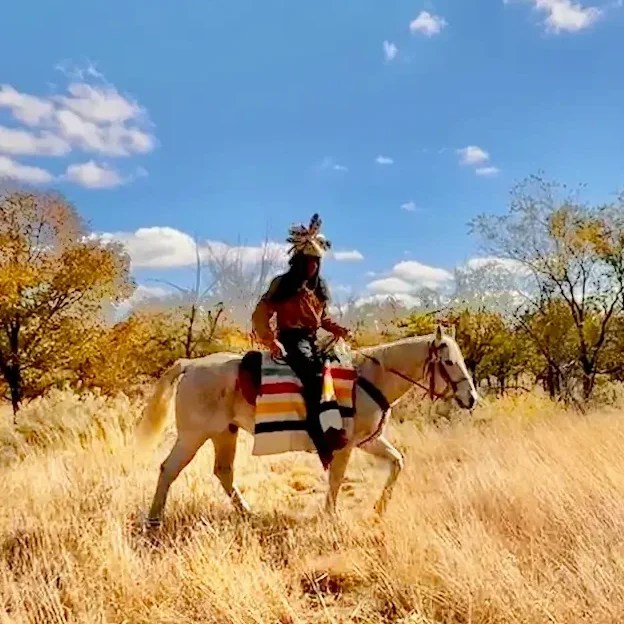
Tommy Cheis is a Chiricahua Apache writer, guide, and Cochise descendant who lives with his horses and writes from Nde benah (Chiricahua Apache land guaranteed by the Treaty of Santa Fe (1852) and currently occupied by the U.S. government. His short stories (will) appear in Yellow Medicine Review, Rome Review, After Dinner Conversation, Chicago Stories, Literary Times, Carpe Noctem, NonBinary Review, Ploughshares, ZiN Daily, Spirits, Red Paint Review, Pictura Journal, Blue Guitar, Florida Review, Exploding Head, Purple Ink, Pine Cone Review, Sufferer’s Digest, Unlikely Stories, Military Experience & the Arts, Medicine & Meaning, and other publications. His first novel, RARE EARTH, is in prepublication; his second, CHILD OF WATER, is on submission.
✶
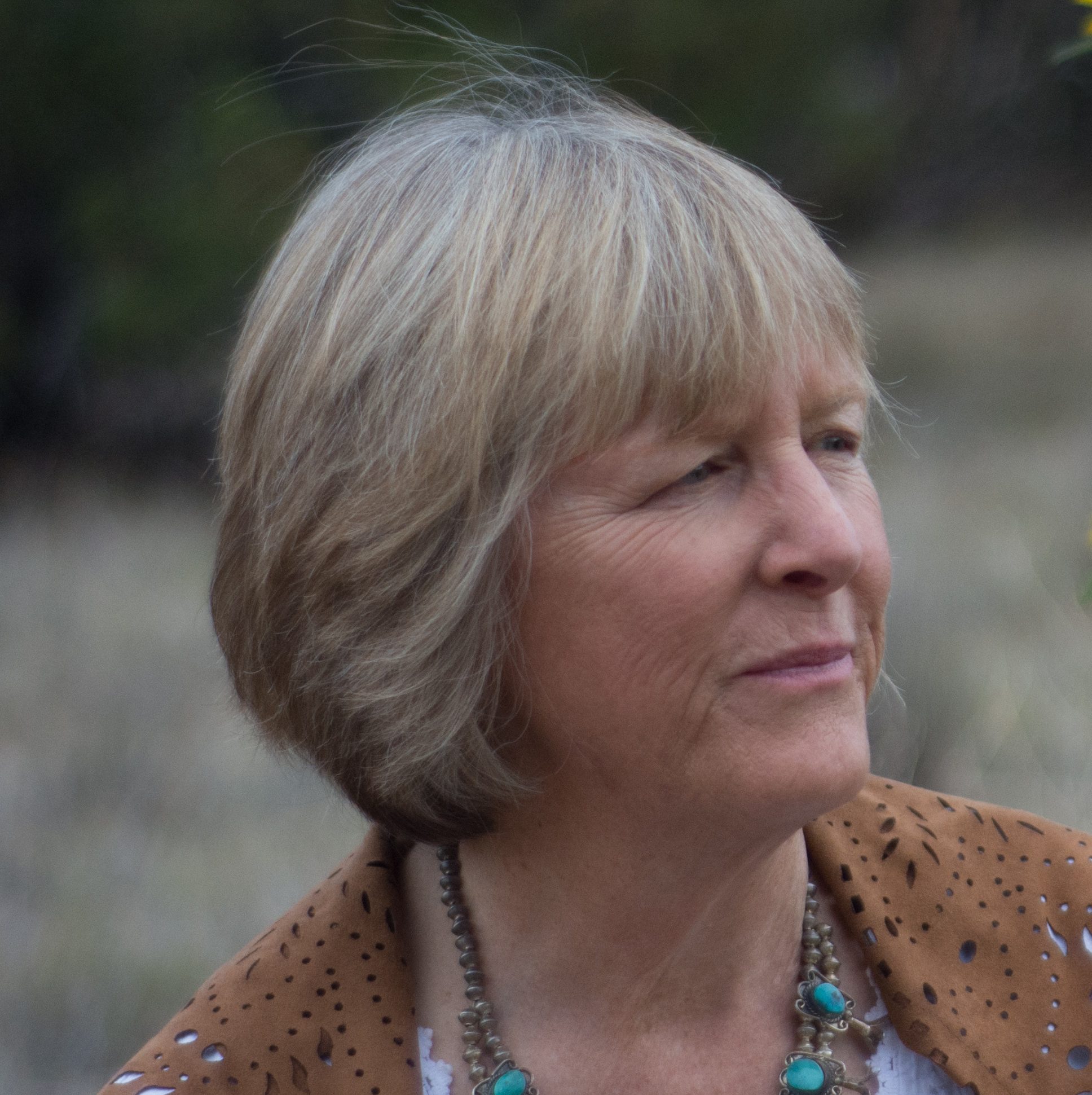
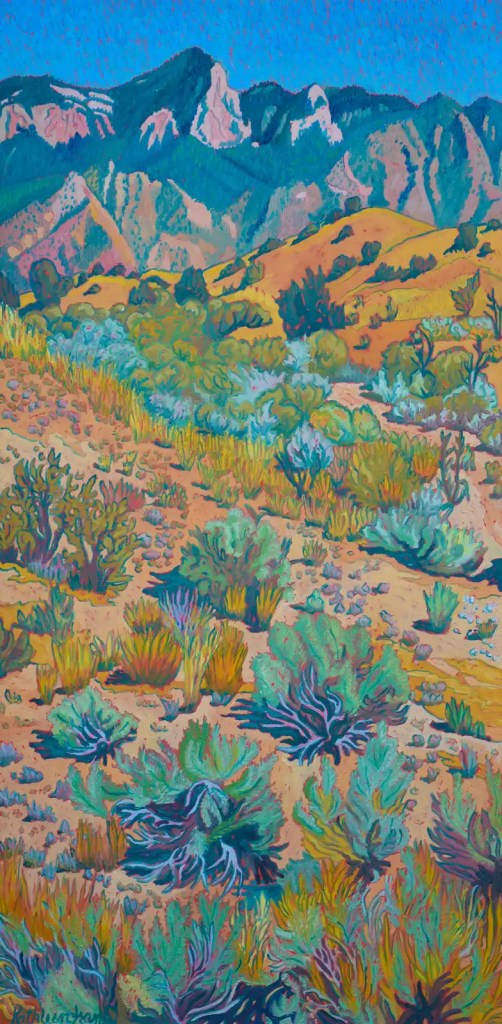
Santa Fe landscape artist Kathleen Frank, raised in Northern California, has a BA Design from San Jose State University, a Masters of Art from Penn State, and has studied woodcarving and printing. In Pennsylvania, she taught printmaking and costume design and co-founded the Printmakers Studio Workshop of Central Pennsylvania. Frank shifted to painting, seeking light and pattern in Pennsylvania farms, California scenery from mountains to sea, and now the unique landscapes of the Southwest. Publications include Southwest Art, Western Art Collector, and The Santa Fe Travel Insider, and exhibitions include Jane Hamilton Fine Art, Desert Caballeros Western Museum, and the Susquehanna Art Museum. Collections: Desert Caballeros Western Museum, Pattee and Paterno Library at Penn State.
 Another Chicago Magazine