
Back in junior high I opened a copy of Esquire and saw an article by Ray Bradbury, a writer I adored and who was, like me, a native of the frigid Great Lakes. He had decamped to Southern California to work on screenplays with John Huston. The title of the magazine piece was full of braggadocio: “Los Angeles is the Best Place in America.” I still believe that, even after what we have been through in the last ten days. But as Rod Serling would say at the beginning of a Twilight Zone episode, cigarette in hand, I offer the following for your consideration.
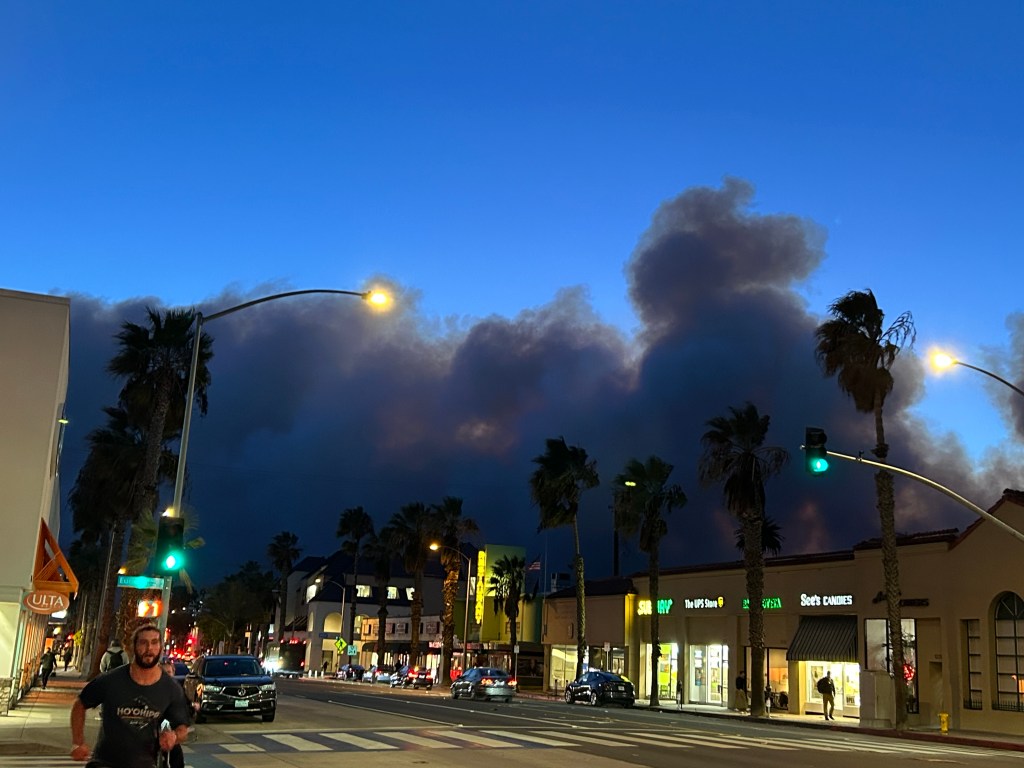
On Tuesday afternoon January 7, I saw the wind whipping up. The royal palms in downtown L.A., outside my law office on the 45th floor, were whipping around in a wind I had never seen before. On a normal day, the skyscrapers around us blunt the effect of wind around the parks and Central Library. But this was something so fierce that the palm trunks were bending at a wild thirty, thirty-five degrees—as if we were out in the open desert. So it would be another day of strong Santa Ana winds, something we had lived with since moving to Santa Monica Beach in 1999.
I happened, with no purpose, to look out a northwest conference room window and saw mild puffs of smoke to the west of the HOLLYWOOD sign, and thought nothing of it. Another grass fire back up over the ridge, in Pacific Palisades, Malibu, Castellammare. People who play the radio or televisions in their offices were suddenly speaking in low tones, slamming their doors. I knew it had been a dry autumn and that climate change was responsible for especially strong Santa Anas. But all of this combined into a suspicion of something wrong. I called my wife and asked her to take a picture of our house and neighborhood from her study across the street and text it to me. Nothing. Blue skies, a few clouds, but the palms still bending, this time lower, at an unreal forty-to-forty-five degrees. I texted her to take things in off our balcony.
An hour later, about 4:45, she sent, with no commentary, the same snap, but with an immense cloud of inky black smoke, the type you see in a petroleum explosion. But what was it doing taking up the whole sky, and why was it that it looked right there, our little Le Corbusier-style building seemingly besieged—or about to be—by a wave of solid smoke at least a hundred feet high?
It was 6:15. People were running to the elevators, pulling on their suit jackets. I ran down to my car and, following radio warnings, stayed off the 10 Freeway, the West Side’s critical conduit from the central city to the ocean towns.
She sent another snap. Inside the mountain of smoke were orange, flickering circles like tornado funnels. And they were bearing south at what was clearly a tremendous speed. This was the Palisades Fire, the worst urban firestorm in a century. It had grown that much in the space of two to three hours.
When I reached Santa Monica the winds were sci-fi, otherworldly, something I had never seen. Sometimes skiing at high elevation I’d seen winds bad enough to blow a friend completely over, landing him on his backside in gravel that then whipped up into our faces with a bullet-like force that blinded us when we tried to lift him. This was much, much worse—approaching a hurricane-force, eighty miles an hour, dust and uprooted bushes blocking tree signs. I crept forward, my two-ton SUV rocking so much that its tires lifted off the ground on each side as the wind swayed the car. The dust and smoke thickened to where I couldn’t see out the car windows. I drove, lost, circling my neighborhood at least ten times. I had to get home—the radio announcers’ voices were high-pitched, panicked, hysterically narrating the black and orange river of heat bearing down on them.
I got to the house. My wife and two daughters were stuffing their bags and watching the suddenly relevant, suddenly useful local news. Everything all at once had to be selected, prioritized: mementos; jewels and hand-painted and lacquered Hungarian boxes and other family heirlooms; photographs; antique maps whose mounting glass I smashed to take them out and roll up; medicines, medicines, medicines I cried out as the air outside turned brown, backlit by flashes of orange. The TV newscasters said we had time because the fire was turning more east than south. But we kept packing, making runs to the car. We grabbed armfuls of deeds, passports, medical records, and life insurance policies. These latter documents were my obsessive focus. My wife and daughters might die here with me, but my son in New York had to be taken care of.
The local news blathered on in the half-light of our living room. This was simply an impossible situation. No firefighting force anywhere in the West Basin could have stopped sheer magnitude of the fire walls. If they had doubled the fifty engines barreling up the Pacific Coast Highway, added crews (already dispatched to the other three mega-fires suddenly rearing up east of town), and even if water resources had behaved as they should, nothing could contain what was happening. Later at a press conference, Los Angeles County Fire Chief Anthony Marrone said the five fires were completely anomalous, like the strike of a limited nuclear device. “There’s nothing you can do to suppress a fire twice the width and twice the length of Manhattan.” Asked how he would advise preparing for a similar situation in the future, he was refreshingly blunt: “I don’t have the ability–the resources–to make this not happen again.” A military fire analyst from Point Mugu Air Force Base in Ventura (always a magnet for wildfires) said he’d witnessed nothing like what he was seeing from drone footage save for Saddam Hussein torching all the tank farms and refineries in his march of defeat out of Kuwait. The fire chief later shook his head on 60 Minutes: “Mother nature owned us Tuesday and Wednesday.”
Without an evacuation order, we never left the house. We couldn’t sleep. No evac order yet, but the Palisades neighborhood was already about sixty percent gone–house frames cratered with black and white ash, high chimneys of mansions still standing like tombstones–and the burning would continue all through the night and leave us a landscape, when looked at from the air, like those of Hamburg and Berlin in 1945.
This was not a ground fire. It was an aerial one that had never been seen when “anchor and flank” was invented. It did not spread on the ground. The three to five-thousand-degree heat of burning Palisades buildings and trees threw off embers—anywhere in size from a thimble to a softball—that hurtled at great speed over the heads of the crews. This is what allowed the Pali Fire to jump Santa Monica Canyon—a natural wedge-type break with streams and soil patches—and head toward the north sections of Santa Monica proper. This had not happened in almost exactly a hundred years. Joan Didion watched the Malibu-Trancas fire jump the Pacific Coast Highway into Zuma colony, the elegant compounds right on the Strand, the prize homes of Malibu. That “jump” phenomenon occurred ten thousandfold all last week. An enormous, vertical mountain of flames spit embers over the clusters of yellow raincoats and impotent hoses, igniting whatever combustible thing they landed on.
I have one, an ember wrapped in cellophane. I wonder if it did its trick in glowing until it landed, or whether it was a dud.
I thank God we did not have to evacuate in a vehicle, the kiss of death in a car town like ours. We didn’t evacuate, by foot or by car. Those who had time to get into vehicles stalled as flames hopped from car to car, incinerating those inside them much like the Paradise Fire did in 2018.
✶
By dawn on Wednesday, we still had no evac order. We only had a “warning.” The different gradations of evacuation could be dizzying, especially because the City and County are separate jurisdictions, with separate law enforcement grids that confusingly overlap. The false alerts have become things of mordant legend, little unfunny jokes peppering the catastrophe. The Palisades and West Brentwood are thick with celebrities. When the first false alert came mid-day Wednesday, I was standing in line with Harrison Ford (smart people stayed inside; we were the line) for a chicken basket at the nearly deserted Brentwood Country Mart. When the high warning whine went off we unholstered our devices like gunslingers squaring off at each other, reading the green text topped by an exclamation mark. I knew he detested Hollywood and the studio system and lived mainly in Montana. But the state of his face and clothes made clear he had lost a Brentwood house, probably seen in drone photos, and would not be able to reach it—if it stood—for days, and then only with a police escort. He was wearing a bird hunting jacket like the ones my father and I used to use, with abundant pockets to hold the game one had downed. The pockets were stuffed with things I couldn’t see. It was covered with soot and smeared ashes. The ashes fell for days like snow, in the same floating drift, the same size. We got our food and walked out in opposite directions.
While death is the leveler, the great equalizer, fire is not far behind. The Palisades is one of the priciest zip codes in the country. The other ruined area was of course Altadena, filled with whites, Hispanic and Black residents: old hippies and artists, people whose parents had dodged red-lining and bought bungalows there in the fifties, handing down the houses for two generations. The diversity of the place is a model of what a community should be. Its bohemian atmosphere is sprinkled with academics. On one street, my friend’s house was still standing. A burned house on the same street had belonged to quantum pioneer Erwin Schrödinger when he taught at nearby CalTech. But most residents earn a fraction of Palisades salaries. They will soon be caught in insurance legal disputes (I am an insurance coverage lawyer) that will fill the courts— and my firm with work that will last the rest of our lives.
Homeowners’ purchases teeter on the balance between fire/disaster coverage and banking. If you don’t have Harrison Ford’s bank account, you of course take out a mortgage. The lender will only loan if the dwelling’s value is collateralized with insurance. Though insurers will honor their commitments and rebuild, the properties will still be at the insurers’ mercy. They can yank coverage immediately under fire exclusions, meaning the bank can then call in your loan, moving under their deeds of trust to outright foreclosure. But even before that cycle begins, it is questionable whether public and private insurers will have enough in their reserves to even begin payouts. What is called a FAIR plan is in place for people—rich and poor—who live where disaster exposure is highest and for whom private insurers will not write at all. The FAIR plan fund—taxpayer money and always in peril—will now begin to deplete exponentially. (L.A., with its mudslides, earthquakes, sinking dwellings, and fires, is the poster child of disaster exposures.) FAIR currently has reserves of between 700 and 800 million dollars. The claims for the Palisades alone are expected to begin at about $1.5 billion. The strong but futile argument is that these are places where people simply should not live. It was brilliantly presented in Marxist historian Mike Davis’s article “The Case For Letting Malibu Burn.” In Davis’s 1999 book Ecology of Fear: Los Angeles and the Imagination of Disaster, he warns that disastrous mega-fires are not only common now, but are part of the area’s ecology going back centuries. And spending millions saving homes in areas never meant for neighborhoods and power lines is a waste of public resources.
Most of us believe that. But we do with fires what we do with earthquakes. We compartmentalize. It is the strangest mixture of bravery and folly I have ever known, and I embody it. After four decades here that dice roll is constantly on my mind, imprinted on my neurons. But like Elizabeth Bishop’s beloved Santarém, “I like the place; I like the idea of the place.” If this is the last place I live it has always been, like Bradbury said, the best one. Where else does the terrain remain resplendent as on these bluffs, where America’s Manifest Destiny plunges itself into the western ocean? Our lives—mine and my neighbors’—are vines creeping along an unstable wall. But we cling. If this is a draught of doom, make mine a double.
✶
The air was thick with soot and ashes for days. The ashes and odors made the whole city of Santa Monica smell like fire, which unnerved us because we were next in line to evacuate. Coupled with false evac orders, the smell added to everyone’s anxiety.
Old Midwestern Calvinist that I am, I went to work every day. No mask because I was driving to downtown Los Angeles, away from the fires, mainly contained in the ocean town.
We are all safe. Winds are expected next week. We cling.
✶✶✶✶

Richard Wirick is the author of four books: One Hundred Siberian Postcards (2006), an adoption memoir, followed by the story collection Kicking In (2010), and the novel The Devil’s Water (2013). An essay collection, Hat of Candles, was published in 2020. A new story collection, Fables of Rescue, was published in 2024. He writes for a wide variety of US and UK periodicals, and practices law in Los Angeles, where he lives with his family.
✶
Whenever possible, we link book titles to Bookshop, an independent bookselling site. As a Bookshop affiliate, Another Chicago Magazine earns a small percentage from qualifying purchases.
 Another Chicago Magazine