
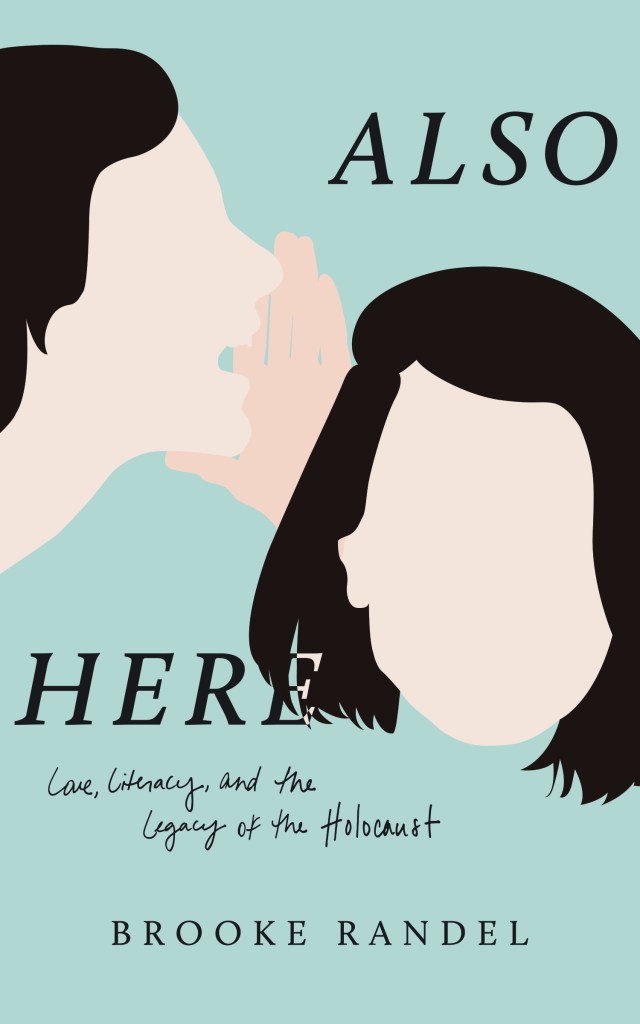
Also Here: Tortoise Books, 218 pp, 2024.
I had fifteen minutes. I slipped out of my work clothes and into a t-shirt and tights. I was meeting friends at the climbing gym and did not want to miss my train. In the kitchen, I filled a pot with water, opened a pack of ravioli, and called my grandma.
“I have an umbrella for you,” she said once I told her who it was, though I don’t think that mattered.
“I don’t need an umbrella,” I said.
“What?”
I shouted into my phone. “I’m good. I don’t need an umbrella!”
Golda Indig, or Bubbie as I call her, was in her mid-eighties and living on her own in a condo in south Florida. I was a few years out of college and sharing an apartment with my best friend in Philadelphia. Bubbie and I hadn’t lived in the same state since I was three, so I was used to calling her on the phone every other week. Despite my post-work rush, I knew I had plenty of time—our phone calls rarely lasted more than four minutes and often less than two.
“You should write about my life,” she said. “What happened in the war.”
I was thrown by this transition, made so swiftly it was almost as if the topics were related. Free umbrella, life story. I didn’t know what she was talking about.
“Um. OK, Bubbie. Maybe.”
As I got the stovetop going, our conversation fell into its usual patter. She asked me how my brother Scott was doing and I told her: he’s good. I asked her about the weather down in Florida and she told me: it’s hot. We talked because we liked hearing one another’s voice, not because we ever had much to say. After a minute or two, we both said goodbye and I love you and kissed our phones.
By the time my food was ready, I wasn’t thinking about Bubbie’s suggestion for me to write her story. I had other things on my mind, namely my latest climbing injury, a torn tendon in my left ring finger. Any traces of our conversation—her life, the umbrella, my brother—dissipated as I finished eating dinner, taped up my finger and booked it for the train.
A week or two later, I called Bubbie again, this time as I was leaving work. I worked for a small ad agency as a copywriter. It was my job to turn convoluted matters into simple, clever lines, campaigns with legs. I wrote billboards and banner ads, radio spots, TV scripts, everything short and snappy. I liked the rhythm of the work, the ease and clarity it required.
“How are you doing, Bubbie? How’s your knee?” I asked outside the office.
“I can’t walk on it for very long,” she said. “No balance. I can’t believe it.”
“Aw, I’m sorry. I hope it feels better.”
“Are you home?” she asked.
“Almost,” I told her, though I was on my way to a restaurant to meet my roommate and some friends. Despite living more than a thousand miles away from me, she didn’t like when I wasn’t home. Something to worry about, I supposed, but really I didn’t understand why she asked, why it mattered at all. We both had cell phones. We could talk anywhere.
“You should write about me,” she said next. “You know, a young girl in the camps.”
“I should?” I had forgotten that she’d mentioned this over our last phone call. The way she’d said it, it seemed like a passing thought and for me, it passed right through.
“How she survived. You could sell it.”
“Yeah, uh, I’ll think about it.”
Bubbie and I never talked about the Holocaust, but now it was popping up on every other phone call. She wasn’t pushy, stating the idea lightly, a casual suggestion, as if it had just come to her. I was caught off guard every time. She was usually so breezy when it came to the past. Were I to ask her for someone’s name in an old photograph, she’d say, “Oh, they’re dead,” as if the person’s mortality canceled out my interest. She cared much more about what was ahead—the next meal, the next holiday, the next time I was coming to visit her in Florida. She wanted to know how I was doing, how work was going, if I was staying warm. Nothing deep or involved or intense. And nothing about writing or war.
For decades, Bubbie avoided mentioning the war. Her close friends were refugees and survivors, already well acquainted with tragedy. They all had their own stories of loss and suffering, and no one wanted another. If the topic did come up, if someone asked her about where she was or what happened there, she chose a few select words, shook her head, and left it at that. With her children, she shared even less. She wanted them to set their sights forward, to look straight ahead. She decided early on that they’d lead very different lives from her. Better ones, with more safety and opportunity. The past would be irrelevant for them and maybe, possibly, the same might become true for her too. Silence, she figured, could function like a coat, like an extra large sweater, protection from the wind and cold.
Now she was inviting me to open that up, pull it apart stitch by stitch. I wasn’t sure why. Would this be a destructive act? Or could it be helpful? The more I thought about what she was asking me to do, the more I felt the weight of her request. We’d be doing something no one in our family had ever done, unraveling the silence that surrounded us. The thought made me uneasy. There were countless ways to tell a story wrong, to mishandle a memory. Especially when the memory wasn’t yours.
My own memories were uncomplicated. I could picture the swimming pool at Bubbie’s old house in Michigan, the water pale and glassy blue, sun-speckled and shining, a diving board and slide off the far end. As a kid, I loved this pool. Scott jumped in the water straight away, but I always lowered myself in an inch at a time, grimacing and tiptoeing until the water felt just right. Once acclimated, I got back out and filled Bubbie’s plastic watering can with a hose. My arm shook from its weight as I climbed the ladder rungs to the top of the slide. This was the height of childhood. I poured the water down and, taking a gulp of air, followed it myself, no longer timid or nervous or cold, no longer anything but free. I loved how my hair went flying, how my body spun around the curve of the slide and into the arms of the deep end. Bubbie watched from the side of the pool as she watered her plants, or from the kitchen, where she prepared our next meal. She was always cooking and baking. We visited every few months, making the five-hour drive between Chicago and Detroit. During Passover, Scott and I snooped through her couch cushions and fabric scraps to find the afikoman. For Hanukkah, we sat with our cousins in a messy circle, opening presents with zeal. We got an inflatable raft one year and blew it up in the middle of Bubbie’s living room, unable to wait for pool weather. I carried no sense of the dangers she faced as a child, the genocide she survived. Our lived experiences had so little overlap, they felt like parallel lines.
For months, Bubbie kept suggesting I write about her life. She wanted me to tell her story. I wasn’t sure why or why now, but I knew why she wasn’t going to do it herself. She couldn’t read.
As someone who struggled with literacy, Bubbie was used to advocating for herself, making her voice known. It was a matter of necessity for her, the way in which she operated. She had to verbalize what she wanted to have any chance of getting it. And so she kept calling me, month after month, kept saying I should write her story.
The call that finally convinced me came in the middle of a weekday. I was re-writing ad copy at my desk when she called, a deadline staring me in the face. No one ever called me during work and I hesitated to answer. I was busy. But there was a part of me that wondered if it might be something important, something urgent. I decided to pick up, figuring the call wouldn’t take too long, whatever it might be about. Our calls never did.
“Hello?” I answered.
“Wrong number,” she said, hanging up with a click.
I burst into laughter, tears rolling down my cheeks. I was right, the call hadn’t taken long at all.
Bubbie, I would later learn, had meant to call my brother Scott, and upon hearing the sound of my voice, knew I was not him. Had she been able to read her address book, she would have known who she was calling, but she couldn’t and she didn’t. So, click. Done. Call over.
Bubbie had no way to tell her own story. Like other Holocaust survivors, she struggled to find the right words, to express the full scope of what she’d endured during the war. But unlike most survivors, she also struggled with everyday matters, mundane tasks like dialing the right grandchild. She could speak six languages—English, German, Hebrew, Hungarian, Romanian and Yiddish (or Jewish, as she called it)—but not read or write in any of them. Her ability to communicate was constantly being capped, in every encounter with a new person, every entrance to a new place. For her, writing her own story was not an option. If she wanted to be heard, she had to come up with something else. Something that might work differently, that might be more accommodating. It would be necessary to invent a new language.
Which was what she was trying to do. She was reaching out to me, her youngest child’s youngest child, the one who liked to write, who called without having anything to say. She had played with me as a kid, watched me grow. She sent homemade pastries in the mail when we weren’t together and showed me how to knead and roll the dough when we were. In junior high, as the ends of my favorite plaid pajama pants got ratty, she hemmed them into shorts for me. I wore those yellow-and-blue shorts everywhere. In my high school years, she sat on the sidelines of my varsity lacrosse games when she came in town to visit, supporting me despite not knowing a single rule to that sport or any other. I could never explain the details of my life to her, the activities and ambitions that filled my time. She was there anyway, watching from the edge, offering her support. Now she was asking me, in her own way, to do the same. All I had to do was show up.
✶✶✶✶

Brooke Randel is a writer, editor and associate creative director in Chicago. She is the author of Also Here: Love, Literacy, and the Legacy of the Holocaust. Her writing has been published in Hippocampus, Hypertext Magazine, Jewish Fiction, SmokeLong Quarterly, and elsewhere. The granddaughter of a Holocaust survivor, she writes on issues of memory, trauma, family and history.
✶
Whenever possible, we link book titles to Bookshop, an independent bookselling site. As a Bookshop affiliate, Another Chicago Magazine earns a small percentage from qualifying purchases.
 Another Chicago Magazine