
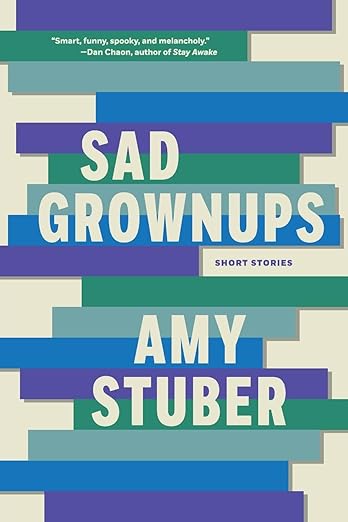
Stillhouse Press, 2024, 232pp.
To say that the often experimental stories in Amy Stuber’s Sad Grownups are clever, funny, and intelligently designed is accurate, but experimentation can give way to gimmickry, wittiness to cattiness, and none of that happens here. Some of the forms are original—as with “Day Hike,” where half of the story follows the titular hikers and the other half details workshopping conversations between the writer of the story and her overly-critical writer frenemy. The experimentation is more conceptual in “Cinema,” where two of the characters are ghostly manifestations of the main character’s dead children, at ages they never reached, randomly chatting with their mother. No matter how unexpected the form, though, something genuine and precise anchors us back into an emotional truth. Even while we’re laughing out loud.
Title stories often showcase qualities that characterize an entire collection, and “Sad Grownups” fulfills this expectation. The story opens with sharp, witty lines: “Childhood geniuses level out. They become sad grownups.” Simple sentences, but the assertion is bold and odd, as with many similarly sharp lines throughout the collection. Here, the lines hook us right away into following Mac and Odon, best buds from fifth grade and now post-high-school burnouts, as they throw their abandoned, restless genius toward a wild plot to rob the bagel shop where Odon’s crush Wendy works. It’s a half-baked idea that involves Gandhi and Mother Teresa masks and a convoluted Robin Hood strategy for giving the stolen cash to Wendy later to help support her family. Similar what-could-go-right plot energy infuses many of these stories, and it’s both a pleasure and a tiny terror to watch them unfold.
“Sad Grownups” displays another feature that shows up across these stories, a classic Edward-P.-Jonesian tactic where the narrator offers alternate endings, as here, where we learn how the failed robbery might have gone: “In a better version of this story, Odon would chase Mac out, and Wendy would be cheering for him. Or he’d get into a math-off with a still-masked Mac, and he’d out-math him, and then Mac would run out unharmed, and Odon and Wendy would split a sesame bagel and laugh together about the charming oddity of the whole thing.” Instead, Mac gets shot by a vigilante bagel shop patron and “spends three weeks in the hospital. Odon gets one text from Mac’s number that says, ‘It’s best for you not to visit’…. and amazingly after all their years, that is that.” Because the scenario of the imagined ending is as compelling and concrete as the real one, this alternate-future strategy clinches the reader’s sympathies without losing our trust.
Another recurring fourth-wall defying maneuver involves commentary on the story being inserted into the action, like in the diptych of “Day Hike,” with one half of the story devoted to the hike referenced in the title and the other half, delivered parenthetically, concerned with the discourse between the writer of the story and her slightly sanctimonious writer friend. In the day hike half, a lesbian couple, contemplating having children, intentionally misleads a family of fellow hikers about how far they are from the lake they’re searching for. Meanwhile, the writer friend with “a book deal[, b]etter hair and clothes” than those of the writer of the story is utterly comfortable tearing the story apart. Her interjected critiques often come across as smug, but, once we’re out of the parentheses and back on the trail, the hikers’ story gains nuance per every suggestion she shares. These playful experiments multiply what’s possible, so we find that a story can be two things at once.
Characters in the collection sometimes find ways to be two things at once, too. In “Dead Animals,” Frida trots through life as one version of herself and through the online dating world as another. Her alternate identities collide when banter with a man she’s texting through a dating site grows increasingly violent and threatens to impinge on her real world. Another version of character duality shows up in “Camp Heather.” Middle-aged Heather, aimlessly grieving her sister’s recent loss to suicide, takes a job at a religious-themed outdoor program for delinquent teen boys, even though she “always thought god was a cruel trick” and doubts the camp will change the boys in any lasting way. Toward the end of the first session, in a moment of unexpected connection with her charges, “She sees all the Heathers, then, the people she could have been but wasn’t…The mother Heather cutting apple slices in the kitchen when the sky is still dark. The wife Heather asking her husband something boring about school forms. The sister Heather who shows up at the right time on the right day to keep the bad thing from happening.” This profusion of potential selves, mixed with the complex guilt of grieving her sister’s death, point to the real Heather’s need to belong somewhere, splitting the story open and shifting how we interpret her ambivalence.
“Doctor Visit” pulls from the same bag of tricks, and it’s possibly the funniest story of the lot. The main character, another middle-aged woman, recounts a host of medical appointments. Each is somehow related to aging, and every paragraph after the nature of an appointment is explained begins this way: “I should mention that we are fucking, the [ophthalmologist/dermatologist/radiologist] and me.” Two other strands braid into this one, both with their own repeated elements. The second begins, “This is something I think about,” and topics include “mattering,” “upkeep,” and “the way joy is temporal.” The third references a tragedy that killed the narrator’s father’s entire extended family. Throughout, the father’s family car remains basically the same, “one of those long, low cars of the 1960s, the kind that look slightly flattened by some kind of giant junkyard compactor,” but the circumstances of the fatal tragedy vary from car crash to house fire to rogue wave. The specificity of details, like “my dad’s sister’s toddler climbing over them every now and then to press a cheek against the car’s back windows,” earns emotional traction, even while the repetitions call attention to the artifice of the form.
These stories play tricks on us. They subvert our expectations of what stories can do and how they should do it. And, time and again, they ground us in our humanity.
✶✶✶✶
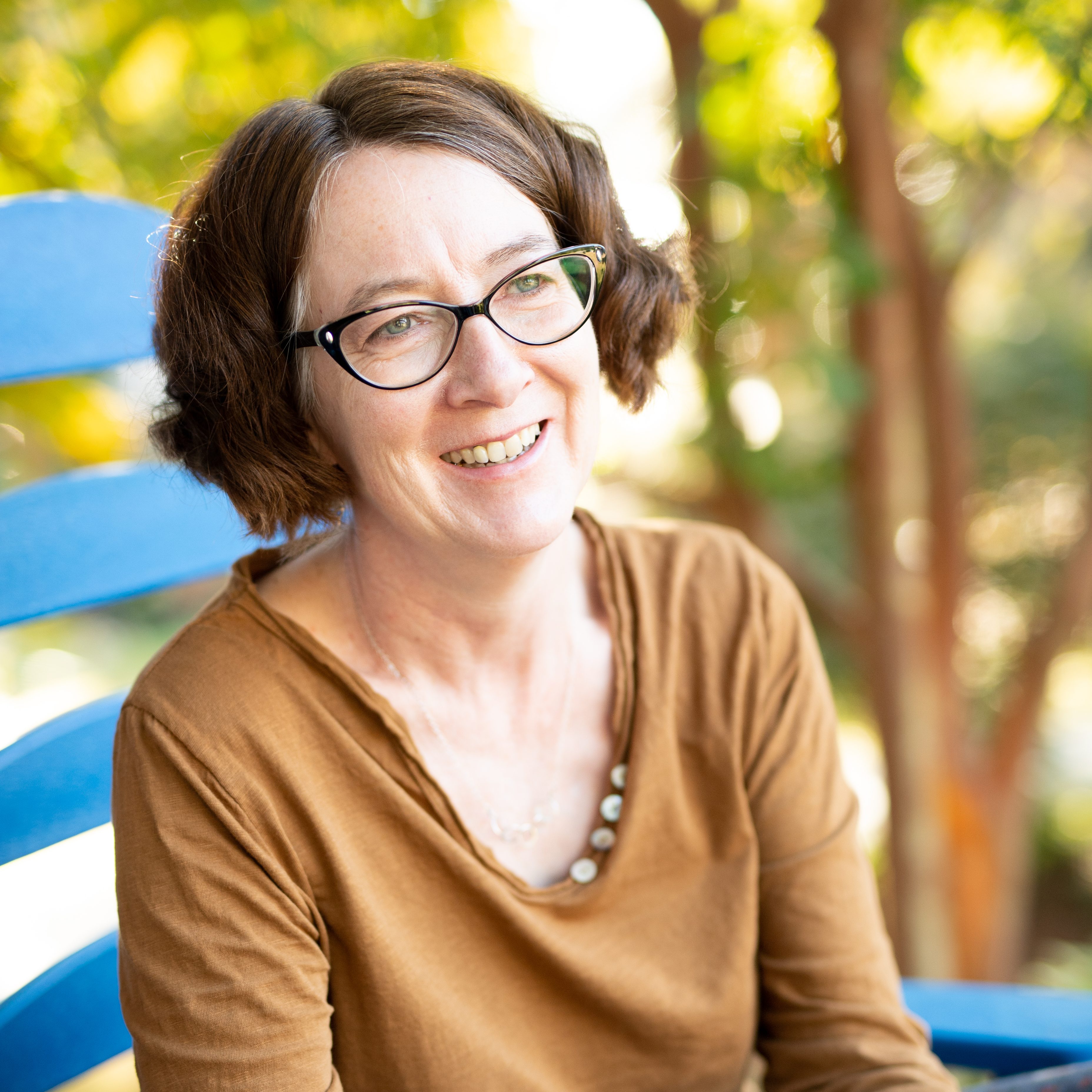
Jody Hobbs Hesler is the author of the novel, Without You Here (Flexible Press, September 2024), and the story collection What Makes You Think You’re Supposed to Feel Better (Cornerstone Press, October 2023). Her words also appear in Necessary Fiction, Gargoyle, Valparaiso Fiction Review, Atticus Review, Writer’s Digest, Electric Literature, CRAFT, Arts & Letters, and many other journals. She teaches at WriterHouse in Charlottesville and for The Writer’s Room out of Chicago, writes and copy edits for Charlottesville Family Magazine, and serves as assistant fiction editor for the Los Angeles Review.
✶
Whenever possible, we link book titles to Bookshop, an independent bookselling site. As a Bookshop affiliate, Another Chicago Magazine earns a small percentage from qualifying purchases.
 Another Chicago Magazine