
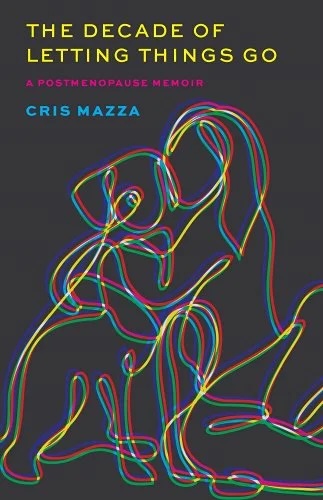
“The Decade of Letting Go,” University of Georgia Press, 2024.
Cris Mazza’s choice of a title for her latest collection of essays – her seventeenth book — is a perfect snare for readers of, not to mention past, a certain age. Her epigraph by Leslie Bennetts wastes no time on indirection: “There are few things this country is less interested in than aging women.” Mazza takes off from there with ferocity, casting off myths about sexuality, about family, about the empty promises that come with publication. She has no difficulty allowing herself to be vulnerable, sometimes painfully so. In a no-more-masks mood, she throws out some interesting challenges to conventional thinking along the way.
What are the things Mazza wants to – needs to – let go of? They aren’t what Marie Kondo suggests we jettison, the clothes we haven’t worn for years, the redundant kitchenware, the clutter of useless objects. Rather, she has lost parents; has had to say goodbye to her favorite dog, Tommy; and she watches an old mentor decline into dementia. She has left one marriage and leaves a bit of ambiguity about the current state of her second marriage, a fascinating saga of a lifetime of longing by Mark, a fellow divorcee, who lost her as a teenager but who stayed so devoted that he reappeared decades later to “win” her and become her second husband.
What preoccupies, even defines, Mazza is her lifelong grappling with her dysfunctional sex life. She is unashamedly anorgasmic, unable to reach orgasm, but also subject to pain during intercourse and – cause or effect? – a self-diagnosis that blames an early confrontation with some (admittedly mild) porn and a few other all-too-common situations that made her profoundly fearful of physical intimacy.
This complicated repulsion to physical intimacy leads her to outrage with which many readers will identify, yet she refuses to accept the ways in which women write about their easy habit of reaching vaginal climax which she thinks is falsely celebratory; she accuses boys and men with sexual selfishness and asks why, then, “women…still write the male-centric view of sex,” which she calls “a teen-age boy’s fantasy” of the ecstasy all their penis-thrusting is responsible for. They, boys and men, are guilty but we are presumably complicit: “I want every woman who wrote [about easy and thrilling sex] to sit in a therapy group with me and honestly describe her own sexual experience so that I can gauge their fictional renditions.” Mazza’s anger is well-placed and her bitter wit will account for a lot of “You go, girl!” nodding, but the particulars of her grimly sexless situation seem to me to lead her to generalize about other women’s experiences with a slightly overplayed fervor.
One of Mazza’s most painful chapters, “Neighborhood,” the longest in the book, is a rather harrowing narrative in which the author is forced to interact with her next-door neighbor, a black man who is pretty clearly bi-polar. Their interaction is fraught: she can’t tell which of his moods he will present, a friendly, neighborly generosity or a dangerous, threatening fury accompanied, at times, with weapons. How much, she wonders, does race play a part in the drama. This is the incomplete story of a man whose inconsistently repressed anger makes him terrifying, but what, if anything, are we, at this distance, to make of its ambiguities? For all its moment-to-moment suspense, the story, unresolved, never rises above the anecdotal.
Her gathering-up of so many tightly-woven and loose ends is almost always inviting, though there were times when I felt that she was revisiting old situations that we’re arriving at a little too late. Her inorgasmia was the subject of a series of filmed interviews that made her see herself as the author “who was relating experiences and past anxieties that I have already written, sometimes in more than one genre, and rewritten, and proofread, and edited, then read at readings.” Having published more than one memoir, the author admits “she has already mastered the material.” And her frequent admissions that she fears she is not liked, not chosen, not appreciated quite frankly made me, a stranger, wish that I didn’t have to observe her self-lacerations.
But Cris Mazza’s ruminations, on full display, are provocative and frequently resonant of the shared problems we women must reckon with. She challenges us to refuse to be victims, she confides a hundred petty aversions it’s satisfying to recognize – when, for example, did “home” replace the less cozy “house”? Why is the word “feral” defined in part by “tending to be interested in environmental issues and having a rugged, unkempt appearance”? Each of us could surely compile our own list of tiny pleasures and losses suggested by this rich compendium of dilemmas intimate and public, large and small.
✶✶✶✶

Rosellen Brown has published eleven books, six of them novels, most recently The Lake on Fire, three collections of poetry and Street Games, stories. She received a Lifetime Achievement Award from the Chicago Literary Hall of Fame in 2016. She has just retired after 27 years on the faculty of the School of the Art Institute.
✶
 Another Chicago Magazine