
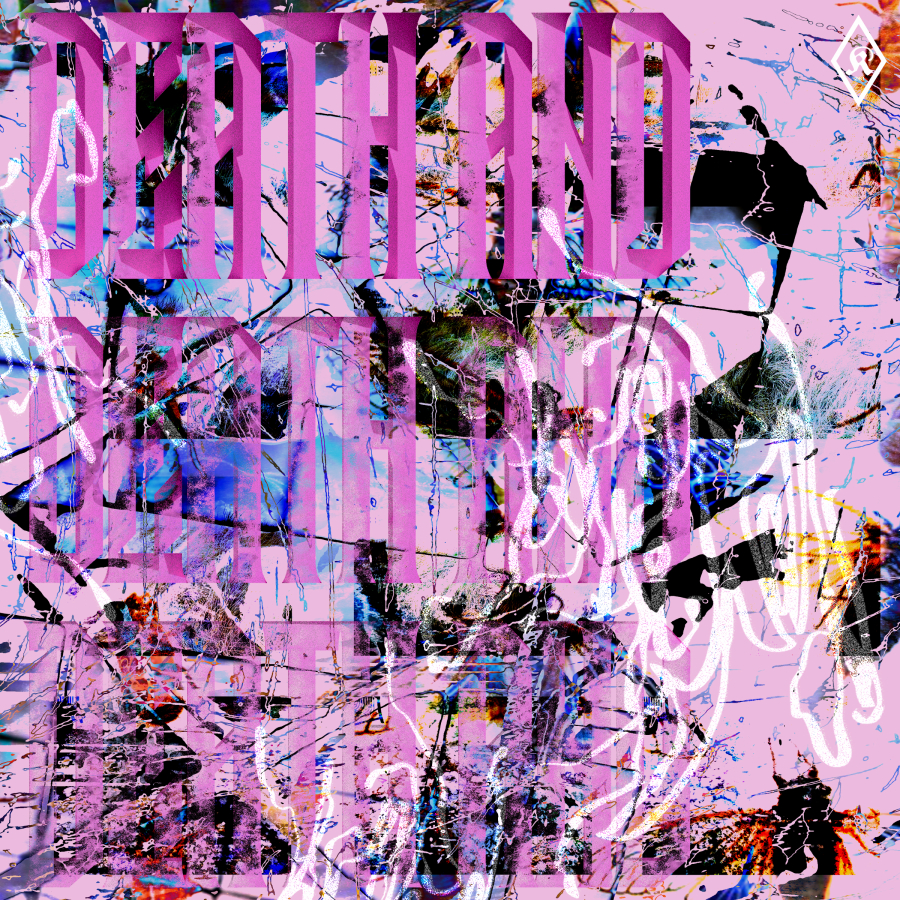
“Death and” from Inside the Castle Books, 2023.
For a decade, independent Kansas-based publisher Inside the Castle has been putting out experimental writing in their recognizable style at the intersection of concrete poetry, the aesthetics of heavy metal, magic and occultism, book arts, noise, and thematic/genre transgression. Over about sixty books, they have cultivated a dense and detailed style of experimentalism that is worth the attention of anyone interested in the “expanded field” of poetry and fiction.
In recent years, and for aesthetic and historical reasons I’d argue are not surprising, Inside the Castle’s most fitting and propulsive publications have been coming from its trans authors. Never Angeline Nørth’s epic Sea-Witch (2020), Ava Hofmann’s Love Poems / Smallness Studies (2022), and Ulrich Jesse K Baer’s Return to the Planet of the Vampires (forthcoming 2025), among others, draw out the most productive and difficult aspects of the press’s maximalist and infinitely hybridized aesthetic. Here, I’ll zoom in on one recent title from Inside the Castle’s trans authors: Death and (2023), the debut book of Chicago-based poet Yarrow Yes Woods.
Death and by Yarrow Yes Woods—“by” perhaps obscuring the book’s true title—is essentially two long poems: the first is the primary text of the book, set in free and loosely formed lines flowing across the pages in standard black print; the second sits just behind the primary text in often unreadable blocks of pink text, whose words are frequently cut off by the edges of the page. The book superimposes these two long poems, clashing and often difficult to fully parse.
The typical reading of a page of Death and includes reading its primary text inflected by a select few readable words of the secondary text. But at times, the primary text opens or dissolves enough to reveal much more of the secondary; at other times, the secondary switches places with the primary, superimposing its pink over the primary’s black. The push-pull of these two texts is as dynamic as it is frustrating, as intimate as it is alienating. Attention to the secondary text is essential, however, as, in a reversal of its formal readability, the secondary text is often more transparent and explicit about the context in which Death and was written, while the primary is covered in rowdy symbolism. Take for example a moment in which the primary text retreats into just a few short lines—“In the street / Baby cries / The MUSE OF HISTORY squints”—revealing the secondary text’s narration of the COVID years, the mpox pandemic, and the political nightmare of both—“i am gay and caught the new disease because the [lowercase D] death cult has failed to worship Death properly…”
Death and is ultimately an epic fable about the relationship between its autobiographical speaker and the figure of Death as the speaker navigates plague, loss, precarious labor (sexual, manual, gig economy), and trans experience. Its abstract, mobile, and noisy style as it relates to these subjects speaks to the fallout of semiotic coherence in the interlocking crises of the twenty-first-century American social ecosystem. The core tension and productiveness of the book are the very multivalent meanings of the figure of Death throughout; Death arrives multiply, as a name for several friends and loved ones, as a name for intimate losses like the suicide of a father, as a figuration of the speaker’s compulsive suicidal ideation, and as a framework for understanding transness.
The line quoted above makes clear that Death is not equivalent to “[lowercase D] death,” which figures more literally as the effect of capitalist exploitation of a multiply laboring, sick, othered class of people. Capital D Death, on the other hand, is the speaker’s negative, their shadow; Death follows the speaker like a witch’s familiar, equally comforting and haunting.
An early line in the book may give us another name for Death: “The First / Negation was of self / & plum tree.” If Death is a symbol of “self-negation,” then it could be read as a name for the productivity of transness, the intimacy of throwing oneself into the love and care of another, the alienation of labor, or the coercive misrecognitions of social life. In Death’s tense ambiguity, it names both a method for surviving death and the emotional strain of being forced to survive it. The image of the “plum tree,” negated too in this line, is not the only time the book implies that self-negation leads to alienation from one’s world.
The intimacy of the poet’s relationship to Death is both the way the speaker proceeds through “death” and death’s most pernicious side effect. Death is the way to stay in the world and the way to distance oneself from it.
In a prose piece that ends the book, which mixes an account of housekeeping labor with metacommentary on the writing of Death and, Woods writes:
“Death and is a struggle to work with. It requires confronting two coping mechanisms that i’ve realized have stopped serving me to the extent that i would like: 1. (intrusive) suicidal ideation 2. Unhealthy attachment to/idealization of a loved one….i often replaced one obsession with the other—that i might switch from plotting, witnessing, and reliving my own death to instead imagining every moment a loved one was living.”
This is enormously helpful for understanding the dynamics at play throughout Death and. But we may go a step further to say that the author writes these two coping mechanisms as forms of each other. By figuring suicidal ideation as a loved one (the “Death” of the book that accompanies the speaker throughout), Woods writes her suicidal ideation as, counterintuitively, an intimate survival method—it imagines her relationship to herself as a relationship to another. As she remarks, though, this process doesn’t feel good; Death and knows that this central symbolic operation is a rather poisonous one to both a durable sense of self and a healthy relationship to others. But it also proposes, in large part because of its formal cacophonies, that this is a coerced position for the working-class trans woman living in the “[lowercase D] death cult” of twenty-first-century America.
The formal structure of Death and—its visually and auditorily cacophonous pages, split into two competing and complementary texts—makes this thematic dynamic shine even more. The psychological, affective, and sociopolitical tensions of the work are clear in the book’s aesthetic maximalism. Woods (as evidenced by earlier projects like her chapbook The Dick the Bitch and the Baby) is an astutely polyvocal writer, progressively finding not “her voice” but the sharpest constellation of “her voices.” In this, she has clearly learned much from both the L=A=N=G=U=A=G=E poets, whose names dot the Notes section of the book, and her contemporaries in trans poetry. Under the auspices of Inside the Castle, Death and joins a cohort of similarly stylistically attuned experimental trans writers and an editorial/design team able to bring their visions to life. They are all worth reading and watching.
✶✶✶✶

Gabriel Ojeda-Sagué is a poet and writer living in Chicago. He is most recently the author of Losing Miami (The Accomplices, 2019) and Madness (Nightboat Books, 2022), which was a finalist for the Publishing Triangle’s Thom Gunn Award in Gay Poetry and the TS Eliot Foundation’s Four Quartets Prize. He is also co-editor of An Excess of Quiet: Selected Sketches by Gustavo Ojeda, 1979-1989. He is currently a Humanities Teaching Fellow at the University of Chicago.
✶
 Another Chicago Magazine