
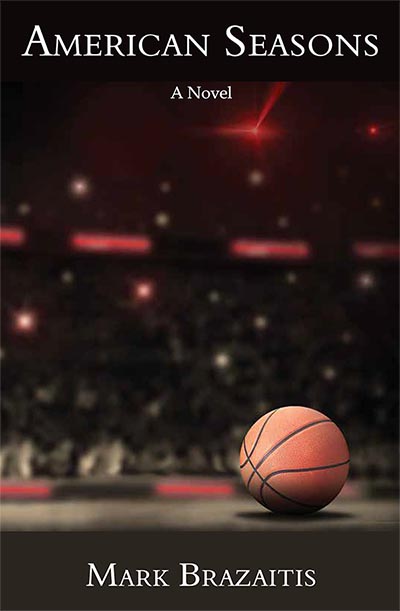
Forthcoming from Main Street Rag, August 2024.
I met Walter Anderson, the new coach of the Sheridan College men’s basketball team, in late August of 1961, in his office in what everyone referred to as the Hollow, otherwise known as the Aaron K. Lamb Gymnasium. The Hollow was at the bottom of two large hills, thus its nickname. If Anderson had been coaching today, his office would be on par, in size and accommodations, with the college president’s. But in 1961, basketball coaches had yet to become gods. His office was only a little larger than a janitor’s closet.
His desk was in the center of the room. Behind it were two circular windows, as on a submarine, offering a view of outdoor basketball courts. To my left was a four-foot-tall bookshelf. From my chair in front of his desk, I glanced at the titles. There were sports books: Basketball: Its Origins and Development by James Naismith, the game’s founder, and a couple of Clair Bee’s Chip Hilton novels, Hoop Crazy and Backboard Fever. There were inspirational titles: Norman Vincent Peale’s The Power of Positive Thinking and Bishop Fulton J. Sheen’s Life is Worth Living. But I also discovered novels by Ernest Hemingway, Graham Greene, Ray Bradbury, and—a writer I’d never heard of—James Baldwin. Giovanni’s Room. I made a note to look up the book. I never did.
There was a pair of photographs on his desk, and when Coach Anderson, who’d been headed to the bathroom when I arrived, stepped into the office, I asked him if the woman in them was his daughter. The coach, who was only thirty eight years old (which nevertheless seemed ancient to me; I’d turned twenty-two the previous month), leaned back in his chair and laughed. He exposed his teeth, which were white and exceptionally wide, like prostheses one might buy at Halloween. His hair was strawberry-blond and thinning, exposing the pale heights of his forehead. Although he’d played college ball at Harvard, he was only a couple of inches taller than six feet and was as slim as a ghost.
“She’s my wife,” he said.
I apologized.
He waved it off. “Am I lucky?” he said. “Like a rabbit in a field of four-leaf clovers.” He spoke as if trying to convince me. I didn’t need convincing. The woman in the photographs was stunning, with blonde hair to her shoulders and the kind of lithe body I would later associate with aerobics instructors. She looked like Grace Kelly in the Alfred Hitchcock movies I liked best. Lucky? Yes, I thought Coach Anderson was lucky.
“Aside from the model,” he said, “what do you think of the photographs?”
“Excuse me?”
“I’m the photographer.” From his desk drawer, he removed a camera. It looked like a black box, its lens like a television. “It’s a Hasselblad, the same equipment astronauts use to snap pictures of the stars.” He returned the camera to his desk. “I’m a passionate amateur. I even have a darkroom.”
As the sports editor of The Sentinel, Sheridan College’s newspaper, I was here to interview him. I’d assigned myself the men’s basketball beat. Sheridan College, one of the first Jesuit institutions of higher learning in the country to become co-ed, was known for its small student-to-faculty ratio, its film studies program (the second of its kind in the Midwest), and its debate team, which three years running had finished in the top four in the country. Its athletic teams, however, were abysmal. The men’s basketball team had never finished higher than fifth in the Mid-American Conference. But with a new coach—he’d been an assistant at Harvard and the head man at Guilford College in Greensboro, North Carolina, before he was hired at Sheridan—hopes were high.
I asked him if he thought the Sheridan Songbirds could do any better than they had since the team’s inception in the early 1920s.
He grinned his square-toothed grin. “No,” he said. “I don’t think we can.”
Dutifully, I wrote this down, but when I heard him laugh, I looked up. “Hold the presses,” he said. “I wouldn’t have taken this job if I didn’t think we could win.”
“But the team lost all five starters to graduation,” I reminded him.
“No disrespect to Coach Raymond”—Nick Raymond had retired at the end of the previous season after thirty years of undistinguished basketball—“but he rewarded seniority over talent. There are two players who sat on the bench last season when they should have been starting.”
I asked him who.
“Darrell Williams and Vince Urban,” Coach Anderson said of the team’s co-captains and only seniors. “If we do anything great this season, it will be because of Darrell Williams and Vince Urban.”
Sometimes I drove over to Sherman, a town thirty miles east of Sheridan and the home of Ohio Eastern University, which was anywhere from the second to the sixth largest university in the state, depending on who was doing the tabulating. Its sports teams, like its academics, were unmemorable. The town had a well-regarded daily newspaper, however, the Sherman Advocate and Post, which featured the work of a sports columnist named Martin Blake, known for his critical portraits of all subjects save thoroughbreds, whom he loved unconditionally. No human deserved iconic status in Mr. Blake’s view, not even Woody Hayes, Ohio State’s football coach, who’d led the Buckeyes to a national championship in 1957.
If Mr. Blake didn’t speak glowingly of athletes, he was even less impressed with sportswriters. He called them “cheerleaders who type.” He was, I sensed, an outcast. It probably explained why he courted my company.
Mr. Blake had straight, short, nickel-colored hair, a thick silver mustache, and large, sad, beagle-like eyes. He always smelled of cigarettes, but I never saw him smoke. He was in press boxes and pressrooms and bars—especially bars—so often their smells coated him. His job was his life—he wasn’t married—and when he wasn’t covering a game or chasing down an athlete or a coach to interview, he was talking about sports with whoever was in Don’s Underground, a Sherman bar opened (officially, anyway) the day Prohibition was repealed.
I met him there a few days after my interviews with Coach Anderson and his players. He ordered us a couple of beers at the bar, and we found a table off to the side. All four men at the next table were smoking cigarettes, and a draft carried the smoke to us. A jukebox in the far corner played Jack Scott’s “What in the World’s Come Over You.”
“I’m curious about your new coach,” Mr. Blake said. “I’m even more curious about his wife. Young and beautiful, right?”
I remembered her photographs. No—I’d never stopped thinking about them.
“Your new coach isn’t exactly Cary Grant with a whistle.”
“He isn’t ugly.”
“All right, but he’s plain and she’s a looker, am I right?”
“Yes, sir.”
“And he’s closer to my age than he is to hers.”
“I don’t know how old you are, Mr. Blake.”
“Thirty two,” he said and laughed. He was, I guessed, at least forty five. “I’m always curious about what brings a man and a woman together, especially if the explanation isn’t money or sex.” He held up his hand, as if I were about to object: “Coach Anderson isn’t a millionaire, and we’ve already acknowledged his homeliness.”
“What’s your theory?”
“I was hoping you had one.”
“He went to Harvard,” I said. “Maybe she admires his intelligence.”
“Maybe.”
“Maybe she admires his coaching.”
“Less likely.”
“Maybe she flat out loves him.”
“I’m suspicious of love, never having experienced it myself.”
Perhaps Walt and Helen Anderson had fallen in love at first sight, the way my parents had. As with the Andersons, there had been a substantial age difference between them. My father, twenty-two years my mother’s senior, had been married before, to a French waitress he’d met in Paris at the end of World War One, when he was nineteen. The marriage lasted only as long as the victory parades, and there were no children. Years later, after he’d become a lawyer, he was walking into the Cleveland Public Library when he collided with my mother, who was late to catch a bus. The eight books she held flew from her hands. By the time he’d helped her gather them, they were in love.
My father was a handsome man, with black hair and green-blue-gray eyes he bestowed on me. What he didn’t bestow on me was much of his presence. He worked twelve-hour days and died—of a heart attack—at his desk when I was five years old.
“Love,” Martin Blake said. “It must be nice.”
Although the first basketball practice of the season, held on an afternoon in mid-September, was closed to the press, Coach Anderson invited me. I sat at center court of the Hollow and watched Vince, Darrell, and their teammates do suicides. In the middle of the eighth suicide, the team’s junior center, Tadas Blinda, collapsed under the basket, his face Communist red. Tadas, who shared a first and last name with the “Robin Hood of Lithuania,” was seven feet tall if one included his hair, which was ample and blond and puffed up over his head like a rooster’s crown. Other players dropped until, twenty minutes into the drill, only Vince and Darrell remained. Darrell, however, was slowing with each stride, and by the time Coach Anderson blew his whistle, he was staggering like a drunk. Only Vince was unbowed, his hair so full of sweat it looked like he’d taken a shower.
“We’ll win basketball games two ways,” Coach Anderson said. “First, by being the smartest team. Second, by being the best-conditioned team. Better to be tired now than in the second half against Ohio State.”
For the next forty five minutes, the team worked on passing. Balls blazed back and forth. Bounce passes. Chest passes. Baseball passes. Behind-the-back passes (Vince’s, when his coach wasn’t looking).
Coach Anderson finished the practice with more suicide drills. By the end, even Vince, his hands on his knees, his chest heaving, looked like he might collapse.
“On Monday we begin running three days a week,” Coach Anderson said. “Meet here at 6:30 in the morning.” He looked over at me. “And if you want to do your job right, you’ll run with us.”
I waggled my pencil above my reporter’s notebook. “How long a run is it, Coach?” I asked.
“Three miles.”
I’d never run more than a mile in my life.
Everyone cleared the court except Vince, who shot foul shots. I walked down from the stands and caught the balls as they fell into the net. He shot for ten minutes, missing no more than half a dozen times. Done with foul shots, he moved around the court, shooting from the right corner, from the top of the key, from the left corner. “We’ll win games three ways,” he said. “Urban shoots, Urban shoots, Urban shoots.” He sunk a shot from near half-court. “See?”
There was applause from the north corner of the Hollow. Helen Anderson was on the oval walkway below the mezzanine level. In a white hat and a blue dress, she leaned over a rail like a first-class traveler on a cruise ship. She removed her hat, rearranged her blonde hair, and returned her hat to her head. In this simple gesture, there was something both graceful and erotic. If asked to describe her, nothing but the most hyperbolic adjectives would have left my mouth.
For another five minutes, Vince showed off for her, firing shots from impossible distances. I was jealous of his talent. I wished I could have countered it by presenting Helen with a poem I’d written, a play, the first chapter of American Seasons.
When, at last, Helen left with a “Goodbye, gentlemen” and a wave, I looked at Vince, who, gazing after her, dribbled the ball off his foot.
✶✶✶✶

Mark Brazaitis is the author of nine books, including “The River of Lost Voices: Stories from Guatemala,” winner of the 1998 Iowa Short Fiction Award, “The Incurables: Stories,” winner of the 2012 Richard Sullivan Prize and the 2013 Devil’s Kitchen Reading Award in Prose, and the novel “American Seasons.” His stories, essays, and poems have appeared in The Sun, Ploughshares, Michigan Quarterly Review, Witness, Guernica, Under the Sun, Beloit Fiction Journal, Poetry East, USA Today, and elsewhere. A former Peace Corps Volunteer and technical trainer, he is a professor of English at West Virginia University, where he directs the Creative Writing Program and the West Virginia Writers’ Workshop.
✶
 Another Chicago Magazine