
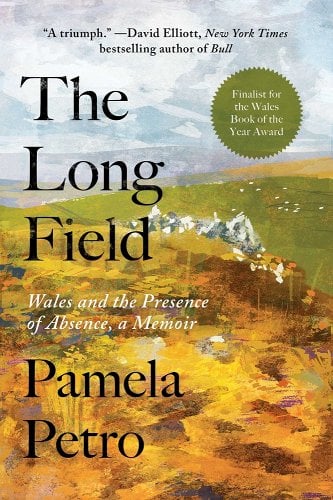
Arcade Publishing, 2023, 356 pp.
Pamela Petro wants us to love Wales. That is the simplest way to describe her rich, poignant, and brilliantly written memoir, The Long Field. As we learn in the preface, to love Wales is to understand “hiraeth”(HERE-eyeth), a Welsh word with no English equivalent that means, essentially, an unfulfillable yearning for a home and sense of belonging; it’s the “emotion of separation.” Hiraeth is painful. It’s inspiring and creative, despairing and hopeful. It’s so multi-layered and universal that to explore how this one word informs and powers the human experience requires an entire book.
The Long Field is written in two parts comprising ten chapters. In Part One, “Something Essentially Welsh,” Petro dives deep into the origins and continuing power of hiraeth in Welsh culture. She embeds her own passion for hiraeth within the history, mythology, and geology of Wales and recounts how she fell in love with both Wales and hiraeth as a young graduate student in Lampeter. “Hiraeth, above all,” she writes, “speaks to the acute presence of absence.”
Think Arthur, the once and future—but never present—King of the Britons. Imagine the longing for a benevolent utopia that once was, may be again, but never is, like a lifelong yearning for the return of a messiah. Imagine Petro in Wales, lying in the shadow of Pentre Ifan, a 5,000-year-old megalith of “six vertical standing stones and a massive horizontal capstone,” where time seems to slow and melt around her—she says the torpor makes her “viscous”—allowing her memories to link in a nonlinear way. She reflects on how her countless visits to Pentre Ifan over three decades, beginning in her twenties, melt together in her mind:
In Wales I live lots of different lives side-by-side, by category. When I’m at Pentre Ifan, one visit hitches to the next in my memory, and it seems like I don’t age in between. Different seasons, skies, haircuts, lovers—they press hard against each other in the Pentre Ifan file, seep together, merge. My own sedimentary layers. My bedrock.
Time and age lose meaning in the one place Petro feels grounded, in which she rests within the long field of hiraeth, “the uncomfortable place where absence stokes the creative imagination; the place where hope is born.”
What’s most striking about Petro’s prose is how elegantly she weaves intensely personal stories into a foundation of historical and literary research. For example, to contemplate hiraethis to explore her relationship with her parents: “It never occurred to me that by growing up and moving away, I had become an absent presence” to them, she writes. Within the context of her aging mother’s dementia, she yearns for the intelligent, loving woman who was “the high school valedictorian, the great reader,” who now forgets her husband’s name—an illustration of the long field between the person her mother was and the person she is, with foreshadowing of the person she will no longer be at all.
Petro wonders, too, about the distance between the father she knew—the man who loved rocks, who “cut and polished them,” fashioning them into cabochons and decorative “snuff bottles,” who shared his love of nature with his daughter—and the man inside her father whom she could never know: a former World War II officer whose ship hit a mine and sunk just before D-Day, killing many of the crew. When awarded the Purple Heart, he turned it down, feeling it would dishonor the dead to accept it, and he rarely spoke about his wartime experiences. This too is hiraeth, a long field of unknowability that inevitably separates children from their parents.
Perhaps most arresting is Petro’s reckoning with the loss of the person she was before a horrific 1987 train accident in which 18 people died. Still in her twenties, hospitalized and bedridden with severe head trauma, Petro spent weeks immersed in reveries of the lush Welsh landscape she’d left two years before, a present unreality that made bearable the transition from pre- to post-accident Pam. This dreamlike state was its own long field of loss and hiraeth:
What I felt as I lay in the hospital was a kind of loping, feral memory of beauty that sniffed around for my wounds and then bit me where I already hurt. And the sharpness of its teeth felt good—concentrated my mind—through a sea of pain.
In Part Two, “An Enduring Human Feeling,” Petro explores hiraeth not only as a Welsh sensibility, but as a unifying human experience. “Hiraeth doesn’t make me Welsh,” Petro writes. “It makes me human. I’d suggest that all the words describing deeply felt absences are more similar than they are distinct. I love Wales, but it’s hiraeth’s leap to the universal, its translatableness, that’s more important than my unique experience.”
By sharing her personal stories, Petro shows us how to travel our own long field between who we were before—before the divorce, the accident, the grief, whatever profound losses shape us—and who we became after, who we are always becoming. And, crucially, it connects us to our empathy for those whose hiraeth has been inflicted on them: refugees forced to flee a home they love for one that may not want them; members of the LGBTQIA+ community who yearn to be fully and publicly themselves in places that often seek to erase them; those who grow up within the history of colonization who long for a home they know only through stories passed down through generations, Wales among them.
Perhaps the best word to help us describe the experience of hiraeth is one created by Robert A. Heinlein in his novel Stranger in a Strange Land. Perhaps hiraeth is something we “grok,” something so utterly understood that “you merge with it and it merges with you.” Hiraeth can dissipate our ego just enough to reveal our innate connection with all that was, is, or will be. Petro’s desire is nothing less than to “live every day as a breathing fossil, with an intimate awareness of deep time—of all the people and creatures who had lived in this place before me, and all those who would come after.”
Imagine that world. Imagine the long field of hiraeth between where we are now and a world where we love life that much. It’s okay, Petro believes, that this world feels unattainable because home can be the unattainability itself. “That’s where I belong,” she declares, inviting us to imagine home not as a literal place but as an internal long field of yearning, hope, and creativity. Home is a quest to bridge this distance, a never-ending voyage available to all human explorers. And that is exactly the point.
✶✶✶✶

Amy Grier is a freelance writer and editor who earned an MFA in Creative Nonfiction at Lesley University. A singer and classically trained pianist, she has taught music and English in the United States and Japan. Amy has an MA in East Asian Studies from Washington University in St. Louis and an MA in Literature and Writing from Rivier University. Her work has appeared in The Hooghly Review, Solstice, Poetry East, the Brevity Blog, Eratio Postmodern Poetry Journal, Streetlight Magazine, and others. Her memoir-in-progress, Terrible Daughter, is about the events leading to her estrangement from her parents. She lives in Florida with her dog and piano.
✶
Whenever possible, we link book titles to Bookshop, an independent bookselling site. As a Bookshop affiliate, Another Chicago Magazine earns a small percentage from qualifying purchases.
 Another Chicago Magazine