
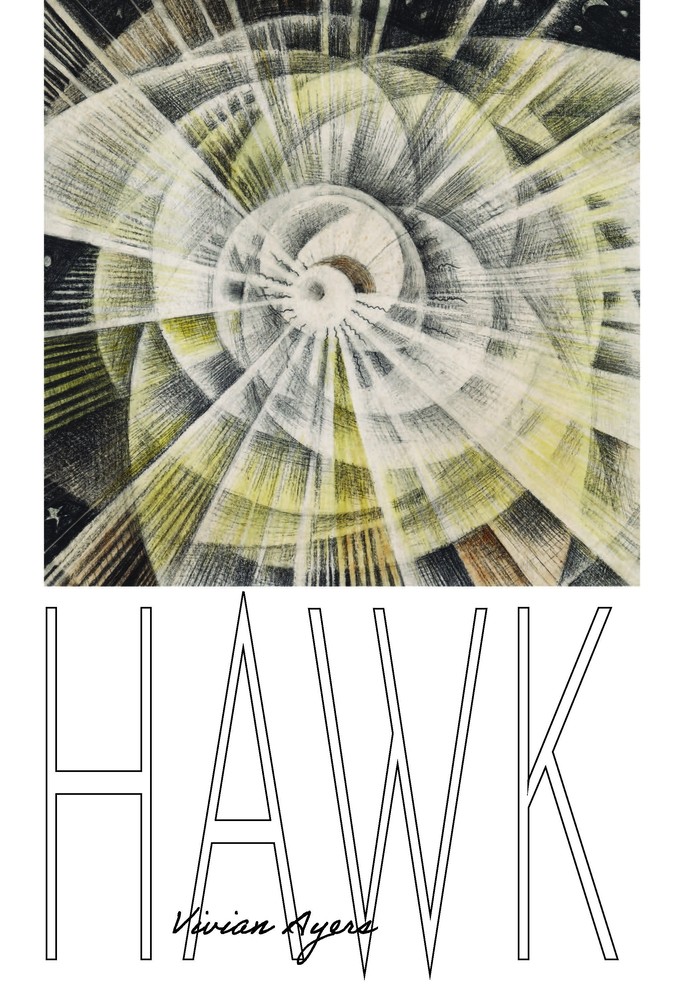
Clemson University Press, October 2023, 80 pp.
Hawk is an allegorical narrative book-length poem of personal struggle, fulfillment and responsibility set in the wilderness of space, written four years before human beings traveled beyond Earth’s atmosphere. An energetic work that moves with jazz-like syncopation, it was originally published in 1957 in a hand-lettered edition, distributed with its pages collated but held loose inside a cover like a folio folder. Ayers published it herself.
Now, it has been reissued by Clemson University Press in two editions: a hardcover facsimile and a paperback in which the Kalem font has been used to suggest the original hand-printing, both regular and boldface. Both editions feature the five exuberant illustrations by artist John Biggers from the original publication.
Ayers’s poetry is predominately in the form of prose paragraphs, although phrases and sections in lines also appear, often as songs. Other elements of sound and sight are the frequent boldface to add emphasis, like a melody raised an octave, as well as Ayers’s frequent use of dashes and ellipses. The effect is hypnotic, incantatory, akin to reading one of William Blake’s prophesies or a page from Revelations. The reader can’t be sure how all the ideas fit together, but they are expressed with great verve and commitment.
The poem opens in the year 2052, as Hawk, “operating from the level of Cestral mind,” is making a visit to Saturn for some wine-drinking with Gator, also called Red Eyes. “Cestral” is an example of several neologisms that Ayers weaves into her poem; it means something like “celestial.” Ayers, it seems, doesn’t use “celestial” for two reasons: first, to put her own stamp on the alternative existence that she is envisioning, and second, to give an echo of everyday conversational language with its frequent truncations.
In the sometimes obscure universe in which the poem takes place, Hawk, having been appointed “Guard of Sleep,” has stopped at Saturn while “enroute to Mars on an Hierarchical mission,” having to do with sobering up a reckless Martian. Hawk now is something of a divine messenger. The Divinity? Well, that’s an It: “It will pamper him,” Hawk tells Gator. “It hath much patience with the carnit mind.” (“Carnit” equals “incarnate.”)
In return for the wine from Gator, Hawk tells a story of having been “a Man on Earth.” This is important, because the reader’s tendency is to want to identify Hawk, the speaker of the poem, with Ayers—a tendency that is reinforced by one of Biggers’ illustrations which shows Hawk with breasts. (Biggers saw Hawk as Ayers, according to the poet’s daughter, actor Phylicia Rashad.) By writing that Hawk had been “a Man on Earth,” Ayers is asserting that hers is a poem that addresses the situation of all humanity—indeed, the meaning of life. This was an era when the word “man” was still used to refer to all people, as in “mankind.”
Hawk is an everyman, a representative of everyone human. And—like Christian in John Bunyan’s moral allegory A Pilgrim’s Progress, like Dante in The Divine Comedy—Hawk is on a journey to the Godhead. Unlike Christian and Dante, however, Hawk holds no truck with institutional faith, saying, “Christianity / is still / the dull / and pretentious lady— / Til now, I am not impressed with the aim of priests and Clergy, whose aim is—at best—a seething thing.”
As a Man on Earth, Hawk finds much to reject in the way people live their lives: “The unsane so far outnumbered the sane that even Tolerance got over on their side. Even Tolerance. Sane ones, not being able to take it, quibbled off their quids, were locked up, labeled insane and given treatment…the unsane working on the insane—umph! The most amusing were the ‘authorities.’ Little folks compelling little folks to revere their squalid opinions, find reward in their paltry emanations, and even fear them.”
Finally, this Man on Earth has a solution: “a bird life apprenticeship!” So, climbing an elm, Hawk perches on a limb most of the day, going down before sunrise to scratch for worms. This seems ridiculous to other characters in the poem, both people and birds alike. But on the forty-ninth day: “[O]n waking further and glancing down, I could see that my feet had webbed…my toes were webbed…prim and clinching!…And I raised my arms to make an expression of thanks…but there were no arms! High on the thorax there were little white wings!”
Now, Hawk hopped from branch to branch, whistling happy tunes: “I could fly. I was free! Earth would be lost moss off a cannon ball—” And Hawk thought: “Thank god…thank god…there is a sky…”
In the process of Hawk becoming a hawk, a man walks by, looks up into the tree, and yells, “What you need is to go get your-self a job…” Later, while moving through deep space, Hawk’s memory of this admonition comes back and is at first amusing, then infuriating: “…the nerve of that character, and his lunch-bucket morality…to say anything!…” Then suddenly, far out in space, Hawk is no longer able to fly. With such snobbishness toward the earthbound, Hawk knows that a line has been crossed: “All right. You win. If I have to love those bastards, I’ll love them. I’ll be as excellent as I have to be. I’m not going back.”
Hawk does not want to fall back to Earth—Hawk wants to get to the center of everything, out in deep space. But, after getting there by the end of the poem, Hawk does voluntarily, purposefully, decide to go back, specifically to help “those bastards.” And when this decision is made, Hawk’s ability to fly is restored.
Loving “those bastards” is an echo of the message of Christianity, but in Hawk, Ayers is in no way toeing an organized-religion line. Indeed, in incantatory but also colloquial language, she has created a vivid, multi-tiered spiritual universe of her own invention and chutzpah.
Throughout the journey, there is a rhythm and cadence to Hawk’s rising flight, even when progress halts or seems to fade. And, finally, Hawk does come face to face with God, “and the man within me died, faintly gasping, ‘…my god, this is God…’” But unlike The Divine Comedy and Pilgrim’s Progress, Hawk’s journey doesn’t end there; unlike Dante and Christian, Hawk, feeling “a growing compassion for Man,” decides to go back to Earth. “I propped my wings like oars and backed out of the area as fast as I could. I had to get back!…I would show mankind the way.”
It is a difficult return, a difficult “regression.” Hawk tells Gator that few believed the story of flying in space, and Hawk was met “with much disregard, neglect and abuse, and disbelief, and it’s painful. / If he’s not very careful he gets more hard knocks than anybody…because the least he can accept is the most Earth offers…goodness, beauty, truth—and dignity—”
✶✶✶
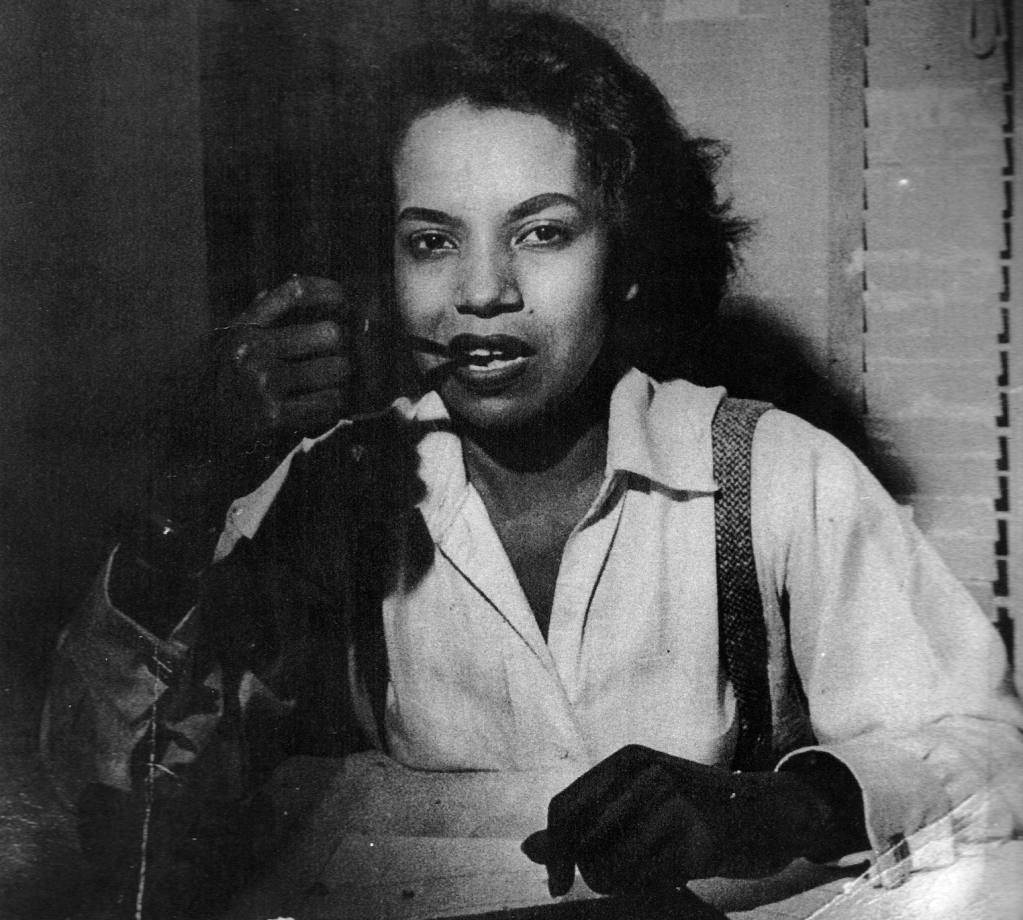
Image courtesy of Phylicia Rashad
The black-and-white photo on the back cover of Hawk shows Vivian Ayers as a young African American woman in her early thirties, sporting a long-stem pipe in her teeth and wearing suspenders over a light-colored shirt. This was not how most mothers of three dressed in America in 1957.
“That was a purposeful statement,” her daughter Phylicia Rashad recalled in a recent Zoom interview.
Ayers, who that year had also published a book-length poem echoing the ecstatic experiences of the saints, gazes just a bit to the left of the camera with thoughtful, self-possessed eyes. The image captures her mother’s free spirit, Rashad said: “My father was a dentist. You understand the societal structure and how a dentist’s wife is to present herself, all of which she did very well because she grew up in the South and she knew what to do. It’s fine. But now she was onto something else. The ladies, they had their little club, and what Mommy wanted to do is have what people have now, book clubs. She wanted to introduce poetry and literature and read it and talk about it and share ideas. But she said they wanted to sit around and talk about their hysterectomies. And she couldn’t do it! She had to leave.”
Born in Chester, South Carolina, in 1923, Ayers lived in Washington, D.C., married Arthur Allen in New York City, and moved to Houston, where she gave birth to her three children, all of whom found careers in the arts. Rashad, among many credits, is best known for her role as Clair Huxtable on The Cosby Show. Her younger sister, Debbie Allen, is an actress, dancer, choreographer, singer, and director who starred on the television series Fame. Their older brother, Andrew “Tex” Allen Jr., is a jazz trumpet player.
After Ayers and her husband divorced in 1954, she spent the rest of her life promoting and creating cultural programing, Rashad said. For a time, she organized events at the Lyndon B. Johnson Space Center, as well as in and around Houston. In 1971, she began publishing a literary magazine, The Adept Quarterly, and borrowed that name for her Adept American Folk Gallery, where, according to the New York Times, “Black cowboys, black artists, and figures from Texas history—including black astronauts of NASA—mingled.” Later, she reestablished the gallery in Mount Vernon, New York.
Rashad was eight years old when her mother published Hawk, and she helped make it happen. “I remember collating pages into the night. The way the pages were, they were not bound … The pages were loose, but they were organized. I remember we were there for hours doing it, and I remember the sun coming up. We were having fun, though. We turned it into a little game and a party.”
Ayers had published a more traditional poetry collection, Spice of Dawns, with Exposition Press in 1953. Later, she wrote a play, Bow Boly, that was, Rashad said, “about an angel who comes to earth with an intention, with a cause, with a mission, but gets entangled in it, engrossed in it. We performed excerpts of it at Texas Southern University—I was thirteen years old—in 1961.”
Ayers had read Dante’s Divine Comedy and Virgil’s Aeneid before writing Hawk, but only later did she study William Blake in a deep way. “She was of that ilk,” Rashad said. “She wasn’t copying them. She liked them because they resonated with her and her own thinking.”
As an eight-year-old, Rashad didn’t read Hawk. “But I understood it through the artwork,” she said, “and through understanding my mother, too. I would not understand the profundity of it, I would not understand the uniqueness of it for a little while.”
Now, as an adult, she said, “I marvel at it. I marvel at the cadence. I marvel at the imagery. I understand what she is saying when she’s talking about flying above gales of wind and what the focus has to be. She’s talking about many things, and one of the things is the art of writing and giving oneself to that discipline where perfection is being asked of you. But it applies to everything that human beings do—whether it’s teaching, whether it’s writing, whether it’s research, whether it’s childcare, whether it’s community planning, community action or involvement, seeking that level of perfection and surrendering to love, unconditional love.”
Ayers, who turns 101 in July 2024, once recounted to her daughter a moment in the writing of Hawk. “When she is describing what she sees, she saw that. It’s inner experience,” Rashad said. “She told me that she was hanging Debbie’s diapers on the line when the sky—it was as if the sky opened and she could see. She dropped everything and ran into the kitchen, where her typewriter was, to write it as she had experienced it.”
Like the central character in Hawk, Ayers carved her own path through life, and it was a journey, Rashad said, that began when she was a young girl and her mother died of tuberculosis. “As she sat in her mother’s funeral—this is what she told me—and listened to the things the adults were saying, because you know how people can carry on at a funeral, she decided that there were none of them intelligent enough to tell her anything. She was not going to let them tell her what to do.
“She’s nine years old. She decided they would never be able to tell her what to do. She would direct her own course. Nine years old, imagine.”
And it was a spirit that Ayers passed on to her children. “It’s caused some hiccups and some problems,” Rashad acknowledged, “but, oh, the joy of it all.”
Whenever possible, we link book titles to Bookshop, an independent bookselling site. As a Bookshop affiliate, Another Chicago Magazine earns a small percentage from qualifying purchases.
✶✶✶✶

Patrick T. Reardon, who worked for 32 years as a Chicago Tribune reporter, is a three-time Pushcart Prize nominee. He has published 14 books, including six poetry collections: Requiem for David, Darkness on the Face of the Deep, The Lost Tribes, Let the Baby Sleep, Salt of the Earth: Doubts and Faith, and Puddin’: The Autobiography of a Baby, A Memoir in Prose Poems. Reardon’s poetry has appeared in America, Rhino, After Hours, Autumn Sky, Burningword Literary Journal, Poetry East, The Galway Review, Under a Warm Green Linden and other journals.
 Another Chicago Magazine