
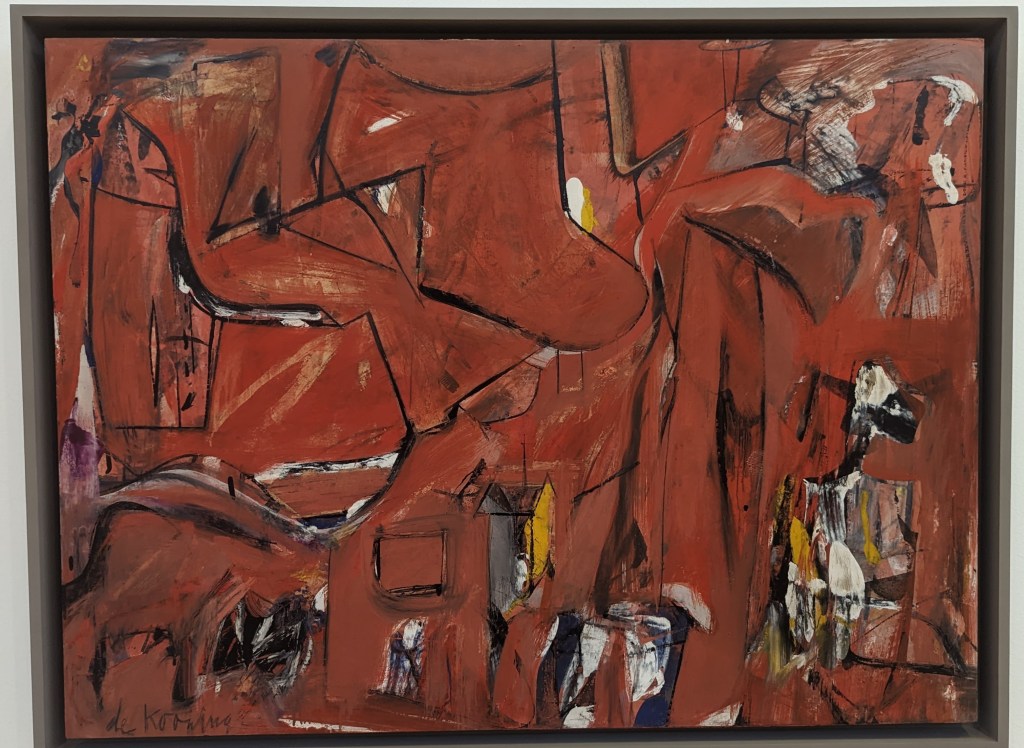
“And then there was Mom’s de Kooning,” we like to recall, our pride as bright as the colors on that enormous canvas. She had an amazing eye, a quickness of response like an electric flash, a sure disdain for the nicely acceptable. Colors that didn’t “go,” shapes that didn’t “fit,” textures that scratched at your mind—here was my mother in her aesthetic element. The de Kooning, as I remember, loomed above a narrow, tightly coiled iron staircase in a former warehouse somewhere in the lower depths of Manhattan (later to be called Tribeca, or maybe Soho). In twisting fits and starts the traffic moved up these stairs, but suddenly stopped dead when my mother halted on her narrow rung to gaze, and then nod at the canvas, as though they were old friends with a deep secret. I was one rung ahead, and sensing I don’t know what, I turned and had a revelation of my own: I’d never before seen my mother’s upturned face from above, and it came as a mild shock. From where I stood, she was “shorter” than me, and looked like a satisfied smart-alecky kid, top of the class smarter than the teacher smart-alecky-kid destined for a great but lonely future, unexpectedly coming face-to-face with a soul mate. It was a moment that couldn’t last—there was jostling from below, a New York hurry to get to the top—and yet the moment, at least in our family, burns on.
My father harks back to “one of my great mistakes,” because they didn’t buy the de Kooning, whose asking price was ten thousand dollars. I don’t know if they could have bought the piece (I think maybe so), but I tend to think the price tag might have been more like a found object, a ready-made excuse for not living with all that rash, brash abstraction, which had stopped him in his tracks as well. The irony is that, under my mother’s tutelage, my father came to love abstract art even more than she did; over the years, her tastes would circle back to the figurative, to more appeasing harmonics of color, tone, and form. She would collect antique quilts and Navajo kachinas, old ceramic pitchers and bowls, glass syrupers, grinders of coffee, seeds and spices, and other objects made for warmth, love, nourishment, or, as in the instance of the Navajo dolls, occult menace.
That whole day of Mom’s de Kooning was like a day out of time. When finally I got to the top of those curling stairs, I felt like I was in a ship bobbing gently in the dock. The floor slightly rose and dipped, the boards were rough and wide, separated by long, cruddy gaps, like leaking black water. When I squatted down to touch what I imagined would feel wet, I found they were gummy, dusty, and darkened the tips of my fingers. Normally soiling my hands—and consequently my white sweater—would have caused me some panic, but that day I took the dirt as a badge, a passport. I set off into the vast room, letting myself be brushed by the trailing scarves of women with scarlet hair, black lipstick or white, and mouths that moved a mile a minute, around voices that were husky and low. My mother too had sailed off alone, and for a terrible moment, I feared that she’d vanished into the crowd. But there she was, in front of another huge canvas, holding my sister by one hand, and my father by the other, aiming his fingers at the spots she wanted him to look at. I was more excited by the totality of the pieces than by any one painting or sculpture, and was drawn like a magnet to the gigantic windows. This, I remember saying to myself, this, as I looked out into the city, on a level with the gigantic wooden barrels that crowned the rooftops, with the narrow snatches of bright blue sky, looked down on the cobbled street, the cop clopping along on a big brown horse with a long black tail, and the small crowd that grew wondrously smaller as people went in through the warehouse door I couldn’t, from my vantage, see, and then larger as others—women with close-cropped crow-black hair, men who wore overalls, baggy shirts, and paisley scarves—strolled up behind them. This, I kept saying to myself, This… not a subject without a predicate, but a subject with a predicate too big, too exciting for words. Here, I remember thinking, is where I belong.
Suddenly I was aware of my father at my side. “Time for lunch, we need to put more money in the basket.” Hand-in-hand, my mother and sister were snaking toward us through the crowd. We walked back to the little parking lot on Mulberry Street where one of the men playing cards called up to a certain window, from which a white-haired lady lowered a basket into which my father tossed some dollar bills, then waved, as my mother released some words of Italian that floated upward like a pretty balloon. We ate lunch in a booth at Marconi’s (which no longer exists), where they brought us huge steaming platters of spaghetti and meatballs, mussels in red sauce, artichokes stuffed to overflowing with seasoned breadcrumbs, escarole and beans. No matter how much we ate and ate from these magic platters, they seemed always full.
From Marconi’s we made our way through Little Italy to Washington Square. What I vividly remember about that walk (indeed about the whole day) is that my sister and I had been told by my mother to wear our summer sandals, even though it was October, and crisp. The day before, she’d gone out and come home with bulky white sweaters so on this special afternoon we wouldn’t need jackets. We’d never before been allowed to dress “out of season,” and it made me feel like skipping, which I did, and my parents didn’t mind, as long as they could see where I was.
In the park, lots of people were (like me!) wearing sandals, some were even barefoot. Everyone, at least in a certain section of the park near the fountain, was singing and clapping. My mother urged me to climb on to a bench so I could see the musicians with their guitars and tambourines. Then she turned away to join in the singing, and I watched her from behind, as she clapped my sister’s hands together, and threw her head back on my father’s shoulder.
She and my father liked to go to jazz clubs, downtown theatre, and poetry readings. Not that they did so every week or even every month, but when they did it was always special, even to my sister and me, who wouldn’t hear about their adventures until the following morning. My parents were great mimics, Mom especially, and we’d be treated to snatches of dialogue from a play, or a street scene, or the banter at the table next to theirs at the restaurant. One of their most cherished outings was to Paterson where they heard the Ginsbergs—Louis, Allen, and Eugene—read their poems. Louis had been a legendary teacher at Paterson Central, where my mother had him, two years running, for English. She still knew by heart whole poems he’d taught them, as well as the art and duty of recitation, but that was a gift she kept to herself, for reasons I never understood. (Stage fright? Lapses of memory? The need to hold tight to this precious thing that preceded marriage and children?) To Allen we were distantly connected by marriage on my father’s side; relatives had known Naomi, whose ordeal they described as “beyond words.” Though I only ever met Allen once, when he came to read at my college, we always felt a sort of kinship for him, which had little to do with mashpocha, and everything to do with words. My parents had always had a copy of Kaddish, which my mother urged us to read, but refused to really discuss the book. Was she trying to let us in on the bad things (sickness, insanity, abandonment) that could happen to a mother? Was it her way of showing us how a person could be undone? How a mother, come what may, could (should?) be her poet-child’s greatest inspiration? How a child, come what may, could love his mother with a love beyond words, then create the words to express that? My first readings of the poem—can I even say readings?—were a raw introduction to my own ignorance, which I felt, bodily, as a kind of terrifying thrill. I found some footing on the familiar—Greenwich Village and Gimbels, Lakeview and the Lower East Side, Paterson, Newark, Seventh Avenue—but mostly my eyes raced around, my mind raced around like a cat with its tail on fire. I was shocked by the unsparing details of Naomi’s bodily decline (that intestinal disaster could have a place in poetry had never before occurred to me, and shouldn’t I really be saying “vomit” and “diarrhea”?). There was so much talk, to himself, to his mother, among the mashpochah; so much eavesdropping and peering through the blinds, seeing, as it seemed, through walls. That Allen was wrestling with a devil of an angel, if angel there was, felt somehow more familiar, though it would take years for me to really have a sense of the depths of that agon, of its sweaty, bloody, raving agony. Allen Ginsberg’s inversion of the Jewish prayer of mourning—a transcendent expression of all-encompassing acceptance of loss, praise for the Creator and joy in the face of sorrow—must have resonated strongly with my mother, whose Church had kicked her out the door, starved her of their sacraments, withheld the mercy Christ preached, and the loving kindness His Mother represents. Through the mining and refining of words, Allen Ginsberg chanted rightful rage at the denial of profoundest earthly sorrow, celebrated that holy rage like a man praying out loud and alone, from within a stunned minyan. The conflations, in the miracle of that poem, crystallize the elements of the Ginsberg family disaster, shifting the terms of both poetry and prayer. Allen Ginsberg offers reams of utterance on matters that, for millennia, had cowed the culture into silence.
Was my immersive reading of this poem bringing me any closer to my mother? Was I seeing what she wanted me to see? Or was I, as so often happened, missing the point, her point? My mother’s urging us to read these pages was a message I have yet to decipher.
And then, one day she blurted out, “I functioned!” She’d erupted defensively, even as she was telling us our father’s cousin had checked herself into the hospital. Like my mother, Cousin D. had lost her mother at an early age. Unlike my mother, she was pale, quiet, and very gentle. “Where does she find time to be depressed…? Well, maybe she’s right. I give her credit. I’m being sincere. She didn’t wait around for them to take her away.” Depressed was a word my mother hated, and always pronounced with disdain; what she meant by sincere was left hanging.
I was in college when my parents went to hear the three Ginsbergs, and I was surprised by the emphasis my mother placed on the deference with which Louis and Allen treated Eugene, who, as we read in Kaddish, tried to nurse Naomi, wrote political poems and letters to the editor, starved himself to pay for law school, and became a lawyer. He wore a trench coat all through the reading, and wasn’t, as my mother put it, “on a par.” By then I was having literary anxieties of my own, and I worried that my mother was trying to comfort–or taunt–me in advance with a promise of public kindness if I shouldn’t “make par.” Or maybe she wanted me simply to note this display of tender respect. Or maybe it had nothing to do with me at all, was entirely about her own experience of her own afternoon. To me at the time, that didn’t seem likely, I’m ashamed now to say.
My mother, shortly after losing her own mother, graduated Salutatorian from Paterson Central, and went to work for Dr. Reuben Budd, one of whose patients and good colleagues was Dr. William C. Williams, who had no idea that the young secretary charged with recording Grand Rounds and who spent her lunch hours at the library, adulated him for being a poet. Dr. Williams also wore a trench coat (according to my mother), and never knocked or rung the bell before coming in. Dr. Budd’s office was in a large Victorian house, and the main door had an etched glass window, which “trembled” if patients barged in. She remembered Dr. Williams as extremely cordial, gentlemanly, and warm. He was also careful with the door. “The Red Wheelbarrow” is a poem she and I read or recited together.
Oddly enough, we never asked each other, what is the “’so much,’” or, “why ‘a red wheel / barrow’”? We loved the poem, we believed in it, said it over and over, and were careful with the line breaks. As though the universe was somehow responding to the lines I was writing, it was reported in The New York Times that the owner of that red wheelbarrow and white chickens had just been identified as one Thaddeus Marshall, an African-American widower who sold eggs and vegetables on the street. Mr. Marshall lived in Rutherford, NJ, 11 Elm Street to be exact. It was an old “negro” neighborhood, where Dr. Williams often made house calls, less than ten blocks from the big house where he and his own family lived. Mr. Marshall died poor, at the age of 69 in 1930, and was buried without a headstone in the adjacent city of Clifton. On July 18, 2015, Mr. Marshall received his share of “poetic justice,” a proper funeral replete with an inscribed headstone purchased with local fundraising, and a red and white wreath, in reference to his wheelbarrow and his chickens.
My mother would have loved this story, and I dearly wish she’d been alive to know how it turned out. She would have heaped praise on William Logan and the city officials who solved the mystery, but would also insist, this wasn’t really a dénouement. I can hear her unspooling the original threads: No sickness in the neighborhood, no house calls. No mess in the yard, no lure for the eye. No Thaddeus Marshall, no poem. No poem, no news. No news, no chance of justice. And I can see her all lit up, as she confronted de Kooning’s divine violence. And the darkness through which she led me to Kaddish and left me there to read in search of light.
✶✶✶✶

Marguerite Feitlowitz‘s latest full-length translation, Night by Ennio Moltedo, was supported by an NEA Fellowship. Feitlowitz has published five volumes of literary translations from French and Spanish. She is the author of A Lexicon of Terror: Argentina and the Legacies of Torture.
✶

Willem de Kooning was a Dutch-American abstract expressionist artist. He was born in Rotterdam and moved to the United States in 1926, becoming an American citizen in 1962. In the years after World War II, de Kooning painted in a style that came to be referred to as abstract expressionism or “action painting”, and was part of a group of artists that came to be known as the New York School.
✶
Whenever possible, we link book titles to Bookshop, an independent bookselling site. As a Bookshop affiliate, Another Chicago Magazine earns a small percentage from qualifying purchases.
 Another Chicago Magazine