
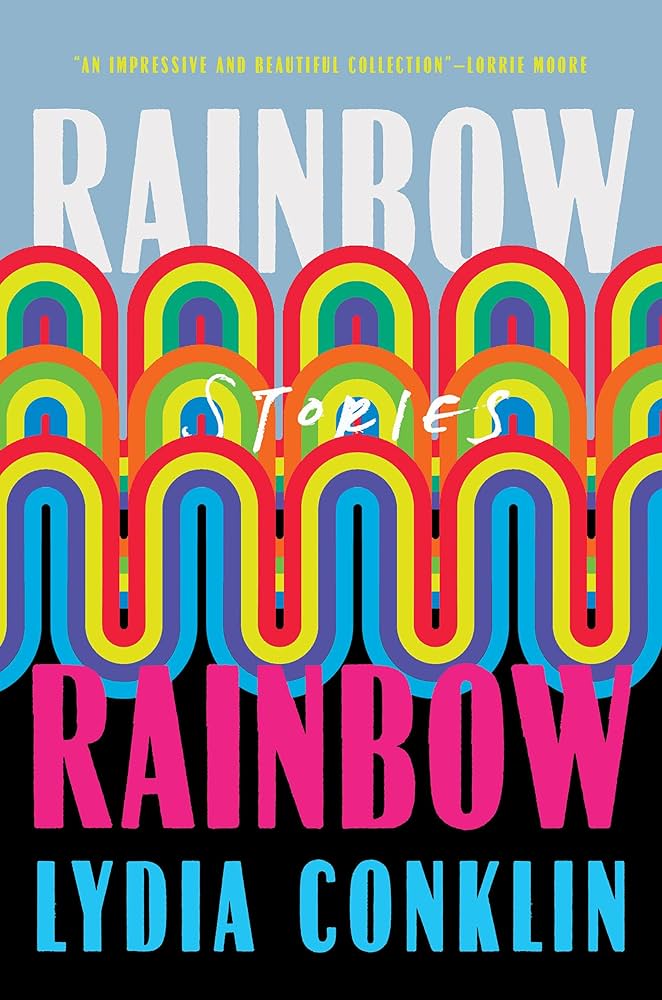
One devours Lydia Conklin’s short story collection about queer and trans life, Rainbow Rainbow, voraciously, but not without ambivalence. First, the voracious: Conklin writes realistic and grounded characters, in complicated and often messy relationships with each other as well as themselves. These characters feel like people you might know, people you meet on the dance floor at a Boystown club or a queer apartment party, people you’ve loved and lost. The stories range from tales of queer adolescence to those about finding recognition of or a name for the their feelings of identity later in life, as many queer and trans people do. Conklin explores hookups and breakups, dysphoria and euphoria, and the dark reality of sexual violence.
I read Rainbow Rainbow in two days, often unable to put it down. I would have finished it in one, because Conklin’s stories are so compellingly relatable. But the aforementioned darkness inflected my reading experience with unease, perhaps because it takes place in our world, with the same violences, and the same struggles to name it that we face. Conklin doesn’t shy away from writing about sexual violence, often with heartbreaking recognition. However, one story in particular, “The Black Winter of New England” takes a scene that reads like sexual assault but reflects it as a coming-of-age moment. As much as I love Rainbow Rainbow, especially how Conklin explores gender, as a survivor I found this moment very hard to get past.
✶
Conklin’s portrayals of trans experiences throughout the collection are powerful, especially “Sunny Talks.” This is the first piece of fiction I’ve read where two nonbinary people flirt. One is the protagonist, Lillia, in the process of coming out as nonbinary, and the other, Minsie, a speaker at a gender conference. Minsie asks Lillia to drinks.
Lillia says, “I can’t tonight.”
”Well.” Minsie’s cheeks brighten, like a candle lit up inside their head. “Tonight isn’t the last night on earth.”
“No,” I whisper.Are they hitting on me? Their breath burns my forehead. They step closer. Those handsome, slender eyes, vibrant slivers in skin that’s invitingly soft, mature. How lovely, a night full of Minsie’s attention.
This scene is a beautifully written quotidian moment, and so real that it brought me to tears. Most of the stories in this collection are similarly gorgeous bits of queer reality in all its lovely and moving complexity.
And Conklin’s prose is beautiful. Unconventional metaphors make for a sensuous read; when the protagonist of “Sunny Talks” is surrounded by other trans people for the first time, “blood shivers through my limbs…the freedom is itchy, bloating my chest, too airy to suffer,” and in “Counselor of My Heart” a burnt cake becomes “delicate fruity clouds This rich language fleshes out the world of Rainbow Rainbow, giving realistic depth to portrayals of gender dysphoria and euphoria. The best example comes from “Pink Knives,” when the nameless speaker decides to let a hookup touch their chest, a loaded act in the context of the Covid-19 pandemic and the speaker’s dysphoria in the lead up to top surgery that’s still months away: “Since you’ve used my right pronoun, which my girlfriend can’t always quite get, which I can’t always quite get, which confuses and upsets my friends…which my family won’t know about until they read this story…I assume what you are doing is right.” Ultimately, though, the pain of being touched pre-op is overpowering for the speaker, who continues: “I’m so skinless I could fall apart. This is the first time I hate myself in this whole experiment.” This is where the story ends, with a breathtaking exploration of the pain of feeling in the wrong body.
✶
Rainbow Rainbow‘s complex portrayals of transness are one of the collection’s biggest strengths. Conklin offers an antidote for the ways in which trans people are portrayed in the media, as either one-dimensional victims or scapegoats. In “Sunny Talks,” a young trans man cannot accept his nonbinary relative, saying “you’re lying, right…trying to fit in or something.” This moment shows how transphobia can be internalized, and how even fellow trans people can weaponize hate, fear, and the myth of transness as a kind of social contagion in ways that harm their loved ones, and how transphobia can drive a wedge between binary and nonbinary trans people.
Rainbow Rainbow is laced with these moments of discomfort that give the stories weight. For the most part, Conklin writes hauntingly about violence and abuse, such as pedophilia in “Ooh, The Suburbs,” a story about two girls visiting an older woman they meet online. Conklin navigates the tension between a naive protagonist and a reader who understands the violence of the scene. The disconnect between the main character’s desire, the older woman’s self-hatred, and the way Conklin narrates the scene’s bleakness makes the story feel true to the characters and, especially, the kids’ naivete, while still recognizing the scene as a violent one.
Unlike “Ooh, the Suburbs,” “The Black Winter of New England” presents a scene that at the very least resembles sexual assault–in terms that make it sound enjoyable for all parties, Kit, Melissa, and Hazel, the protagonist:
Chill out, everybody,” Kit says. “Let’s do a practice sex and then go home.”
Maybe Melissa will practice on Hazel. The notion jars her, but she wilts when, once again, Melissa takes Kit’s shoulder in that irresistible, tender way, the way she never touches anyone outside the practices. “Are you ready?” Melissa’s voice is hard and low.
Kit lies down on the slope, on her back like the corpses buried under her. Hazel wipes her hands off on her snow pants and pins Kit’s wrists into the icy grass, tight enough to cut the dirt. She must hold Kit in place while Melissa dips her fingers into Kit’s body. Not that Kit would try to escape.
It’s Kit’s idea, Melissa’s in control, and later on this scene is described as “Hazel’s favorite time.” But the violent imagery of being held down, under Melissa’s control, make this scene feel far more coercive than it appears on the surface. Nobody seems to be having a good time. This scene marks the first place where Conklin’s close third-person point of view and realistic characters start to work against the story, leaving the reader feeling as though there’s something missing, that these characters’ inner lives are more complicated, more ambivalent, than the narration lets on. When a friend did something similar to me, I buried it so deep that it was years before I even told my therapist. Consequently, I keep catching myself wondering what these characters are burying, if they’re like me. I find it concerning that the story doesn’t acknowledge this moment as a violent one. Because these events take place in the first five pages of a much longer story, they ultimately overshadow the rest, making it very hard to come away from “Black Winter” with anything other than the sense that you read something very different from what the characters and the narration actually acknowledge. Though this is one of several stories in the collection addressing sexual violence, because it doesn’t acknowledge that violence it is particularly disturbing. Where three-dimensional characters make for good queer storytelling, “Black Winter” only haunts—a storm cloud blotting out a double rainbow.
✶✶✶✶

Sasha Weiss is a poet who moved from LA to Chicago for the weather. He’s written a poetry chapbook, autumn is when the ghosts come out, and made a glitchy video game, Tissue Paper.
✶
Whenever possible, we link book titles to Bookshop, an independent bookselling site. As a Bookshop affiliate, Another Chicago Magazine earns a small percentage from qualifying purchases.
 Another Chicago Magazine