Bike riders get a chance to see the sites of the 1919 Chicago riots.
(The Loop)
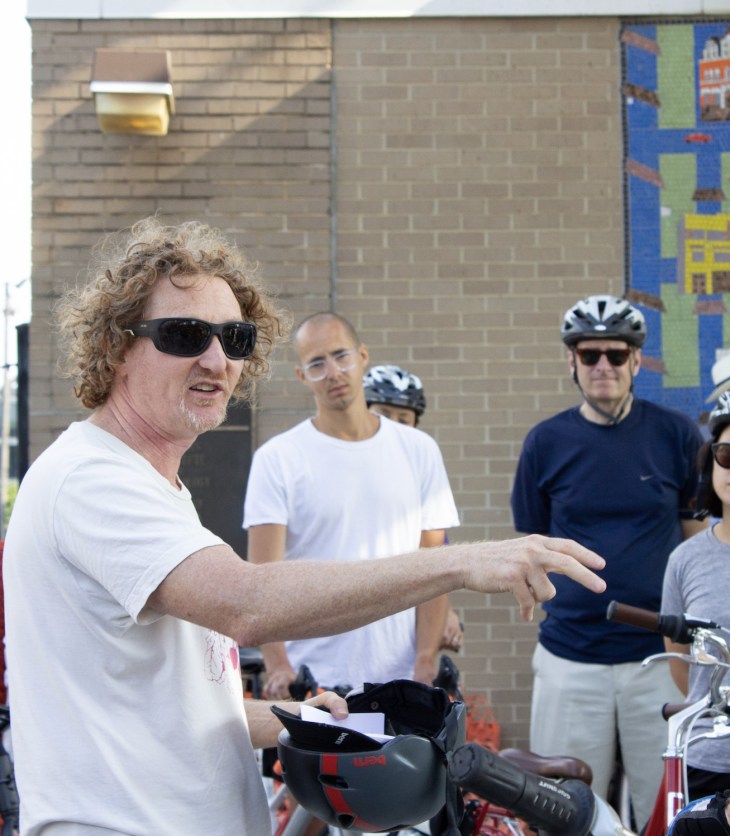

Bike riders get a chance to see the sites of the 1919 Chicago riots.
(The Loop)

I asked why I was being taken aside. A woman in uniform and gloves told me I had to be screened for bomb paraphernalia.
“Do you speak English?” she asked me. This was after I had asked her why I was being taken aside, in perfect English.
(nonfiction)

I can’t conceptualize the poverty. None of us can. How do you make something of yourself in a new country when you came here with nothing?? When you’ve been starving for years in your own country and come here to a land with so much food, so much sweet smelling, fattening, beautiful food . . . and you with no money to buy it.
(nonfiction)

In the book, a Dakota “spirit” reminds Mary Todd Lincoln that despite Abe’s mainstream legacy as the hero who ended slavery, “Lincoln’s actual record on racial equality is fraught with violence and oppression,” Sarah Sorensen writers.
(review)

After a while, I started to think she might fall for me. I thought she might leave her husband and come live with me in my small one-bedroom along the river. We’d find our own space eventually, maybe get a dog. It would be hard at first—I’d have to adjust to her working all the time, but we’d make it through.
(fiction)

Overlooked buildings on Chicago’s South Side, photographed by Lee Bey from his book “Southern Exposure”

“Bey’s examination points to the long history of racism, classism, and economics that have ingloriously combined to create the particular set of circumstances that give rise to contradictions,” reviewer Philip Berger notes.
(review)


Almost seventy years after the founding of the People’s Republic of China, and while the Hong Kong protests continue, Richard Wirick looks back at the 1989 Tiananmen Square protests and the violent government crackdown.
(nonfiction)

